
Why Is India Emerging as One of the World’s Most Dynamic Watch Markets?
How Rising Incomes, Smartwatch Adoption, Fashion Consciousness, and Digital Commerce Are Transforming the India Watch Market

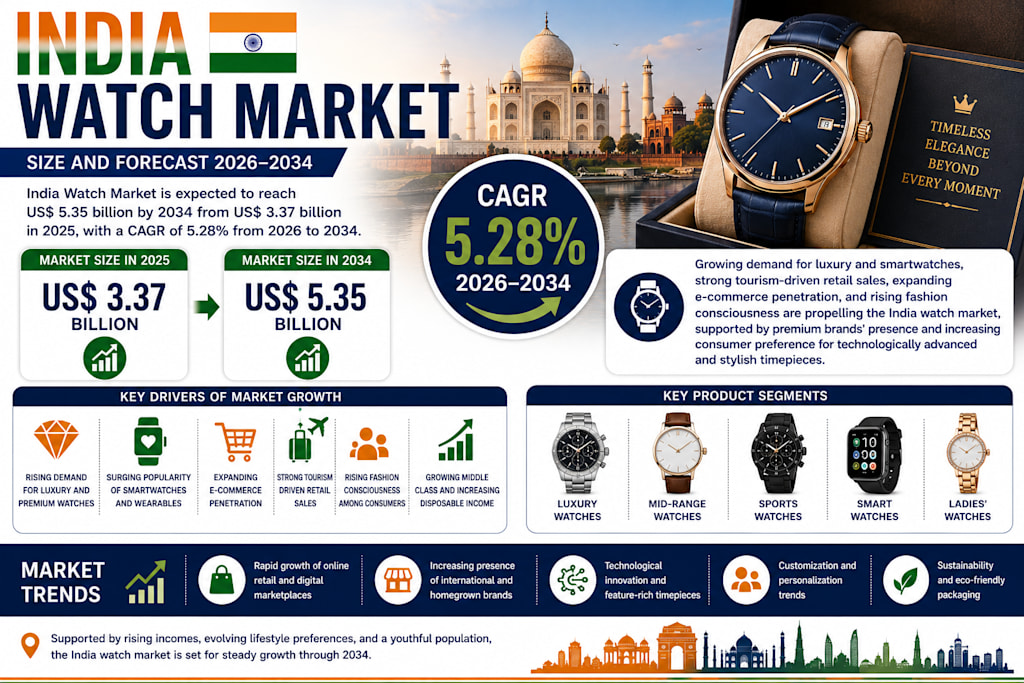
India's watch industry is undergoing a remarkable transformation. Once dominated by traditional analog timepieces used primarily for timekeeping, the market today reflects a dynamic blend of fashion, technology, luxury, and personal expression. Consumers are increasingly viewing watches not only as practical accessories but also as lifestyle statements that showcase individuality, status, and technological sophistication.
The growing popularity of premium analog watches, affordable smartwatches, and luxury timepieces is reshaping purchasing behavior across the country. Rising disposable incomes, expanding urban populations, increasing digital connectivity, and changing fashion preferences are creating favorable conditions for sustained market growth.
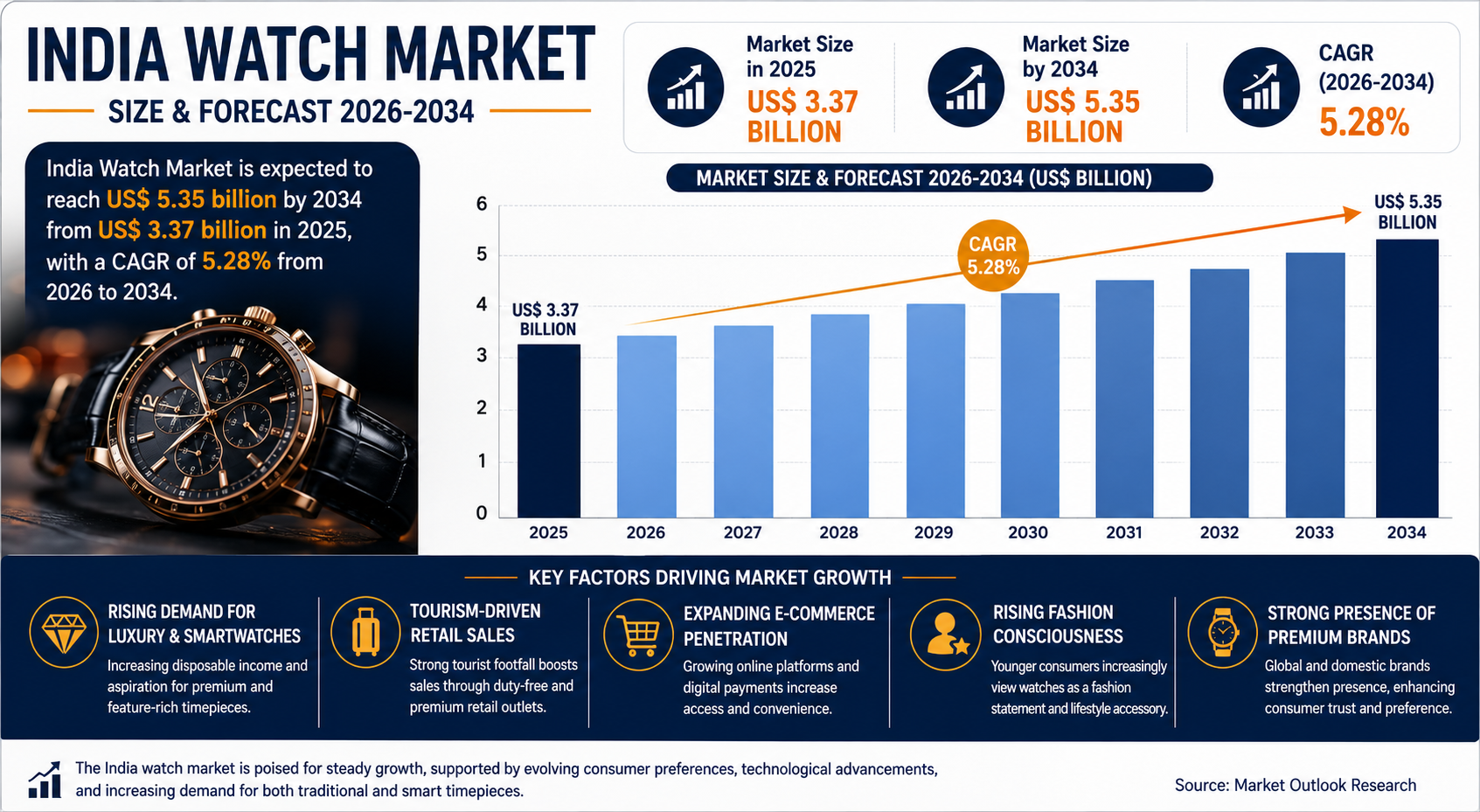
According to Renub Research, the India Watch Market is expected to grow from US$ 3.37 billion in 2025 to US$ 5.35 billion by 2034, registering a compound annual growth rate (CAGR) of 5.28% between 2026 and 2034. This growth is being supported by increasing consumer spending, rapid smartwatch adoption, premiumization trends, expanding e-commerce penetration, and growing interest in branded watches across multiple demographic groups.
As watches evolve from simple timekeeping devices into lifestyle products and wearable technologies, India's watch market is becoming one of the most exciting consumer sectors in the country.
Watches Have Become More Than Timekeeping Devices
The role of watches in India has changed dramatically over the past decade.
Modern consumers no longer purchase watches solely to check the time. Today, watches are widely viewed as fashion accessories, status symbols, fitness companions, and personal lifestyle statements. Whether it is a luxury Swiss watch, a stylish analog model, a rugged sports watch, or a feature-rich smartwatch, consumers are increasingly choosing products that reflect their identities and aspirations.
The market now encompasses a diverse range of categories including quartz watches, mechanical watches, electronic watches, luxury timepieces, and smartwatches. This variety enables brands to serve consumers across different age groups, income levels, and lifestyle preferences.
As consumer expectations continue evolving, watches are becoming increasingly integrated into both fashion and technology ecosystems.
Young Consumers Are Driving Market Growth
One of the strongest drivers of growth within India's watch industry is the influence of younger consumers.
India's large Gen Z and millennial populations are highly engaged with fashion, technology, and digital culture. These consumers actively seek products that reflect individuality, authenticity, and modern lifestyles.
Brands are increasingly leveraging social media campaigns, influencer collaborations, music festivals, and limited-edition product launches to connect with younger audiences. Experiential marketing initiatives often generate stronger engagement than traditional advertising methods, helping brands build emotional connections with consumers.
Limited-edition collections and exclusive launches frequently sell out rapidly due to strong demand driven by social media buzz and digital communities. Younger consumers value uniqueness and are often willing to experiment with emerging brands that align with their personal values and style preferences.
This generation's influence is expected to remain a major force shaping the future of India's watch market.
Rising Incomes Are Fueling Premiumization
Increasing disposable incomes across urban India are encouraging consumers to upgrade from basic watches to premium and luxury timepieces.
Affluent consumers in metropolitan and Tier-I cities are increasingly purchasing watches as symbols of success, sophistication, and personal achievement. Premium analog watches, hybrid models, and luxury brands are benefiting from this trend.
The growing accessibility of financing options, installment payment plans, and online retail platforms has further expanded the market for higher-priced products.
Consumers increasingly view luxury watches as long-term investments that combine craftsmanship, exclusivity, and prestige. This shift is creating significant opportunities for both international luxury brands and domestic premium manufacturers.
As India's middle and upper-income populations continue expanding, premiumization is expected to remain a key growth driver.
Smartwatches Are Revolutionizing Consumer Preferences
Perhaps the most significant trend transforming the Indian watch market is the rapid adoption of smartwatches.
Consumers increasingly seek multifunctional devices that offer fitness tracking, health monitoring, smartphone connectivity, notifications, GPS capabilities, and productivity features. Smartwatches have become particularly popular among younger consumers, fitness enthusiasts, and technology-focused professionals.
Advancements in local manufacturing have significantly increased affordability, allowing brands to introduce feature-rich devices at competitive prices. As a result, smartwatches have moved beyond premium segments and become accessible to a much broader audience.
Features such as heart-rate monitoring, sleep tracking, workout analytics, AI-powered insights, and integrated digital assistants continue attracting new users.
The growing focus on health and wellness further strengthens smartwatch demand, positioning the segment as one of the fastest-growing categories within the broader watch market.
Domestic Manufacturing Is Strengthening Industry Competitiveness
Government initiatives encouraging domestic manufacturing are helping reshape India's watch industry.
Production-linked incentive programs have encouraged companies to expand local assembly and manufacturing operations, particularly within the smartwatch segment. Investments in batteries, displays, electronic components, and related supply-chain infrastructure are creating a more robust domestic ecosystem.
Local production offers several advantages, including reduced costs, faster product launches, and improved supply-chain resilience. These benefits enable manufacturers to remain competitive while responding quickly to changing consumer preferences.
Indian brands are increasingly leveraging local manufacturing capabilities to introduce innovative products tailored specifically to domestic market needs.
As manufacturing capabilities continue improving, India is expected to play a larger role within the global watch and wearable technology industry.
E-Commerce Is Expanding Consumer Access
Digital commerce has become one of the most influential factors driving watch sales across India.
Online platforms provide consumers with access to a vast selection of domestic and international brands, allowing them to compare prices, evaluate features, read customer reviews, and make informed purchasing decisions.
The growth of smartphones, digital payments, and reliable delivery networks has significantly expanded e-commerce adoption, particularly in Tier-II and Tier-III cities.
Brands are increasingly adopting omnichannel strategies that combine online convenience with offline retail experiences. Personalized recommendations, digital marketing campaigns, influencer collaborations, and exclusive online launches continue driving consumer engagement.
The convenience and accessibility offered by e-commerce platforms are expected to remain major contributors to market growth throughout the forecast period.
Luxury Watches Continue to Attract Affluent Consumers
The luxury watch segment remains an important source of market value despite representing a smaller share of overall unit sales.
Affluent consumers increasingly seek luxury timepieces that reflect status, craftsmanship, and exclusivity. International brands continue benefiting from growing consumer appreciation for heritage, precision engineering, and premium materials.
Luxury watches are frequently purchased for special occasions, milestone celebrations, corporate gifting, and personal collections. Many consumers also view these products as investments capable of retaining long-term value.
The continued expansion of India's affluent population is creating favorable conditions for sustained growth within the luxury segment.
Quartz Watches Maintain Strong Demand
Despite the rapid rise of smartwatches, quartz watches continue to enjoy widespread popularity throughout India.
Consumers appreciate quartz watches for their affordability, accuracy, low maintenance requirements, and versatility. These products remain particularly attractive to students, working professionals, and consumers seeking dependable everyday accessories.
Manufacturers continue enhancing quartz watches with modern designs, lightweight materials, and contemporary aesthetics to appeal to evolving consumer preferences.
The segment's broad accessibility and practical value ensure that quartz watches remain a cornerstone of the Indian watch market.
Unisex Watches Reflect Changing Lifestyle Trends
Consumer preferences are increasingly shifting toward versatile products that transcend traditional gender distinctions.
Unisex watches have gained popularity due to their minimalist aesthetics, adaptability, and broad appeal. Many consumers prefer designs that can be worn across different settings, occasions, and fashion styles.
Brands are responding by introducing collections featuring neutral color palettes, streamlined designs, and adjustable sizing.
The growing emphasis on individuality and flexibility is expected to support continued growth within the unisex segment.
Challenges Facing the India Watch Market
Despite strong growth prospects, the market faces several important challenges.
One of the most significant challenges is intense competition. Domestic manufacturers, international luxury brands, fashion labels, and smartwatch companies all compete for consumer attention. This crowded landscape creates pricing pressures and makes differentiation increasingly difficult.
The rapid shift toward smart devices also presents challenges for traditional watch manufacturers. Many younger consumers prioritize multifunctionality over conventional timekeeping, reducing demand for basic analog and digital watches.
To remain competitive, brands must continually invest in innovation, design enhancements, technology integration, and marketing initiatives.
Successfully navigating these challenges will be critical for maintaining long-term growth and profitability.
Maharashtra Leads Market Demand
Maharashtra represents one of the largest watch markets in India.
Cities such as Mumbai and Pune benefit from high levels of urbanization, strong purchasing power, and growing consumer interest in premium lifestyle products. The state's large professional workforce supports demand for both formal watches and advanced smartwatches.
Well-developed retail infrastructure, including shopping malls, luxury boutiques, and brand-exclusive stores, further contributes to market growth.
Strong e-commerce adoption also ensures widespread access to a broad range of products across different price categories.
Karnataka Benefits from Technology-Driven Demand
Karnataka, particularly Bengaluru, has emerged as a key market for technologically advanced watches.
The city's large technology workforce, high disposable incomes, and strong interest in innovation contribute significantly to smartwatch adoption. Fitness tracking, health monitoring, and productivity features are especially popular among consumers in the region.
The growing startup ecosystem and digitally connected population continue supporting demand for advanced wearable devices.
Tamil Nadu and Gujarat Continue Supporting Growth
Tamil Nadu benefits from a combination of urban development, industrial growth, and increasing consumer spending. Cities such as Chennai generate strong demand for both traditional and smart watches, supported by a large working population and expanding retail infrastructure.
Meanwhile, Gujarat's business-oriented culture supports steady demand across mid-range and premium categories. Consumers often view watches as symbols of professional success and personal achievement, contributing to sustained market expansion throughout the state.
Recent Industry Developments Highlight Market Momentum
Several recent developments demonstrate the continued dynamism of India's watch market.
In August 2025, Casio India introduced a new range of locally manufactured watches, reinforcing its commitment to domestic production and market expansion.
In July 2025, CMF launched the Watch 3 Pro, featuring a 1.43-inch AMOLED display, dual-band GPS, AI-powered workout insights, and integrated ChatGPT support.
Samsung introduced the Galaxy Watch 8 in July 2025 with enhanced durability and Galaxy AI-powered features, while Apple expanded its portfolio with the Apple Watch Series 10 and Apple Watch SE, featuring advanced health-monitoring capabilities and improved performance.
These developments illustrate how innovation continues driving competition and consumer interest across the industry.
Leading Companies Competing in the Market
The India watch market includes a mix of globally recognized manufacturers and established industry leaders. Major companies operating within the market include Seiko Holdings Corporation, Casio Computer Co. Ltd, Timex Group, Rolex SA, Compagnie Financière Richemont S.A., The Swatch Group Ltd, Citizen Watch Co. Ltd., Fossil Group Inc., and Google LLC through Fitbit. These organizations continue investing in product innovation, retail expansion, technology integration, and brand development to strengthen their market positions.
Final Thoughts
The India Watch Market is evolving rapidly as consumers increasingly seek products that combine fashion, technology, functionality, and personal expression. Rising disposable incomes, expanding smartwatch adoption, premiumization trends, and growing digital commerce are creating strong momentum across the industry.
With the market expected to grow from US$ 3.37 billion in 2025 to US$ 5.35 billion by 2034, manufacturers have substantial opportunities to capitalize on changing consumer preferences and technological innovation.
As watches continue transitioning from simple accessories to multifunctional lifestyle products, India's watch industry is well-positioned for sustained growth and continued transformation in the years ahead.
About the Creator
Enjoyed the story? Support the Creator.
Subscribe for free to receive all their stories in your feed.
Comments
There are no comments for this story
Be the first to respond and start the conversation.