
Why Is Communication Equipment Becoming the Backbone of America’s Digital Future?
How 5G Expansion, Cloud Computing, Connected Devices, and Data Infrastructure Are Driving Growth in the United States Communication Equipment Market

The United States is experiencing an unprecedented wave of digital transformation, and communication equipment sits at the center of this evolution. From 5G networks and fiber-optic systems to cloud computing infrastructure and connected devices, communication technologies are enabling businesses, governments, and consumers to operate in an increasingly connected world.
As organizations continue investing in digital infrastructure and consumers rely more heavily on high-speed internet, video streaming, cloud services, remote work, and smart technologies, demand for advanced communication equipment continues to rise. Communication networks have become critical not only for telecommunications providers but also for industries including healthcare, education, defense, manufacturing, finance, and transportation.
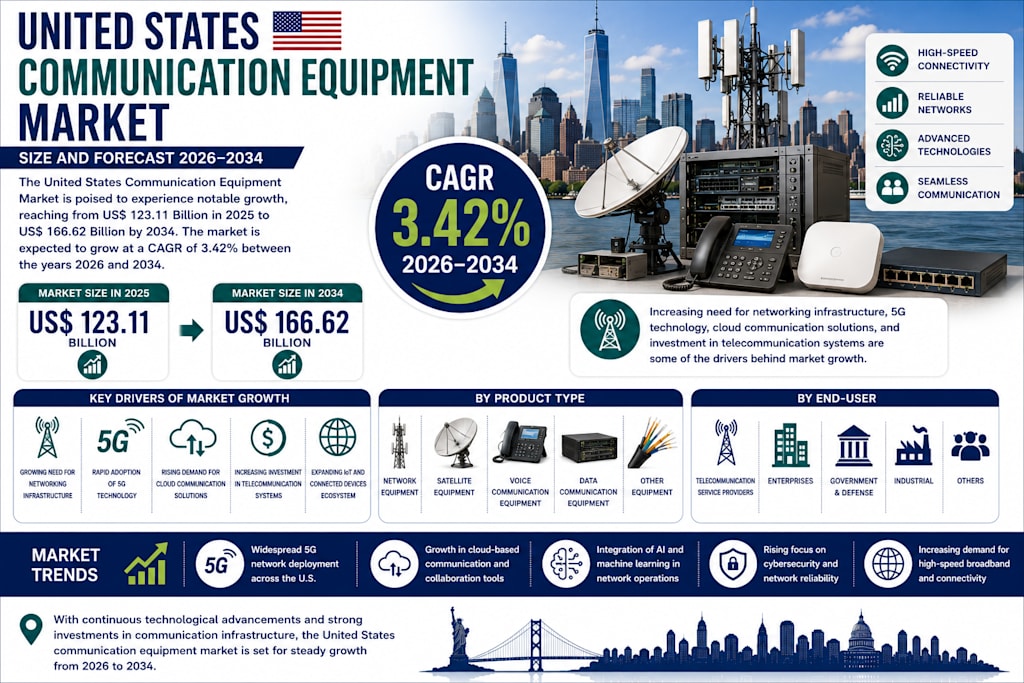
According to Renub Research, the United States Communication Equipment Market is projected to grow from US$ 123.11 billion in 2025 to US$ 166.62 billion by 2034, expanding at a compound annual growth rate (CAGR) of 3.42% from 2026 to 2034. Growing investments in 5G infrastructure, cloud communication solutions, broadband expansion, and advanced networking technologies are among the key factors driving market growth.
As digital connectivity becomes increasingly essential to economic growth and technological innovation, communication equipment is emerging as one of the most important pillars supporting America's digital future.
Communication Equipment Powers Modern Connectivity
Communication equipment encompasses the technologies responsible for transmitting, receiving, and processing voice, video, and data across networks.
This broad category includes routers, switches, antennas, modems, fiber-optic systems, wireless communication devices, satellite technologies, mobile network equipment, and cloud communication infrastructure. These systems enable internet access, telecommunications services, enterprise networking, broadcasting, and digital communications across countless applications.
Businesses increasingly depend on communication equipment for collaboration, file sharing, video conferencing, customer engagement, cloud computing, and cybersecurity operations. Likewise, consumers rely on communication infrastructure to access entertainment, education, healthcare services, and social platforms.
As society becomes increasingly digital, communication equipment continues to serve as the foundation supporting everyday connectivity.
Connected Devices Are Reshaping Communication Needs
The rapid growth of connected devices has significantly increased demand for communication equipment throughout the United States.
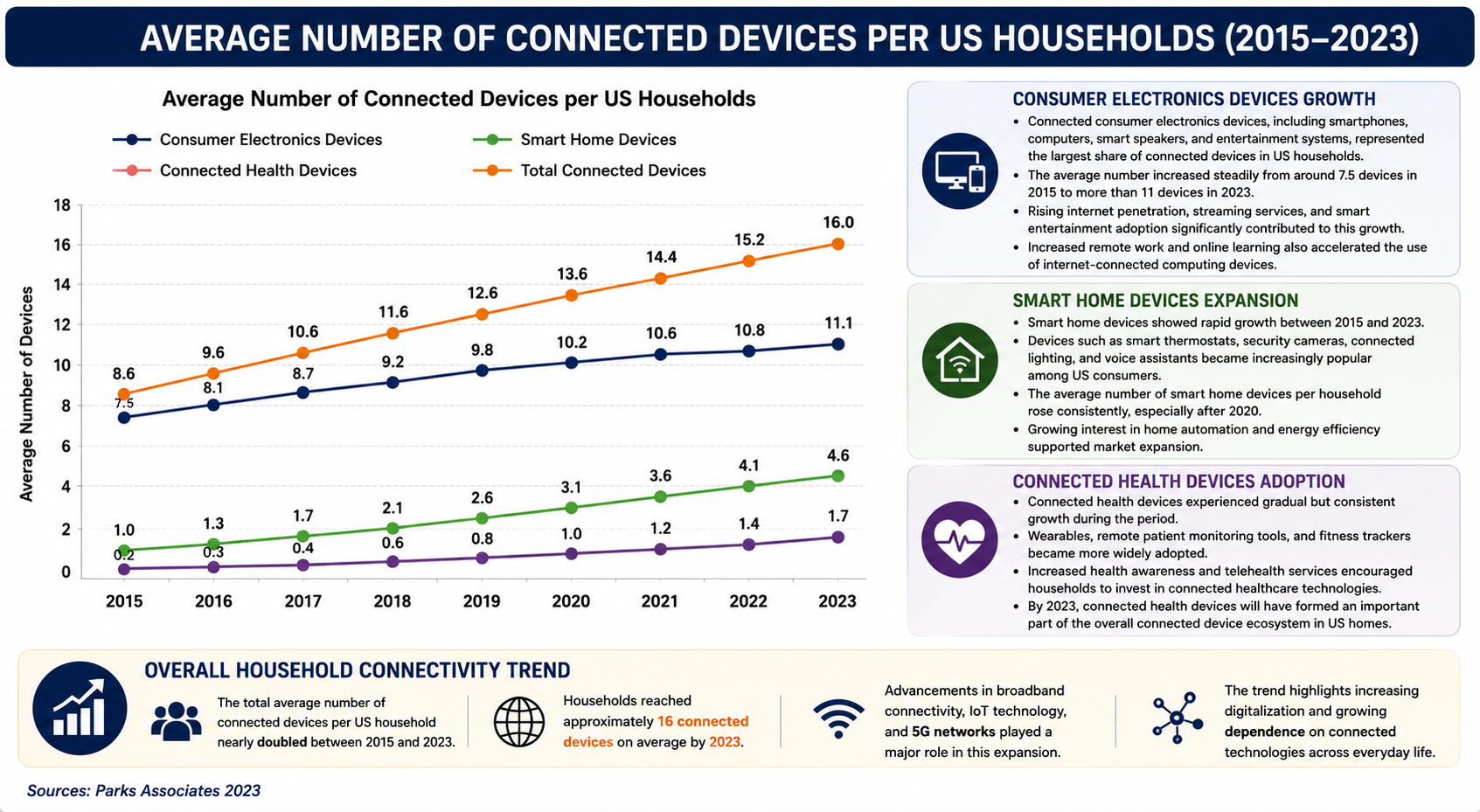
According to industry research, the average number of connected devices per U.S. household nearly doubled between 2015 and 2023, reaching approximately 16 connected devices per household by 2023. These devices include smartphones, computers, smart televisions, gaming systems, smart speakers, security cameras, connected appliances, wearable devices, and healthcare monitoring technologies.
Consumer electronics continue representing the largest segment of connected devices, while smart home technologies and connected healthcare products are experiencing particularly strong growth.
The increasing number of devices connected to household and business networks requires more robust communication infrastructure capable of supporting higher bandwidth demands and greater network reliability.
This trend continues creating substantial opportunities for communication equipment manufacturers and service providers.
Rapid 5G Deployment Is Driving Infrastructure Investment
One of the strongest growth drivers within the market is the nationwide deployment of 5G technology.
Telecommunications companies are investing heavily in next-generation communication infrastructure to deliver faster internet speeds, lower latency, improved network reliability, and expanded capacity. These investments require substantial deployment of antennas, base stations, fiber-optic systems, routers, and other networking equipment.
The benefits of 5G extend beyond consumer connectivity. Industries such as healthcare, manufacturing, transportation, logistics, entertainment, and smart city development increasingly rely on advanced communication systems enabled by 5G networks.
According to industry data, the United States recorded approximately 341 million 5G connections by late 2025, making it one of the world's leading markets for 5G adoption. North America achieved a regional 5G penetration rate approaching 95% of the population.
As demand for bandwidth-intensive applications continues increasing, investments in communication equipment supporting 5G infrastructure are expected to remain strong.
Cloud Computing Is Expanding Demand for Advanced Networking
Cloud computing has become another major catalyst for communication equipment growth.
Organizations across virtually every industry are migrating workloads, applications, and data storage systems to cloud-based environments. This transition requires sophisticated networking infrastructure capable of supporting secure, high-speed, and reliable data transmission.
Cloud adoption is fueling demand for servers, switches, optical communication equipment, wireless networking technologies, and data center infrastructure. The rapid growth of artificial intelligence, machine learning, big data analytics, and Internet of Things (IoT) applications further increases networking requirements.
Technology companies continue investing in hyperscale data centers to support expanding digital ecosystems.
In May 2026, Blackstone announced a partnership involving Google Cloud technologies aimed at supporting advanced data center and networking services.
As cloud computing becomes increasingly central to enterprise operations, communication equipment demand is expected to grow accordingly.
Smart Technologies Are Accelerating Market Expansion
The growing adoption of smart technologies is creating additional opportunities throughout the communication equipment market.
Smart homes, connected vehicles, wearable devices, industrial automation systems, and IoT-enabled applications all depend on reliable communication infrastructure. These technologies require seamless connectivity and efficient data transmission to operate effectively.
Consumers increasingly embrace home automation solutions such as smart thermostats, connected lighting systems, security cameras, and voice assistants. Businesses are implementing IoT solutions to improve operational efficiency, predictive maintenance, and real-time decision-making.
Educational institutions, healthcare providers, and government agencies are also investing in digital communication technologies to enhance service delivery.
As connected technologies continue expanding across society, communication equipment providers are benefiting from growing demand for advanced networking solutions.
Mobile Communication Equipment Remains a Core Segment
Mobile communication equipment represents one of the most important segments within the market.
This category includes smartphones, wireless routers, antennas, mobile base stations, radio access equipment, and signal transmission technologies essential for mobile network operations.
The widespread adoption of smartphones, mobile applications, streaming services, online gaming, and social media platforms continues driving demand for mobile communication infrastructure.
Telecommunications providers are actively upgrading networks to accommodate increasing mobile data consumption while improving coverage and performance.
Additionally, industries such as healthcare, transportation, and manufacturing increasingly utilize mobile communication systems to support digital transformation initiatives.
As mobile connectivity becomes even more central to daily life, this segment is expected to maintain strong growth momentum.
Fixed-Line Communication Equipment Continues Supporting Critical Infrastructure
Despite the rapid expansion of wireless technologies, fixed-line communication equipment remains an essential component of the communication ecosystem.
Fiber-optic cables, Ethernet switches, broadband modems, wired networking devices, and telephone systems continue supporting reliable and secure communication services for businesses, institutions, and residential users.
Fixed-line networks often provide superior stability, reliability, and security compared with some wireless alternatives, making them critical for enterprise operations, government communications, and data-intensive applications.
Broadband expansion initiatives are encouraging telecommunications providers to invest heavily in fiber-optic infrastructure, particularly in underserved communities.
As demand for high-speed internet continues growing, fixed-line communication equipment remains highly relevant within the broader market.
Optical Communication Equipment Is Experiencing Strong Growth
Optical communication technologies are becoming increasingly important as data traffic continues expanding.
Optical communication equipment includes optical fibers, transmitters, receivers, amplifiers, switches, and wavelength division multiplexing systems that enable high-speed data transmission using light signals.
The rapid growth of cloud computing, artificial intelligence, streaming media, and hyperscale data centers is generating significant demand for optical networking solutions.
Fiber-optic infrastructure also plays a crucial role in supporting 5G deployments by providing reliable backhaul connectivity between network components.
As data consumption continues accelerating, optical communication equipment is expected to remain one of the market's fastest-growing segments.
Cybersecurity Concerns Are Influencing Market Development
While market prospects remain positive, cybersecurity challenges continue creating significant concerns.
Modern communication networks handle vast amounts of sensitive personal, financial, corporate, and government data. As connectivity increases, so does the potential risk of cyberattacks, data breaches, ransomware incidents, and network disruptions.
Organizations are investing heavily in cybersecurity technologies, encryption systems, network monitoring solutions, and threat detection capabilities to protect communication infrastructure.
In May 2026, eight major U.S. communications companies collaborated to establish the Communications Cybersecurity Information Sharing and Analysis Center (C2 ISAC) to strengthen cybersecurity cooperation within the telecommunications industry.
Maintaining secure communication systems will remain a critical priority across the industry.
Infrastructure Costs Remain a Significant Challenge
High deployment and infrastructure costs represent another major challenge facing the communication equipment market.
Building 5G networks, expanding fiber-optic infrastructure, constructing data centers, and upgrading communication systems require substantial financial investments. Telecommunications providers must allocate significant resources toward equipment procurement, installation, maintenance, and modernization.
Rural and remote areas often present additional deployment challenges due to geographic barriers and lower population density.
Rising labor costs, regulatory compliance requirements, and energy expenses further increase operational complexity.
Manufacturers and service providers must balance innovation with affordability while maintaining profitability and network reliability.
California Leads Technological Innovation
California remains one of the most influential communication equipment markets in the United States.
The state's concentration of technology companies, telecommunications providers, semiconductor manufacturers, and innovation centers creates strong demand for advanced communication solutions.
Silicon Valley continues driving development of cloud computing, artificial intelligence, IoT technologies, and next-generation networking infrastructure.
Major urban centers such as Los Angeles and San Francisco are also investing heavily in smart city initiatives and high-speed communication networks.
California's leadership in digital innovation ensures continued demand for communication equipment across multiple sectors.
Texas, New York, and Florida Continue Supporting Growth
Texas benefits from rapid industrial expansion, population growth, and increasing investments in 5G infrastructure, fiber-optic networks, and data centers. Major cities such as Dallas, Houston, and Austin are becoming increasingly important communication technology hubs.
New York's financial services sector, media industry, and dense urban population create strong demand for advanced networking equipment and low-latency communication solutions.
Florida continues expanding communication infrastructure to support tourism, population growth, healthcare services, and smart city development initiatives throughout major metropolitan regions.
Together, these states represent some of the most significant regional markets driving national industry growth.
Leading Companies Competing in the Market
Major participants in the United States communication equipment market include Apple Inc., LG Electronics, Lenovo, Xiaomi, AT&T, Google, Panasonic Corporation, Sony Corporation, and OnePlus. These companies continue investing in innovation, network infrastructure, connected technologies, and advanced communication solutions to strengthen their market positions.
Final Thoughts
The United States Communication Equipment Market is playing a critical role in supporting the country's digital transformation journey.
With the market expected to grow from US$ 123.11 billion in 2025 to US$ 166.62 billion by 2034, communication equipment providers have significant opportunities to benefit from expanding 5G deployments, cloud computing adoption, connected device growth, and infrastructure modernization initiatives.
As consumers, businesses, and governments become increasingly dependent on reliable digital connectivity, communication equipment will remain a foundational component of America's technological and economic future.
About the Creator
Enjoyed the story? Support the Creator.
Subscribe for free to receive all their stories in your feed.
Comments
There are no comments for this story
Be the first to respond and start the conversation.