
Why Electric Vehicles Are Driving the Future of Global Transportation
Rising Environmental Awareness, Government Support, and Battery Innovation Are Accelerating the Worldwide Shift Toward Electric Mobility

Electric Vehicles, EV Market, Sustainable Transportation, Green Mobility, Battery Technology, Automotive Industry, Clean Energy, Electric Cars, Future Transportation, Global Market Trends
The automotive industry is experiencing one of the most significant transformations in its history. For more than a century, gasoline and diesel-powered vehicles dominated roads around the world. Today, however, a new era of transportation is rapidly emerging as electric vehicles gain popularity among consumers, businesses, and governments alike.
What was once considered a niche technology has evolved into a global movement that is reshaping how people think about mobility. Improvements in battery technology, growing environmental concerns, government incentives, and rising fuel costs are encouraging millions of consumers to consider electric vehicles as a practical and sustainable alternative to traditional automobiles.
The transition is happening across multiple vehicle categories, from compact passenger cars and luxury SUVs to buses, commercial trucks, and electric two-wheelers. As charging infrastructure expands and vehicle performance continues to improve, electric mobility is becoming increasingly accessible to consumers worldwide.
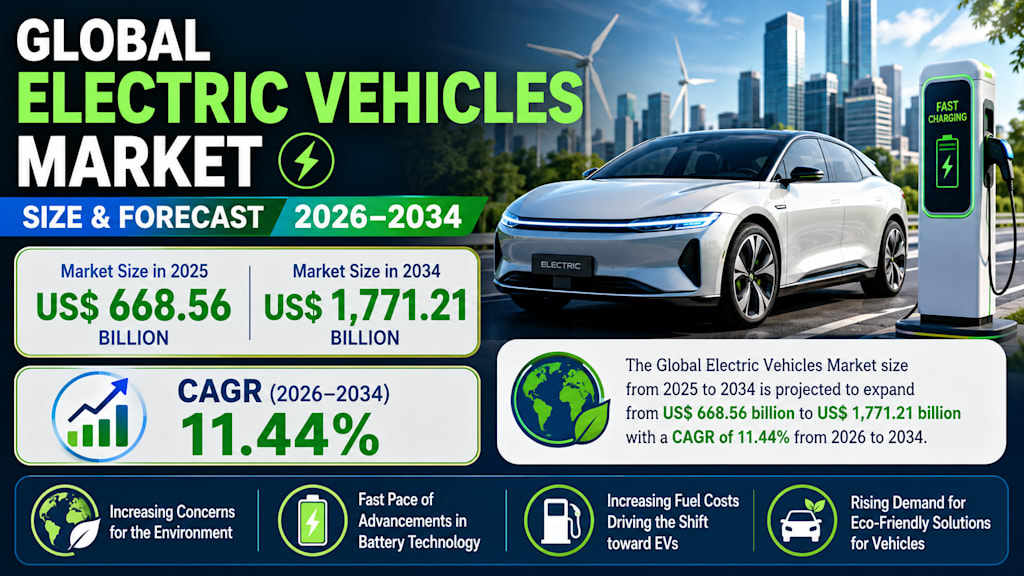
According to Renub Research, the Global Electric Vehicles Market is projected to grow from US$ 668.56 billion in 2025 to US$ 1,771.21 billion by 2034, expanding at a compound annual growth rate (CAGR) of 11.44% between 2026 and 2034. This remarkable growth reflects the accelerating shift toward cleaner transportation solutions and highlights the growing importance of electric vehicles within the global automotive landscape.
Understanding the Electric Vehicle Revolution
Electric vehicles, commonly known as EVs, are automobiles powered partially or entirely by electricity instead of traditional internal combustion engines. Rather than relying on gasoline or diesel fuel, EVs use electric motors that draw energy from rechargeable battery systems, most commonly lithium-ion batteries.
The two primary categories of electric vehicles include Battery Electric Vehicles (BEVs), which operate entirely on electricity, and Plug-in Hybrid Electric Vehicles (PHEVs), which combine electric propulsion with a conventional engine. Hybrid Electric Vehicles (HEVs) also play an important role by integrating electric motors with fuel-powered engines to improve efficiency and reduce emissions.
One of the biggest advantages of electric vehicles is their ability to produce little or no tailpipe emissions. This characteristic makes them a cleaner alternative to traditional vehicles and positions them as a key solution in global efforts to reduce greenhouse gas emissions and combat climate change.
Environmental Concerns Are Fueling Demand
Environmental sustainability has become one of the strongest drivers behind the rapid adoption of electric vehicles.
Governments, corporations, and consumers are increasingly focused on reducing carbon emissions and limiting the environmental impact of transportation. Since the transportation sector contributes significantly to global greenhouse gas emissions, electric vehicles are viewed as a critical component of long-term climate strategies.
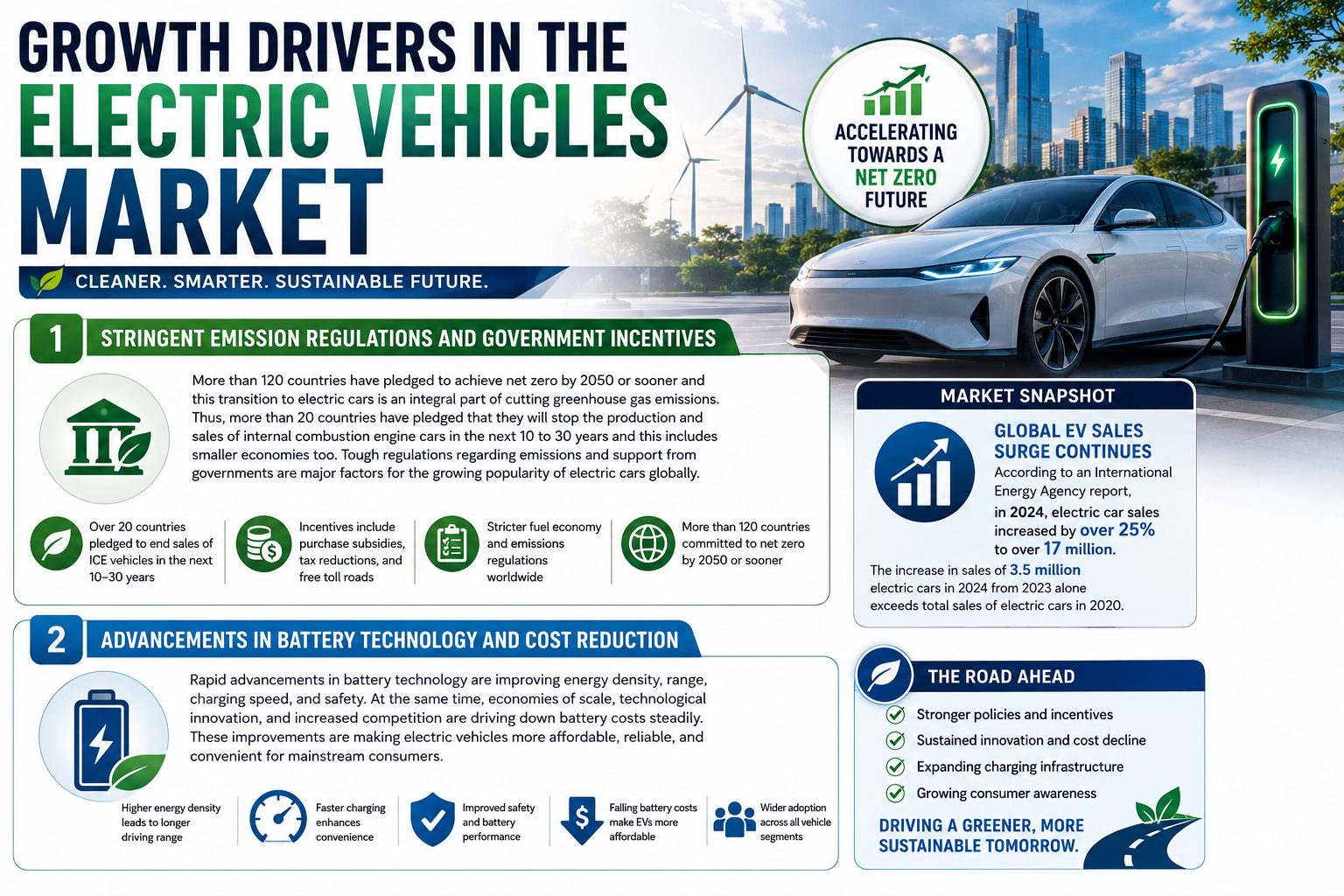
Many countries have committed to achieving net-zero emissions targets by 2050 or earlier. As part of these commitments, governments are introducing policies that encourage the transition away from traditional combustion-engine vehicles.
Several nations have already announced plans to phase out the production and sale of internal combustion engine vehicles over the coming decades. These initiatives are accelerating investments in electric mobility and encouraging consumers to explore cleaner transportation alternatives.
The growing awareness of environmental issues has also influenced consumer behavior. More individuals are actively seeking products and services that align with sustainable lifestyles, and electric vehicles fit naturally into this trend.
Government Incentives Continue to Drive Adoption
Public policy has played a critical role in supporting the growth of the electric vehicle industry.
Governments around the world have introduced financial incentives designed to make EV ownership more attractive and affordable. These measures include tax credits, purchase subsidies, registration fee reductions, toll exemptions, and preferential parking privileges.
Such incentives help offset the higher initial purchase prices that electric vehicles often carry compared to conventional vehicles. By reducing financial barriers, governments are encouraging wider adoption among consumers and businesses.
The impact of these policies is becoming increasingly visible. According to the International Energy Agency, global electric car sales surpassed 17 million units in 2024, representing an increase of more than 25% compared to the previous year. Remarkably, the increase in EV sales during 2024 alone exceeded total global electric vehicle sales recorded in 2020.
This momentum demonstrates how government support can accelerate market growth while helping countries achieve broader environmental objectives.
Battery Technology Is Transforming the Industry
Advancements in battery technology are among the most important factors driving the success of electric vehicles.
Early electric vehicles faced significant limitations related to driving range, charging speed, and battery costs. Over the past decade, however, technological innovation has dramatically improved battery performance.
Modern lithium-ion batteries offer greater energy density, enabling vehicles to travel longer distances on a single charge. Charging times have also decreased substantially, making EV ownership more convenient for everyday use.
At the same time, large-scale manufacturing and technological improvements have contributed to declining battery costs. As batteries become more affordable, electric vehicles are becoming increasingly competitive with traditional automobiles in terms of overall pricing.
Researchers are already exploring next-generation technologies such as solid-state batteries and alternative battery chemistries that promise even greater efficiency, safety, and performance.
In December 2025, Graphene Manufacturing Group announced progress in developing Graphene Aluminium-Ion Battery technology through partnerships involving the University of Queensland and Rio Tinto. Innovations such as these highlight the ongoing efforts to enhance battery capabilities and accelerate the evolution of electric transportation.
Rising Fuel Prices Are Influencing Consumer Decisions
Economic considerations are also contributing to the growth of the electric vehicle market.
As fuel prices fluctuate and often trend upward, consumers are increasingly evaluating alternatives that offer lower operating costs. Electric vehicles typically cost less to operate and maintain than conventional vehicles because electricity is generally cheaper than gasoline and EVs contain fewer moving mechanical components.
Reduced maintenance requirements can generate significant savings over the lifetime of a vehicle. There are no oil changes, fewer engine-related repairs, and simplified drivetrain systems compared to traditional automobiles.
These financial advantages are attracting not only individual consumers but also commercial fleet operators and logistics companies seeking to reduce transportation expenses while meeting sustainability objectives.
As consumers become more aware of the long-term economic benefits associated with EV ownership, adoption rates are expected to continue increasing worldwide.
Battery Electric Vehicles Lead Market Growth
Among the various segments within the electric vehicle industry, Battery Electric Vehicles are currently experiencing the fastest growth.
BEVs rely entirely on electricity and produce zero tailpipe emissions. Their environmental benefits, combined with lower operating costs and improving performance, have made them increasingly attractive to consumers.
Although battery electric vehicles have existed for decades, limitations related to charging infrastructure and battery performance initially restricted their popularity. Today's advancements in charging technology and battery capacity have transformed BEVs into practical options for a growing number of drivers.
Automakers are rapidly expanding their BEV portfolios, introducing vehicles across multiple price points and categories to meet diverse consumer preferences.
Hybrid Vehicles Continue to Play an Important Role
Hybrid electric vehicles remain an important part of the broader electrification movement.
By combining traditional combustion engines with electric motors, hybrid vehicles provide improved fuel efficiency and lower emissions without relying entirely on charging infrastructure.
This makes hybrids particularly appealing in regions where charging networks are still developing. Consumers often view hybrid vehicles as a practical transitional solution that offers many of the benefits of electrification while maintaining the familiarity and convenience of conventional fueling.
As charging infrastructure continues expanding globally, hybrids are expected to remain a valuable bridge technology within the automotive market.
Commercial Vehicles and Two-Wheelers Are Expanding Opportunities
The electric vehicle revolution extends far beyond passenger cars.
Electric buses, delivery vans, trucks, and logistics vehicles are becoming increasingly common as businesses seek cleaner and more cost-effective transportation solutions. Corporate sustainability commitments and regulatory requirements are encouraging fleet operators to invest in electric commercial vehicles.
Urban delivery services, public transportation systems, and logistics companies are among the leading adopters of commercial EV technologies. Advances in battery capacity and charging infrastructure are enabling these vehicles to handle longer routes and heavier workloads.
At the same time, electric scooters and motorcycles are experiencing rapid growth, particularly in densely populated urban areas and emerging economies. Affordable pricing, lower energy consumption, and practical commuting capabilities make electric two-wheelers attractive transportation options for millions of consumers worldwide.
Challenges Remain on the Road Ahead
Despite impressive progress, the electric vehicle industry still faces several challenges.
One of the most significant barriers is the availability of charging infrastructure. While charging networks continue expanding, many regions, particularly in developing countries, still lack sufficient charging facilities to support widespread adoption.
Charging times also remain longer than conventional refueling processes, which can contribute to consumer concerns regarding convenience and travel flexibility. These issues often contribute to what is commonly known as "range anxiety," where drivers worry about running out of battery power before reaching a charging station.
Another challenge involves vehicle affordability. Although battery costs have declined substantially, electric vehicles often remain more expensive upfront than conventional alternatives. This price difference can discourage budget-conscious consumers despite long-term savings potential.
Supply chain constraints also present ongoing risks. The production of batteries relies heavily on materials such as lithium, cobalt, and nickel, which are subject to geopolitical factors, mining limitations, and price fluctuations. Ensuring reliable access to these resources will be essential for sustaining industry growth.
Regional Markets Are Accelerating Adoption
The United States remains one of the world's largest electric vehicle markets, supported by government incentives, growing environmental awareness, and investments in charging infrastructure. Major automakers continue expanding their electric offerings, providing consumers with a broader range of options than ever before.
Germany continues to lead the European market through strong environmental policies, generous incentives, and the active participation of globally recognized automotive manufacturers. Investments in renewable energy integration and charging infrastructure further strengthen market growth.
India's electric vehicle market is expanding rapidly as the government seeks to reduce pollution and fuel imports. Two-wheelers, three-wheelers, buses, and passenger vehicles are all contributing to the country's electrification efforts. Government subsidies and supportive policies continue to encourage adoption despite infrastructure challenges.
Saudi Arabia is also investing heavily in electric mobility as part of broader economic diversification initiatives. Charging infrastructure development, renewable energy investments, and smart city projects are expected to support long-term market growth throughout the region.
Looking Toward the Future
The future of electric vehicles appears exceptionally bright. Continuous advancements in battery technology, expanding charging infrastructure, stronger government support, and growing environmental awareness are creating favorable conditions for long-term growth.
Leading companies such as Tesla, BMW Group, BYD, Mercedes-Benz, Ford, General Motors, Nissan, and Toyota continue investing billions of dollars in electric vehicle development, demonstrating confidence in the industry's future potential.
As technology improves and production scales increase, electric vehicles are expected to become more affordable, accessible, and practical for consumers around the world.
Final Thoughts
Electric vehicles are no longer simply an emerging trend—they are becoming a defining feature of the future transportation landscape. Driven by environmental concerns, technological innovation, supportive government policies, and evolving consumer preferences, the global shift toward electric mobility continues to gain momentum.
With the market projected to exceed US$ 1.77 trillion by 2034, electric vehicles are positioned to transform how people travel, how businesses operate, and how societies address environmental challenges.
The journey toward a cleaner and more sustainable transportation future is already underway, and electric vehicles are leading the way.
About the Creator
Enjoyed the story? Support the Creator.
Subscribe for free to receive all their stories in your feed.
Comments
There are no comments for this story
Be the first to respond and start the conversation.