
Why All-Terrain Vehicles Are Becoming More Important Beyond Recreation
From adventure tourism and outdoor sports to agriculture, defense, and industrial operations, all-terrain vehicles are finding new opportunities across the global economy.

The global fascination with outdoor adventure, off-road exploration, and utility vehicles has transformed the all-terrain vehicle market into one of the most dynamic segments of the automotive and recreational industries. Once viewed primarily as recreational machines used for trail riding and off-road racing, all-terrain vehicles, commonly known as ATVs, have evolved into versatile tools serving industries ranging from agriculture and forestry to military operations and disaster response.
Their ability to operate efficiently in rugged environments where conventional vehicles struggle has made them indispensable in both recreational and professional settings. Whether navigating deserts, forests, snow-covered landscapes, rocky terrain, or agricultural fields, ATVs offer a unique combination of mobility, durability, and cost-effectiveness that continues to attract new users around the world.
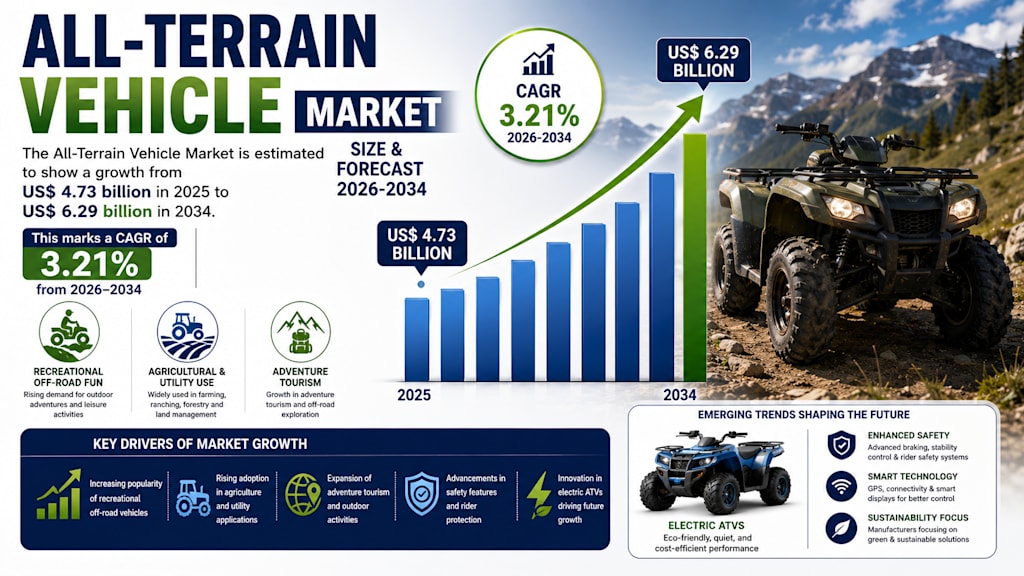
According to Renub Research, the global All-Terrain Vehicle Market is expected to grow from US$ 4.73 billion in 2025 to US$ 6.29 billion by 2034, registering a compound annual growth rate (CAGR) of 3.21% between 2026 and 2034. Growing demand for adventure tourism, increasing agricultural applications, expanding utility use, technological innovations, and the emergence of electric ATV models are among the major factors supporting market growth.
Understanding the Modern ATV Market
All-terrain vehicles are specialized off-road vehicles designed to operate across a wide variety of landscapes and environmental conditions. Unlike conventional passenger vehicles, ATVs feature low-pressure tires, compact dimensions, handlebar steering, and enhanced suspension systems that allow them to navigate difficult terrain with ease.
Their versatility is one of their greatest strengths.
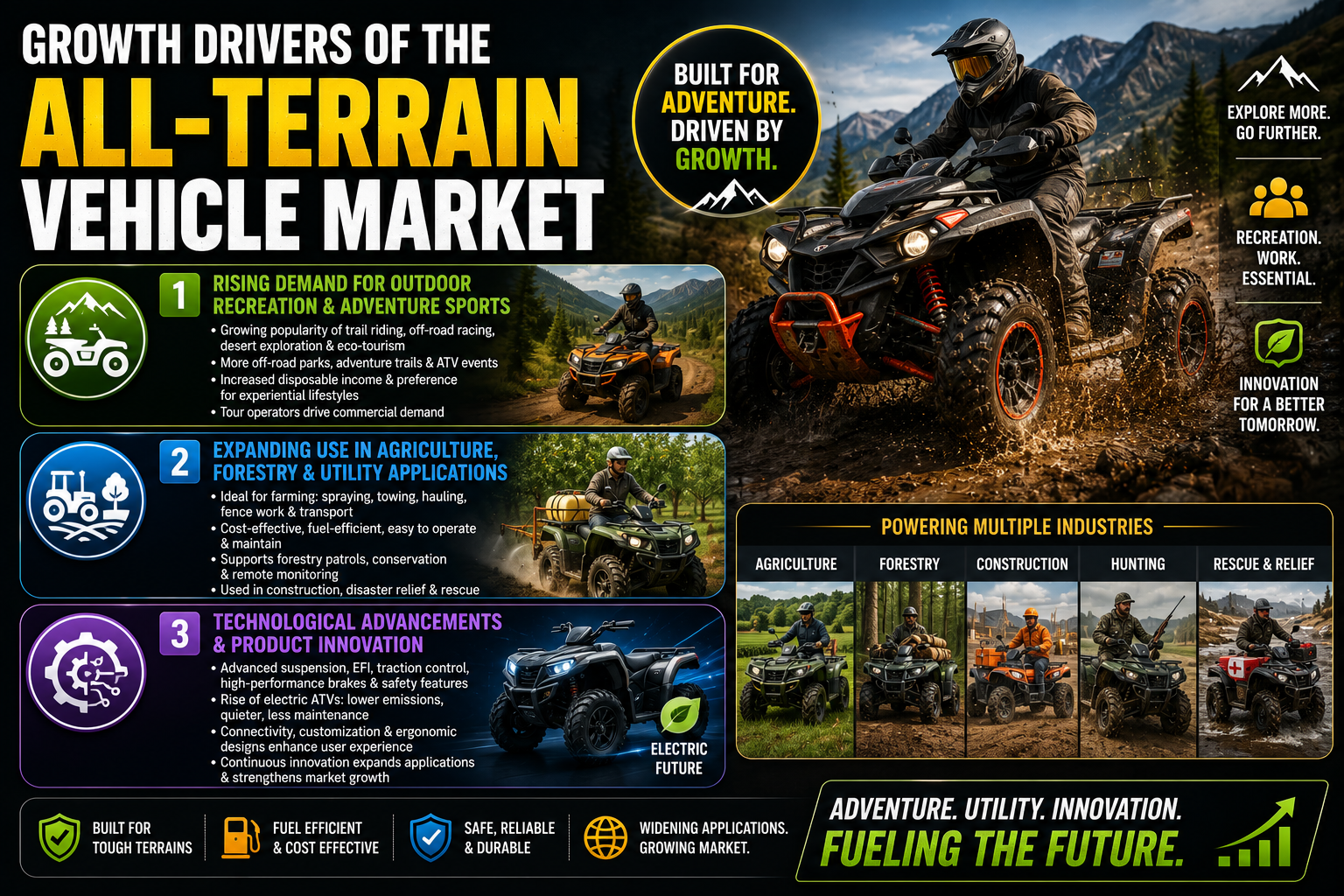
Modern ATVs are used for recreational trail riding, competitive racing, hunting, agricultural operations, forestry management, military patrols, industrial inspections, rescue missions, and tourism activities. Manufacturers have expanded product offerings to address the needs of diverse user groups, introducing models ranging from lightweight recreational machines to heavy-duty utility vehicles capable of towing equipment and carrying substantial loads.
As technological advancements continue to improve performance and safety, the appeal of ATVs continues to expand globally.
The Growing Popularity of Outdoor Recreation
One of the strongest drivers behind ATV market growth is the increasing popularity of outdoor recreation.
Across the world, consumers are placing greater emphasis on experiences rather than material possessions. Activities such as off-road exploration, trail riding, desert adventures, eco-tourism, and motorsports have gained significant popularity among individuals seeking excitement and unique travel experiences.
ATVs are ideally suited for these activities because they provide access to locations that are often inaccessible by traditional vehicles.
Adventure tourism operators increasingly incorporate ATV experiences into their offerings, allowing travelers to explore forests, mountains, deserts, beaches, and remote natural environments. Social media has further amplified interest in outdoor recreation by showcasing off-road adventures to global audiences.
As experiential travel continues to grow, demand for recreational ATVs is expected to remain strong.
Adventure Tourism Is Creating New Opportunities
The global tourism industry has experienced a shift toward adventure-based experiences.
Travelers increasingly seek activities that combine excitement, exploration, and personal engagement with natural environments. ATV tours have emerged as one of the most popular offerings within this category.
Tourism companies use ATVs to provide guided excursions through challenging terrains that would otherwise be difficult to access. These experiences appeal to a broad range of customers, including families, thrill-seekers, and international tourists.
Countries with extensive desert landscapes, forests, mountain trails, and coastal environments have particularly benefited from this trend.
As governments and private investors continue developing tourism infrastructure, the role of ATVs in supporting adventure tourism is likely to expand significantly.
Agriculture Has Become a Major Growth Segment
Although recreational use often receives the most attention, agriculture represents one of the most important applications for ATVs.
Farmers around the world increasingly rely on all-terrain vehicles to perform a wide range of daily tasks. ATVs provide an efficient and affordable means of transporting equipment, inspecting crops, monitoring livestock, spraying fields, repairing fences, and navigating large agricultural properties.
Compared with larger utility vehicles, ATVs offer several advantages.
They consume less fuel, require lower maintenance costs, and can access areas that may be difficult for tractors or trucks to reach. Their maneuverability makes them especially useful in rugged or uneven terrain.
As agricultural operations seek ways to improve productivity and reduce costs, demand for utility-oriented ATV models continues to grow.
Forestry and Conservation Applications Continue to Expand
The forestry sector has also embraced ATV technology.
Forestry professionals frequently operate in remote environments where mobility is critical. ATVs provide an effective solution for monitoring forests, inspecting infrastructure, conducting conservation activities, and responding to emergencies.
Environmental agencies and conservation organizations use ATVs to patrol protected areas, monitor wildlife habitats, and support field research activities.
Because these vehicles can travel efficiently through dense forests and challenging terrain, they have become valuable tools for land management and environmental protection.
The continued expansion of forestry operations and conservation initiatives is expected to contribute positively to long-term ATV demand.
Defense and Security Agencies Are Increasing Adoption
Military and defense organizations are increasingly incorporating ATVs into their operations.
The ability to navigate rough terrain quickly and efficiently makes these vehicles particularly useful for reconnaissance, patrol missions, search-and-rescue operations, and border security.
Many defense agencies use specialized ATV models equipped with enhanced durability, cargo capacity, and tactical features designed for demanding operational environments.
Emergency response organizations also utilize ATVs during natural disasters and humanitarian missions where conventional vehicles may struggle to reach affected areas.
As governments continue investing in mobility solutions for defense and emergency preparedness, this segment presents meaningful growth opportunities for manufacturers.
Technological Innovation Is Driving Market Expansion
Technology remains a major factor shaping the future of the ATV industry.
Manufacturers are investing heavily in product development to improve performance, safety, efficiency, and user experience.
Modern ATVs increasingly feature advanced suspension systems, electronic fuel injection, traction control, high-performance braking systems, ergonomic seating, and digital displays.
These innovations enhance vehicle reliability while improving rider comfort and safety.
Manufacturers are also incorporating connectivity features that allow users to monitor performance, navigation, and maintenance requirements through mobile applications and digital platforms.
As technological sophistication increases, ATVs continue attracting both recreational and professional users.
Electric ATVs Are Gaining Attention
One of the most significant developments within the market is the emergence of electric all-terrain vehicles.
Growing environmental awareness and stricter emissions regulations are encouraging manufacturers to explore alternatives to traditional gasoline-powered models.
Electric ATVs offer several advantages, including reduced emissions, quieter operation, lower maintenance requirements, and improved energy efficiency.
These characteristics make them attractive for applications in environmentally sensitive areas, tourism destinations, agricultural operations, and industrial facilities.
Advancements in battery technology are helping address concerns related to driving range and performance.
As charging infrastructure improves and battery costs decline, electric ATVs are expected to become an increasingly important segment of the overall market.
Safety Remains a Critical Industry Challenge
Despite strong growth prospects, safety concerns continue to represent one of the most significant challenges facing the ATV industry.
ATVs operate in challenging environments where accidents, rollovers, and rider injuries can occur if vehicles are used improperly.
Governments around the world have introduced regulations governing ATV usage, safety equipment, rider training, and operational restrictions.
While these regulations help improve safety outcomes, they can also limit market growth in certain regions.
Manufacturers continue investing in safety technologies such as stability control systems, enhanced suspension designs, rollover protection features, and improved braking performance.
Balancing safety improvements with affordability remains an important priority for the industry.
Cost Considerations Influence Purchasing Decisions
Another challenge involves the relatively high cost of ownership.
Premium ATV models equipped with advanced technology and utility capabilities often require significant upfront investment.
In addition to purchase costs, owners must consider expenses related to maintenance, fuel, accessories, insurance, and safety equipment.
Economic uncertainty can also affect discretionary spending on recreational vehicles.
For commercial users, purchasing decisions often depend on careful evaluation of productivity benefits and return on investment.
Manufacturers must continue balancing innovation with affordability to maintain competitiveness across both developed and emerging markets.
Regional Markets Continue to Evolve
The United States remains one of the world's largest and most influential ATV markets.
A strong outdoor recreation culture, extensive trail networks, hunting activities, agricultural demand, and robust aftermarket support contribute to sustained market growth. Recreational riding and utility applications remain equally important sources of demand across the country.
Germany represents a unique market where utility-oriented ATV applications dominate. Agricultural operations, forestry activities, municipal services, and industrial uses account for much of the demand, while recreational usage remains more tightly regulated.
India is emerging as a promising growth market due to rising adventure tourism, expanding defense applications, growing agricultural mechanization, and increasing consumer awareness of off-road vehicles. Infrastructure development and tourism investments continue supporting adoption.
Saudi Arabia remains one of the most attractive ATV markets in the Middle East. The country's strong off-road culture, extensive desert landscapes, growing tourism sector, and rising demand for outdoor recreation create favorable conditions for market expansion.
The Future of the ATV Industry
The future of the all-terrain vehicle market appears increasingly diverse.
While recreational demand will continue driving growth, utility applications are becoming equally important contributors to industry expansion. Agriculture, forestry, military operations, emergency response, tourism, and industrial activities all present significant opportunities for manufacturers.
Technological innovation will likely remain a central theme.
Electric powertrains, advanced safety systems, connected vehicle technologies, and improved performance capabilities are expected to shape the next generation of ATV products.
Manufacturers that successfully combine innovation, reliability, affordability, and sustainability will be best positioned to capitalize on evolving customer needs.
Final Thoughts
The all-terrain vehicle market has evolved far beyond its recreational origins.
Today, ATVs serve as versatile tools that support industries, governments, tourism operators, farmers, and outdoor enthusiasts around the world. Their ability to operate in environments where traditional vehicles cannot provides unique value across numerous applications.
Although challenges related to safety, regulations, and ownership costs remain, the industry's commitment to innovation and expanding functionality continues to create new opportunities.
With the global market projected to reach US$6.29 billion by 2034, all-terrain vehicles are expected to play an increasingly important role in recreation, commerce, agriculture, defense, and environmental management.
As consumer preferences evolve and technology advances, the ATV industry appears well-positioned for sustained growth and continued transformation in the years ahead.
About the Creator
Enjoyed the story? Support the Creator.
Subscribe for free to receive all their stories in your feed.
Comments
There are no comments for this story
Be the first to respond and start the conversation.