
Wholesale Power Tools: What Distributors Need to Know
A sourcing guide for distributors evaluating suppliers, margins, and product mix.
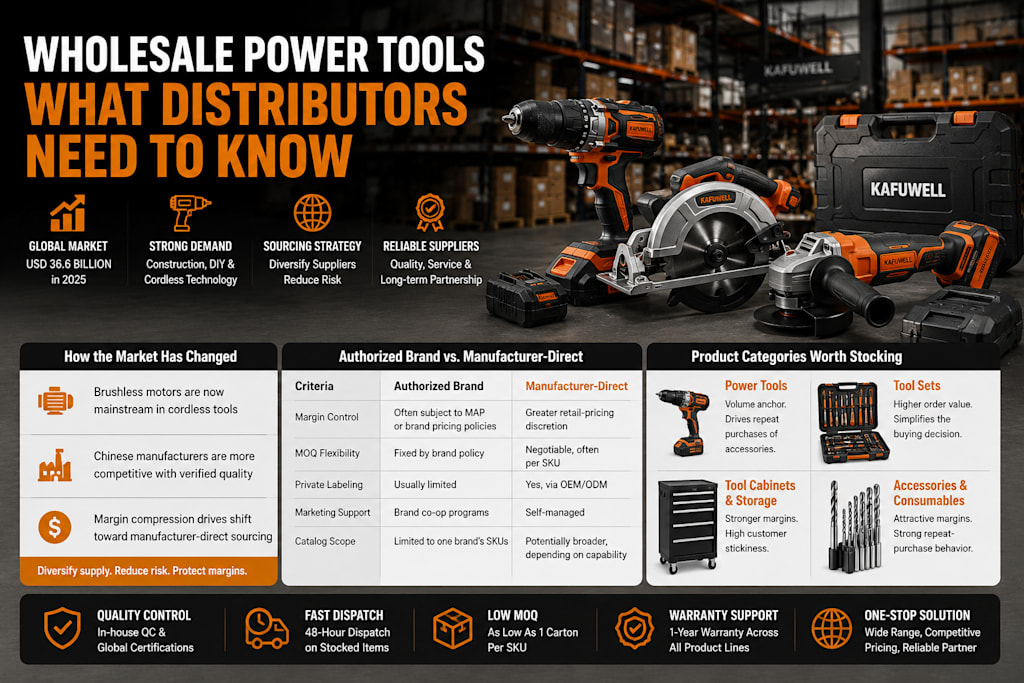
Precedence Research calculated the global power tools market at approximately USD 36.6 billion in 2025. Construction activity, cordless technology adoption, and sustained DIY/home-improvement demand are among the major demand drivers. For distributors, that growth creates opportunity — and raises the stakes on supplier selection.
This guide covers what wholesale tool distributors should evaluate before committing to a sourcing partner. Supplier credentials, product mix, pricing architecture, and supply chain logistics all determine whether a distribution business builds real margin or just moves inventory.
The focus is operational — the kind of sourcing detail that separates distributors who scale from those managing stockouts and thin margins.
How the Wholesale Power Tools Market Has Changed
The wholesale tool landscape shifted in the past five years. Distributors who built catalogs exclusively around legacy Western brands may face tighter margins and fewer sourcing advantages than competitors willing to diversify their supplier base.
Three trends help explain this shift:
Brushless motors have moved beyond premium-only positioning and are increasingly mainstream in cordless tools, broadening the supplier field
Chinese manufacturers, including Zhejiang clusters, have become more competitive — though distributors should verify quality through certifications, samples, and factory audits
Margin compression on branded tools pushes mid-market distributors toward manufacturer-direct sourcing
Distributors who spread sourcing across product tiers and supplier geographies build more resilient operations over time. Single-source dependency carries tangible risk when tariff structures shift, shipping lanes constrict, or a key factory encounters production delays.
What Separates a Reliable Supplier from a Risky One
The sourcing decision typically comes down to two competing models: authorized brand distribution or manufacturer-direct wholesale. Each path carries distinct tradeoffs in margin control, minimum order flexibility, and the ability to customize or private-label products.
With an authorized brand, margin control is often subject to MAP or brand pricing policies, MOQs are fixed by brand policy, and private labeling is usually limited. You get brand co-op marketing programs, but your catalog scope stays limited to one brand's SKUs.
With a manufacturer-direct supplier, you gain greater retail-pricing discretion and MOQs are typically negotiable on a per-SKU basis. Private labeling is available through OEM/ODM, though marketing support is self-managed. The catalog scope is potentially broader, depending on the supplier's production capability.
SKU Depth and Catalog Coverage
A limited supplier catalog forces distributors into multiple vendor relationships, each carrying separate payment terms, logistics overhead, and communication costs. Suppliers listing several thousand SKUs across power tools, hand tools, accessories, and storage can help distributors consolidate sourcing into a single efficient channel.
Quality Control and Warranty Structure
In-house quality control tightens the feedback loop between defect detection and production correction. A manufacturer-backed warranty — one year across all product lines, for instance — can signal confidence in production consistency, but distributors should confirm claim procedures, replacement costs, and warranty exclusions in writing.
Lead Time and Minimum Orders
Short lead times on stocked items reduce supplier-side queue time and improve replenishment predictability. A 48-hour dispatch window — the supplier ships within two days, not delivers — can help distributors react faster to demand signals.
Despite fast dispatch, cross-border buyers still need to plan safety stock around ocean transit, customs clearance, and inland delivery. Additionally, minimum orders as low as one carton per SKU lower the barrier for testing unfamiliar product categories.
Product Categories Worth Stocking
Revenue in wholesale tool distribution does not spread evenly across product categories. Experienced distributors typically pair high-turnover, cash-flow-positive items with slower-moving products that carry stronger unit margins. Four category tiers tend to form the core of most wholesale tool catalogs.
Power Tools — The Volume Anchor
Drills, drivers, fastening tools, and common cutting/grinding tools often serve as volume anchors in distributor catalogs. Margins run thinner because buyers price-compare aggressively across vendors and platforms. Their primary value lies in anchoring customer relationships — a drill buyer returns for bits, batteries, and blades.
Tool Sets and Bundles
Bundled products — a cordless drill kit packaged with batteries, charger, and carrying case — command higher per-transaction revenue than individual SKUs. Buyers compare less aggressively on unit price when purchasing kits. Tool sets also simplify the buying decision for end users entering a new trade or stocking a first workshop.
Tool Cabinets and Storage
Industrial-grade tool cabinets can carry stronger margins because they often face less price commoditization than high-visibility power tools. Buyers evaluate build quality, drawer configuration, and load rating — not brand alone. Storage products also create customer stickiness: buyers invested in one cabinet system tend to reorder from the same supplier for expansions.
Because cabinets and storage systems are bulky, distributors should model margin per CBM or per container, not only gross margin per unit. Poor container utilization, destination handling, and inland freight can quickly erode the apparent margin advantage.
Accessories and Consumables
Drill bits, saw blades, safety gear, and sanding discs can carry attractive gross margins and strong repeat-purchase behavior in many distributor catalogs. Actual profitability depends on brand mix, channel pricing, and fulfillment costs. A deep accessories catalog converts many initial tool sales into a recurring revenue stream.
Pricing, MOQs, and Supply Chain Economics
Wholesale tool pricing operates on a layered structure shaped by order volume, payment terms, and shipping arrangements. Managing each variable well determines whether a competitive factory price actually translates into healthy margin by the time product reaches the distributor's warehouse.
Three variables typically define wholesale pricing:
Order volume and annual purchase commitments
Payment structure — prepayment percentage, deposit splits, and net payment windows
Shipping terms — FOB, CIF, or DDP — which allocate transport responsibilities, costs, and risk-transfer points but should be read alongside payment terms, insurance, and title-transfer provisions
Volume Pricing and Break Points
Manufacturers set price reductions at defined order thresholds. Distributors who commit to consistent quarterly volumes often secure better per-unit costs than those placing sporadic large orders. Align pricing negotiations with realistic sell-through data and historical inventory turns, not aspirational volume targets.
Payment Terms and Cash Flow
Deposit structures, net payment windows, and currency terms all affect realized margin directly. A supplier demanding full prepayment forces the distributor to absorb total inventory risk upfront. More favorable arrangements — a 30% deposit with balance against shipping documents — reduce capital exposure during the growth phase.
Shipping Costs and Landed Price
Full container loads (FCL) deliver the lowest per-unit freight cost but demand significant order volume from the distributor. Less-than-container-load (LCL) shipping suits smaller orders and initial market tests. Factor these four post-factory cost components into every landed price calculation:
Ocean freight rate — FCL versus LCL
Port handling, customs clearance, applicable base duties, trade-remedy duties, and any temporary tariff exclusions or surcharges
Inland freight from port of entry to warehouse
Insurance and currency exchange costs
Geopolitical factors make tariffs a volatile cost component. Distributors importing from major hubs must model how sudden duty increases might erode profit margins before committing to long-term volume agreements. For U.S. imports, model duties at the HTS subheading level with a customs broker rather than applying a generic tariff assumption.
OEM and ODM — The Private-Label Route
In an OEM arrangement, the brand owner provides the design and specifications while the factory manufactures to those requirements. In ODM, the factory supplies an existing design that the distributor customizes with branding, packaging, or limited feature changes.
Private-label margins can exceed branded resale when demand is validated and the distributor controls pricing without competing against authorized dealers selling identical branded SKUs. The tradeoff is upfront investment in packaging design, compliance testing, and minimum production runs.
Before entering either arrangement, confirm the manufacturer's engineering capacity, certification and conformity support for target markets — such as applicable NRTL listing for the U.S., CE conformity documentation for the EU/EEA, and UKCA/CE regime support for Great Britain — IP ownership terms, and willingness to accept pilot-run volumes before committing.
Case Study: Evaluating a Manufacturer-Direct Supplier
To illustrate these sourcing criteria, consider Kafuwell, a Hangzhou-based manufacturer and wholesale supplier with a brand history dating back to 1998. The company’s operational model aligns with several benchmarks outlined in this guide, including in-house R&D, direct quality control, and 48-hour dispatch windows for stocked inventory.
Its catalog lists over 4,000 SKUs across eight categories. Minimum orders start at one carton per SKU, offering a low barrier for testing new lines. Kafuwell also presents OEM and ODM programs online, but distributors should independently verify these claims through factory audits, sample testing, current certificates, and written contracts.
FAQ
What certifications should wholesale power tools carry for the U.S. market?
Electrical tools, chargers, and related equipment sold or used in the U.S. may need evaluation to applicable safety standards by an OSHA-recognized NRTL, depending on workplace use, retailer requirements, local AHJ/code expectations, and product category. UL Solutions and Intertek’s ETL Listed Mark are common examples, but they are not the only NRTL paths.
Products containing digital electronics, chargers, Bluetooth/Wi‑Fi modules, or other RF functions may also fall under FCC equipment authorization rules. The correct route may be Supplier’s Declaration of Conformity or Certification, depending on the device design and whether it is an unintentional or intentional radiator.
Cordless tools also raise battery-specific compliance issues. Lithium-ion cells and battery packs must meet UN 38.3 transport testing requirements before shipment, and distributors should request current test summaries from suppliers. If a distributor handles returned, damaged, used, or end-of-life batteries, EPA/RCRA universal-waste and state battery-recycling rules may also apply.
Can small distributors compete against national retail chains?
Small distributors compete effectively by serving segments that national chains underserve — specialized trade contractors, regional builder networks, and niche online-only sales channels. Lower overhead, faster decision-making, and deeper product expertise offset the scale advantages of big-box retailers in these more focused markets.
How should distributors negotiate warranty terms with overseas suppliers?
Define warranty scope before signing any supply agreement. Clarify who handles claims — the manufacturer or the distributor — and whether replacement units ship at no additional cost. A documented warranty protocol covering return logistics, response timelines, and cost allocation protects margin and preserves buyer trust.
About the Creator
Enjoyed the story? Support the Creator.
Subscribe for free to receive all their stories in your feed.
Comments
There are no comments for this story
Be the first to respond and start the conversation.