
What Is Leverage in Futures Trading? - Meaning, Risks & the 10x Rule
Leverage in futures trading can amplify both profits and losses, making it a powerful but double-edged tool. Understanding its risks—and applying disciplined frameworks like the 10x Rule—can be the difference between long-term survival and rapid account failure.
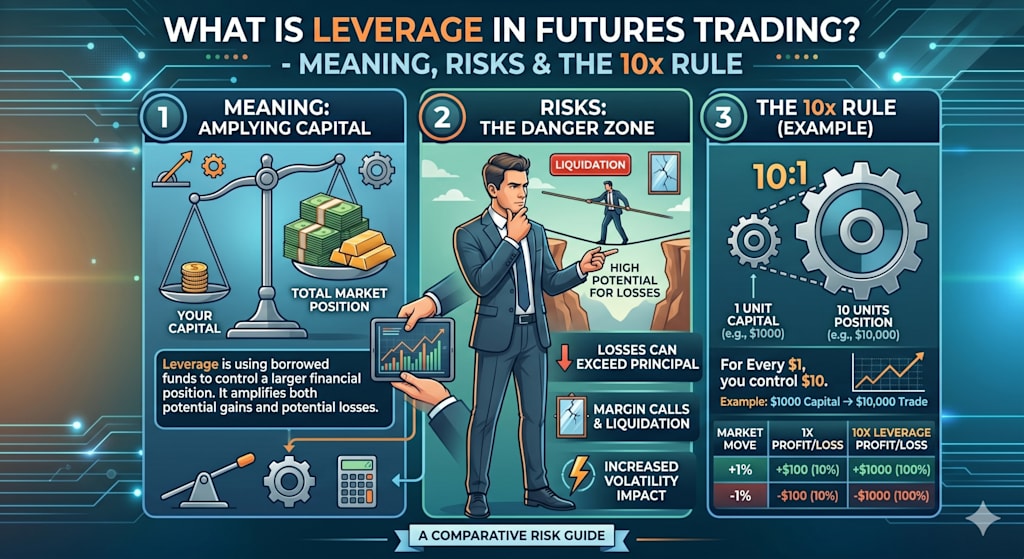
Leverage is one of the most powerful — and misunderstood — concepts in futures trading. It’s the reason traders can control large positions with relatively small capital, but it’s also the reason accounts can disappear faster than expected. To use leverage effectively, you need to understand not just how it works, but how it quietly shapes your risk, psychology, and long-term survival.
What Is Leverage in Futures Trading?
At its core, leverage allows you to control a large contract value with a fraction of the total amount, known as margin. For example, instead of needing $100,000 to trade a contract, you might only need $5,000 in margin. That difference is leverage.
In futures markets, leverage is built into the structure of the contracts themselves. Exchanges set initial and maintenance margin requirements, and brokers may adjust them further. This means every trade you take is inherently leveraged — whether you consciously think about it or not.
Let’s say you’re trading an E-mini S&P 500 futures contract. A small price move of just a few points can translate into significant profit or loss because your exposure is much larger than your deposited capital. That amplification is leverage in action.
Why Leverage Feels Attractive
Leverage creates the illusion of efficiency. You can generate meaningful returns without needing a large account. For many traders, especially those starting out, this feels like an advantage — a way to “speed up” progress.
It also aligns with the appeal of futures trading itself: capital efficiency, liquidity, and the ability to go long or short easily.
But this is where most traders misinterpret leverage. They see it as a tool for growth, when in reality, it is primarily a tool that magnifies outcomes — both positive and negative.
The Hidden Risks of Leverage
The biggest risk with leverage is not just losing money — it’s how quickly losses compound.
Because your position size is large relative to your capital, even small market moves against you can result in outsized losses. A 1% move in the underlying asset might translate into a 10–20% impact on your account, depending on how aggressively you’re positioned.
This creates three major problems:
1. Accelerated Drawdowns
Leverage compresses time. What might have been a manageable loss over weeks in an unleveraged environment can happen in a single session.
2. Psychological Pressure
Large swings in P&L affect decision-making. Traders begin reacting emotionally — cutting winners early, holding losers longer, or revenge trading.
3. Reduced Margin for Error
When using high leverage, there’s very little room for mistakes. Even a few consecutive losses can put you at or beyond your risk limits.
This dynamic becomes even more visible in structured trading environments like Apex Trader Funding, where traders operate under strict drawdown rules. Many account failures in such setups are not due to poor strategy, but because excessive leverage causes traders to hit risk limits before their edge has time to play out.
The 10x Rule: A Practical Way to Think About Leverage
One of the simplest ways to stay grounded is the “10x Rule.”
The idea is straightforward:
Trade as if your effective exposure is 10 times your account size — even if margin requirements suggest otherwise.
For example, if you have a $5,000 account, don’t think in terms of what contracts you can trade based on margin. Instead, think in terms of what position size would make sense if you were managing $50,000 in real capital.
This shift does two things:
- It forces you to reduce position size
- It aligns your risk-taking with long-term survivability rather than short-term opportunity
The 10x Rule is not a strict formula, but a mental framework. It counteracts the natural tendency to over-leverage simply because the platform allows it.
Why Most Traders Misuse Leverage
The misuse of leverage usually comes down to intent.
Traders often increase position size not because their strategy justifies it, but because they want faster results. This leads to inconsistent risk per trade, which ultimately makes performance unpredictable.
Another common issue is anchoring to account size instead of drawdown limits. In many trading setups, your real constraint isn’t the total balance — it’s the maximum loss you’re allowed to take.
If you size positions based on the full account instead of the allowable risk, leverage becomes a silent account killer.
A More Sustainable Approach
Using leverage effectively isn’t about avoiding it — that’s impossible in futures trading. It’s about controlling how much of it you express through your position sizing.
A few principles help:
- Define risk per trade first, not position size
- Think in terms of drawdown tolerance, not account balance
- Keep position sizing consistent, regardless of recent wins or losses
- Focus on execution quality, not profit per trade
Interestingly, traders who operate within structured constraints — such as those imposed by certain funding models — often develop a better intuitive understanding of leverage over time. When breaching a limit has immediate consequences, it forces a level of discipline that discretionary environments don’t always demand.
The Role of Discipline Over Math
Leverage is often explained mathematically, but its real impact is behavioral.
Two traders can use the same level of leverage and get completely different results. The difference comes down to how they manage risk, handle losses, and stick to their plan.
This is why reducing leverage isn’t just about lowering contract size — it’s about reducing emotional volatility. When your trades don’t feel overwhelming, you’re more likely to execute consistently.
Final Thoughts
Leverage is neither good nor bad — it’s a multiplier. It amplifies whatever system, mindset, and discipline you bring into the market.
If used carelessly, it accelerates failure. If used thoughtfully, it becomes a tool for capital efficiency and controlled growth.
The key is to stop thinking in terms of “how much can I trade?” and start thinking in terms of “how much should I risk?”
That shift, combined with frameworks like the 10x Rule, is what separates traders who last from those who burn out quickly.
About the Creator
Enjoyed the story? Support the Creator.
Subscribe for free to receive all their stories in your feed.
Comments
There are no comments for this story
Be the first to respond and start the conversation.