
What Is a Prop Firm Challenge? A Complete Beginner’s Guide
A beginner-friendly guide to understanding prop firm challenges, evaluation rules, funding requirements, and how the process works from start to funded account.
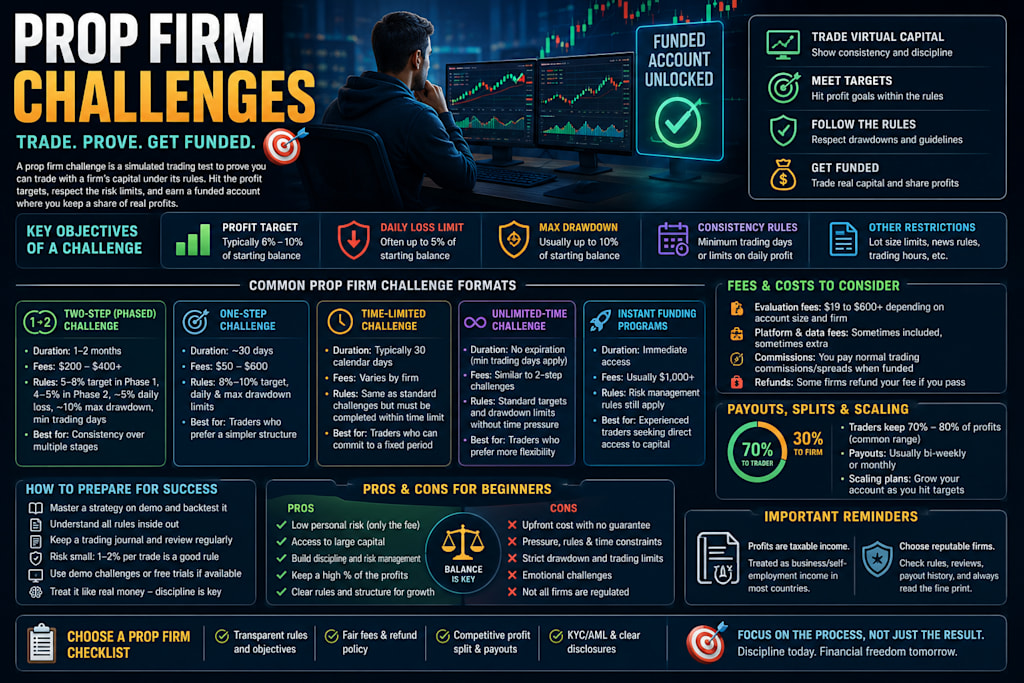
A prop firm challenge (or evaluation) is a simulated trading test to prove you can trade with a firm’s capital under its rules. Traders start on a demo account and aim for a set profit target (often ~6–10% of the starting balance) while observing strict risk limits like daily and total drawdowns. Passing the challenge earns a funded account: you keep a share of future profits (commonly 50–80% of profits) and trade real firm money. The process varies by firm – for example, FTMO and Apex Trader Funding run their own challenges – but the key steps (virtual trading, meeting targets, following rules) are similar. Success usually requires disciplined risk management, a tested strategy, and practice on demo accounts before paying any fees.
How Prop Firm Challenges Work
A prop firm challenge is essentially a trading exam. You receive a simulated (demo) account with “virtual” funds and must hit specific objectives set by the firm. These objectives typically include:
Profit target: You must grow the account by a certain percentage (e.g. 6–10%).
Drawdown limits: You cannot lose more than a set percentage of your balance. Often this includes a daily loss limit (e.g. 5% of the starting balance in one day) and a total drawdown limit (e.g. 10% overall).
Consistency rules: Some programs require a minimum number of trading days or limit profits in a single day to ensure you’re trading steadily, not on a lucky spike.
Other restrictions: These can include lot size caps, news-event rules, or no trading outside certain hours, depending on the firm.
Firms use these rules to make sure traders manage risk. As NinjaTrader explains, evaluations test your ability to generate profits and control losses. You must treat the demo money “as if it’s real” – if you break any rule, you fail the challenge. For example, The Funded Trader (TFT) describes itself as “a simulated trading evaluation firm” where after passing, “eligible traders are allowed to receive a profit split” on real profits.
Challenge Formats and Rules
Challenges come in different formats. The most common are two-step (multi-phase) and one-step (single-phase) evaluations, but there are variations:
Two-Step (Phased) Challenge: The most traditional format. You must first pass Phase 1 (often 5–8% profit target with standard drawdowns), then complete Phase 2 (a lower target, e.g. 4–5%, with similar or stricter rules). FTMO is a well-known example, with a 10% target and 5% daily drawdown in phase 1. This approach tests consistency over time.
One-Step (Single) Challenge: A single evaluation where you hit one profit target (often 8–10%) without a second phase. These tend to be shorter and simpler in structure. Traders who prefer quick results may favor one-step challenges, but as ForTraders notes, they emphasize short-term performance and have tighter time pressure.
Time-Limited vs. Unlimited: Some challenges must be completed within a set calendar period (e.g. 30 days), while others allow trading until you pass (often with a minimum of 5 profitable days required). An unlimited-time challenge gives more flexibility (no rush), whereas a 30-day challenge demands faster results.
Profit-Target vs. Drawdown-Focused: Almost all have a profit target, but the risk controls vary. Most impose a fixed daily loss (e.g. 5% of starting balance) and a fixed overall drawdown (often 10% of starting balance). Some firms use balance-based drawdowns (calculating losses from peak equity) instead of fixed percentages.
Typical rules include: aiming for a profit target (for instance, 8% profit on a $100K account means $8K gain), not losing more than ~5% in one day, and not dropping the account equity below ~10% loss overall. Many challenges also require at least five trading days, and often limit news-event trading to avoid extreme risk. Always read the specific rules for each program.
Common Prop Firm Challenge Formats
- Two-Step (Phased) Challenge
- Typical duration: Around 1–2 months across two evaluation phases
- Typical fees: Moderate, often between $200–$400 depending on account size
Common rules: Profit targets in each phase (often 5–8% in Phase 1 and 4–5% in Phase 2), daily loss limits around 5%, maximum drawdown around 10%, and minimum trading-day requirements
Best suited for: Traders focused on demonstrating consistency over multiple stages
One-Step (Single) Challenge
- Typical duration: Usually completed within a few weeks, often around 30 days
- Typical fees: Generally range from $50–$600 depending on the provider and account size
- Common rules: One profit target, typically around 8–10%, combined with daily and overall drawdown limits
- Best suited for: Traders who prefer a simpler evaluation structure
Time-Limited Challenge
- Typical duration: Fixed deadline, commonly 30 calendar days
- Typical fees: Vary by firm and account size
- Common rules: Similar profit targets and drawdown limits as other challenges, but all objectives must be achieved within the specified timeframe
- Best suited for: Traders who can commit to trading consistently during a defined period
Unlimited-Time Challenge
- Typical duration: No expiration date, although minimum trading-day requirements often apply
- Typical fees: Similar to traditional two-step evaluations
- Common rules: Standard profit targets and drawdown limits without strict time pressure
- Best suited for: Traders who prefer a more flexible pace
Instant Funding Programs
- Typical duration: Immediate access to a funded account without a traditional evaluation phase
- Typical fees: Usually higher upfront costs, often exceeding $1,000 depending on account size
- Common rules: Risk management requirements still apply, including drawdown limits and trading rules
- Best suited for: Experienced traders who prefer direct access to capital and are comfortable with higher entry costs
Note: Fees, profit targets, and risk parameters vary between firms. These examples reflect common industry structures rather than any specific firm's offering.
(Fees and targets are examples; actual numbers depend on the firm. The table summarizes common patterns, not a specific offer.)
Fees and Costs
Joining a prop challenge usually requires paying a fee upfront. Evaluation fees vary widely depending on the account size and firm. For example, The Funded Trader charges about $578 USD for a $100K challenge, whereas The5%ers offers a small $2.5K account challenge for as little as $19. In general, expect anywhere from a few tens to a few hundred dollars (or more) for larger programs.
Other costs may include:
- Platform or data fees: Some firms include trading platform and data fees in the evaluation price, but others charge them separately.
- Monthly/ongoing fees: A few firms require a subscription or maintenance fee for live accounts or data after funding.
- Trading commissions: Once funded, you often still pay normal trading commissions or spreads. Even small fees per trade can add up, so factor them into your profit targets.
- Some firms offer special models: a few have fee-refund policies, where if you pass the challenge, your initial fee is refunded or credited. For example, a blog on prop costs notes that “certain prop firms offer to refund your evaluation fee if you successfully pass their challenge”. Always check the refund and cancellation policy before you pay. Be cautious of hidden costs: read the fine print on minimum time, data charges, or any required minimum trading volume.
Payout Splits and Scaling
Once funded, you trade with live capital and keep a share of the profits. Profit splits vary by firm. A common range is that the trader receives 70–80% of profits and the firm keeps 20–30%. For example, The5%ers advertises splits up to 100% (meaning the trader keeps all profits) for high performance tiers. TFT and others may start lower and increase the split over time. In fact, TFT recently introduced a tiered system where a new trader might keep 30% of profits on the first payout, rising to 70% after a few withdrawals.
Most firms pay out profits on a regular schedule (bi-weekly or monthly) after verifying the account hasn’t broken any rules. Some allow you to reinvest profits to grow your account under a scaling plan. For example, The5%ers automatically increases your account size by 10% each time you gain 10%. In their High-Stakes program, every 10% profit target triggers a 10% balance increase up to $500K. Check each firm’s scaling or growth plan details if you plan to grow beyond the initial allocation.
Pros and Cons for Beginners
Pros:
- Low personal risk: You aren’t risking your own trading capital beyond the evaluation fee.
- Access to capital: Successfully passing gives you much larger funds (tens or hundreds of thousands) than most retail traders start with.
- Structured learning: The strict rules force good habits (discipline, risk management) that can make you a better trader.
- Profit potential: You keep a significant portion of profits (often the majority) with no upfront capital beyond the fee.
Cons:
- Cost and commitment: You must pay the fee even if you fail, and larger account challenges can be expensive.
- No guarantee: There is no promise you’ll pass or get funded. The Firm’s FAQs always note that passing is based on meeting criteria.
- Pressure: The rules and time frames can be stressful. Overtrading and impatience often cause failures.
- Rigid rules: Some restrictions (e.g. no news trading, forced loss limits) may not suit every style.
- Regulation: Prop firms are usually not regulated brokers; you have to trust their processes. Look for firms that at least do KYC/AML checks (TFT requires ID verification) and have clear terms.
Each person’s experience varies. Many traders find challenges tough: common pitfalls include overtrading, ignoring risk limits, and trading emotionally. Set realistic expectations: treat the challenge as a test of consistency, not a get-rich-quick scheme.
How to Prepare
Preparation is key. Here are practical steps beginners can take:
- Master a strategy on demo: Before the challenge, perfect a trading plan on a practice (demo) account. Your plan should include clear entry/exit rules and a fixed risk per trade (e.g. 1–2% of the account).
- Understand the rules: Read the firm’s rulebook or FAQs thoroughly. Make sure you know every requirement (profit target, loss limits, allowed instruments, session times, etc.).
- Use a trading journal: Record all demo trades with notes. Track what works and where mistakes happen. NinjaTrader specifically advises keeping a journal to identify patterns and improve strategy.
- Risk management practice: In the evaluation, it’s often recommended to risk only a small percentage of your balance on any trade (NinjaTrader suggests 1–2%). Practice position sizing to stick to those rules.
- Demo challenge: If available, use any free trial or demo challenge the firm offers. This lets you experience the challenge conditions at no cost.
- Simulate Psychology: Treat demo trades in the challenge like real money. The rules are often the same as the live funded account. Practice patience – many challenges allow weeks to succeed, so slow and steady wins.
By practicing rules compliance and consistent performance on demo, you’ll be better prepared for the real challenge. As the NinjaTrader blog puts it, approach the evaluation with a business mindset and disciplined plan.
Realistic Expectations and Pitfalls
Pass rates can be low, and success often takes experience. Traders commonly underestimate how emotional and difficult it is to trade under pressure. Keep these points in mind:
- Consistency over luck: Don’t try to “gamble” your way to the target with huge bets. Consistent small gains beat big swings.
- No guaranteed outcome: Even a good strategy can hit a losing streak. Failing once doesn’t mean you’re a bad trader – it means you need more practice. Almost all prop firms allow retakes after a reset.
- Fear of losses: Losing trades are inevitable. The key is to not violate the loss rules. For example, if a 5% daily loss limit is reached, you fail – so always cut losses early and strictly.
- Watch out for emotional bias: After a few wins or losses, it’s easy to start trading too aggressively or hesitantly. Stick to your original plan and risk parameters.
- Beware “confirmation” pitfalls: Just because a setup worked yesterday doesn’t mean it will work the same way today. Each day is new.
In short, success in a prop challenge requires patience and adaptation. Don’t fall for advice that promises easy win strategies. Focus on process (following rules) rather than outcome (hitting X profit).
Regulation and Tax Considerations
Prop firms typically require KYC/AML verification before funding you, just like brokers do. For example, The Funded Trader requires ID verification before issuing a funded account payout. However, unlike retail brokers, prop firms often clarify they are not custodians or regulated exchanges. The5%ers explicitly notes it “is not a custodian, exchange, [or] financial institution” and uses a simulated environment for evaluation. This means they aren’t subject to the same financial regulations as brokerages. Always ensure the firm’s terms are clear and see if they have registration or oversight in any jurisdiction.
On taxes, remember that profits from a funded account are taxable income. Most countries treat funded trading income as business/self-employment earnings, not capital gains. For instance, a tax guide notes: “Funded prop trading income is typically treated as self-employment or business income, not capital gains”. This means you must report payouts on your tax return like any other income. On the plus side, many tax authorities allow you to deduct trading-related expenses; challenge fees and software costs are often deductible as business expenses. Keep detailed records of all payments, profits, and losses from the evaluation and funded accounts for accurate reporting. Check tax rules in your country or consult an accountant – rules vary (for example, the US classifies it as ordinary income and allows deduction of the fee).
Choosing a Reputable Prop Firm – Checklist
When selecting a prop trading firm, use this checklist:
- Transparent, clear rules: The firm should publish all trading objectives and limits (profit target, daily/total drawdowns, allowed instruments, etc.). Avoid firms with vague or changing rules. Check their official FAQ or rulebook.
- Fair fee and refund policy: Look at the cost vs. benefits. A refundable fee or trial period is a good sign. Confirm if any fees (monthly, data, platform) apply later.
- Profit split & payout terms: Ensure you understand the profit-sharing ratio and how/when withdrawals are processed. A competitive split (often 70% or more to trader) and reasonable withdrawal frequency are positive features.
- Regulation or compliance: Prefer firms that do KYC/AML and operate out of reputable jurisdictions. Even if not regulated as brokers, they should at least provide legal disclosures and risk warnings (see how The5%ers handles disclosures).
- Reputation and reviews: Research other traders’ experiences. Look for community feedback (forums, reviews) about the firm’s reliability in paying out and following its own rules. Watch for any consistent red flags.
- Choosing the right firm matters. Taking time to compare a few – looking at rule complexity, cost, and community reputation – can help you find a program that matches your style and budget.
In summary: A prop firm challenge is an opportunity to trade larger capital with strict limits. By understanding the format, honing your skills on demo, and managing risk carefully, you give yourself a better chance to pass the challenge and earn real profits from firm capital. Remember to budget for costs, follow the rules to the letter, and treat the process as a learning experience. Success can lead to a profitable funded account, but it starts with preparation, discipline, and realistic expectations.
About the Creator
Enjoyed the story? Support the Creator.
Subscribe for free to receive all their stories in your feed.
Comments
There are no comments for this story
Be the first to respond and start the conversation.