
US Plasmid DNA Manufacturing Market Size Growth Demand & Outlook 2034
The U.S. plasmid DNA manufacturing market reached USD 526.11 million in 2025 and is projected to grow to USD 4,122.70 million by 2034, reflecting a CAGR of 22.86% during 2026–2034.

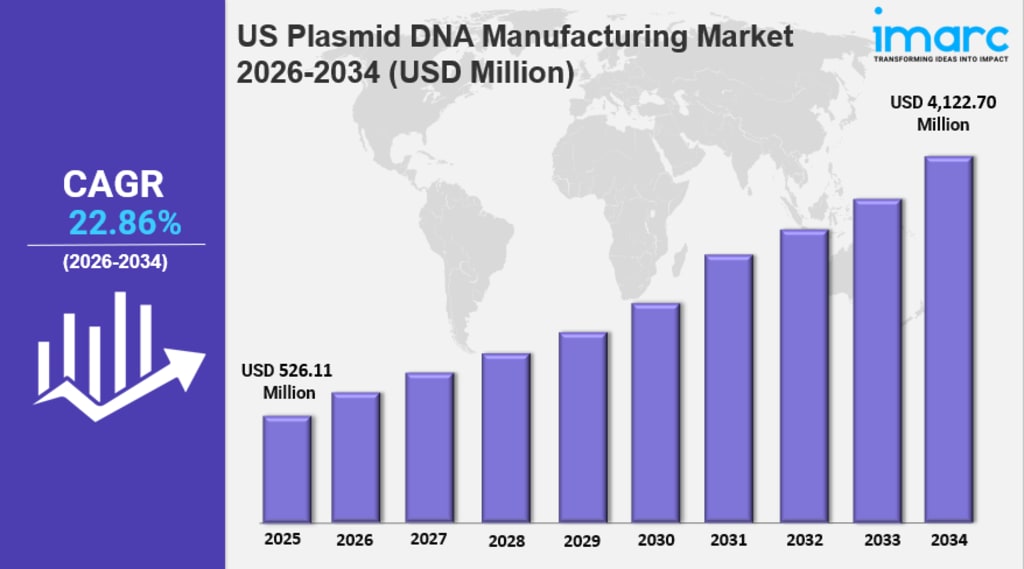
U.S. Plasmid DNA Manufacturing Market Size, Share, and Growth Forecast (2026–2034)
The U.S. plasmid DNA manufacturing market is entering a rapid growth phase, supported by the expansion of advanced therapeutics and increasing demand for high-quality biological materials. The market reached USD 526.11 million in 2025 and is projected to grow to USD 4,122.70 million by 2034, reflecting a CAGR of 22.86% during 2026–2034.
This strong growth trajectory highlights the critical role of plasmid DNA as a foundational component in modern biopharmaceutical development. It serves as a key starting material for viral vector production, which is essential for cell and gene therapies. For B2B stakeholders, including biotech firms, contract development and manufacturing organizations (CDMOs), and pharmaceutical companies, the market represents a high-value segment with long-term demand visibility.
Request a Sample Report with Latest 2026 Data & Forecasts:
Key Growth Drivers in the U.S. Plasmid DNA Manufacturing Market: Gene Therapy and Vaccine Demand
The primary driver of this market is the increasing number of gene therapy programs moving through clinical and commercial stages. Regulatory approvals for these therapies are accelerating, creating sustained demand for plasmid DNA used in vector development.
In parallel, vaccine innovation—particularly nucleic acid-based platforms—has reinforced the importance of scalable and high-purity DNA manufacturing. Although demand spikes during global health events may vary, the underlying infrastructure built for vaccine production continues to support broader applications.
Another important growth factor is the rise in public and private investment. Government-backed initiatives and funding programs are supporting research, infrastructure, and partnerships, enabling companies to expand their capabilities and accelerate production timelines.
Rising Demand for Plasmid DNA in Cell and Gene Therapy Applications
Plasmid DNA plays a central role in the development of cell and gene therapies, acting as a building block for viral vectors such as AAV and lentivirus systems. As more therapies progress from research to commercialization, the demand for clinical-grade and commercial-scale plasmid DNA is increasing.
Biotech companies are focusing on improving therapeutic outcomes, which requires consistent and high-quality raw materials. This is pushing manufacturers to adopt advanced production processes that ensure purity, scalability, and regulatory compliance.
From a B2B perspective, long-term supply agreements and strategic partnerships are becoming more common, as therapy developers seek reliable manufacturing partners to support their pipelines.
Manufacturing Capacity Expansion and CDMO Trends in the U.S. Market
Capacity expansion is a defining trend in the U.S. plasmid DNA manufacturing market. Companies are investing in new facilities and upgrading existing infrastructure to meet growing demand. This includes the development of large-scale production sites designed to handle both clinical and commercial volumes.
CDMOs are playing a critical role in this ecosystem. Many biotech firms prefer outsourcing manufacturing to specialized partners rather than building in-house capabilities. This trend is driving growth for CDMOs that can offer end-to-end services, from process development to large-scale production.
In addition, flexible manufacturing models are gaining traction. Facilities designed to support multiple projects and adapt to different production requirements are becoming increasingly valuable in a dynamic market environment.
Regulatory Landscape and Quality Standards in Plasmid DNA Production
Regulatory compliance is a central consideration in plasmid DNA manufacturing. The U.S. market operates under strict guidelines to ensure product safety, consistency, and traceability. Companies must adhere to current Good Manufacturing Practices (cGMP) and meet regulatory expectations for documentation, validation, and quality control.
As therapies move toward commercialization, regulatory scrutiny increases. This requires manufacturers to maintain robust quality systems and invest in continuous process improvement.
For businesses, strong compliance capabilities are not only essential for market entry but also serve as a competitive advantage. Companies that can consistently meet regulatory standards are better positioned to secure long-term contracts and partnerships.
Technology Advancements in Plasmid DNA Manufacturing: Scaling, Purification, and Automation
Technological innovation is transforming plasmid DNA manufacturing processes. Advances in fermentation technology are enabling higher yields and more efficient production at scale. Improved purification techniques are helping achieve the high levels of purity required for therapeutic applications.
Automation is also playing a growing role. Automated systems reduce manual intervention, improve consistency, and enhance process efficiency. This is particularly important for large-scale production, where maintaining quality across batches is critical.
Digital tools and data analytics are further supporting process optimization, allowing manufacturers to monitor performance in real time and identify areas for improvement.
Investment Opportunities in the U.S. Plasmid DNA Manufacturing Market for Biotech and Pharma Companies
The U.S. plasmid DNA manufacturing market offers strong investment potential across multiple areas. Infrastructure development remains a key opportunity, with demand for new production facilities continuing to grow. Investors are also focusing on companies that offer specialized capabilities, such as high-yield production or advanced purification technologies.
CDMOs represent another attractive segment, as outsourcing trends continue to expand. Firms that can provide integrated services and scale with client needs are well positioned for growth.
In addition, there is increasing interest in companies developing innovative manufacturing technologies that improve efficiency and reduce costs. These solutions can address key industry challenges and create competitive advantages.
As the market evolves, businesses that align their strategies with industry needs—focusing on scalability, compliance, and technological advancement—are likely to capture significant value in this high-growth sector.
About the Creator
Kim Soo hyun
My name is Kim Soo hyun, and I am a research analyst at IMARC Group, specializing in market trends and data analysis to provide insights and support strategic decision-making.
Enjoyed the story? Support the Creator.
Subscribe for free to receive all their stories in your feed.
Comments
There are no comments for this story
Be the first to respond and start the conversation.