
US Family Offices Market Size is Expected to Reach USD 7,540.9 Million by 2034 | CAGR 3.88%
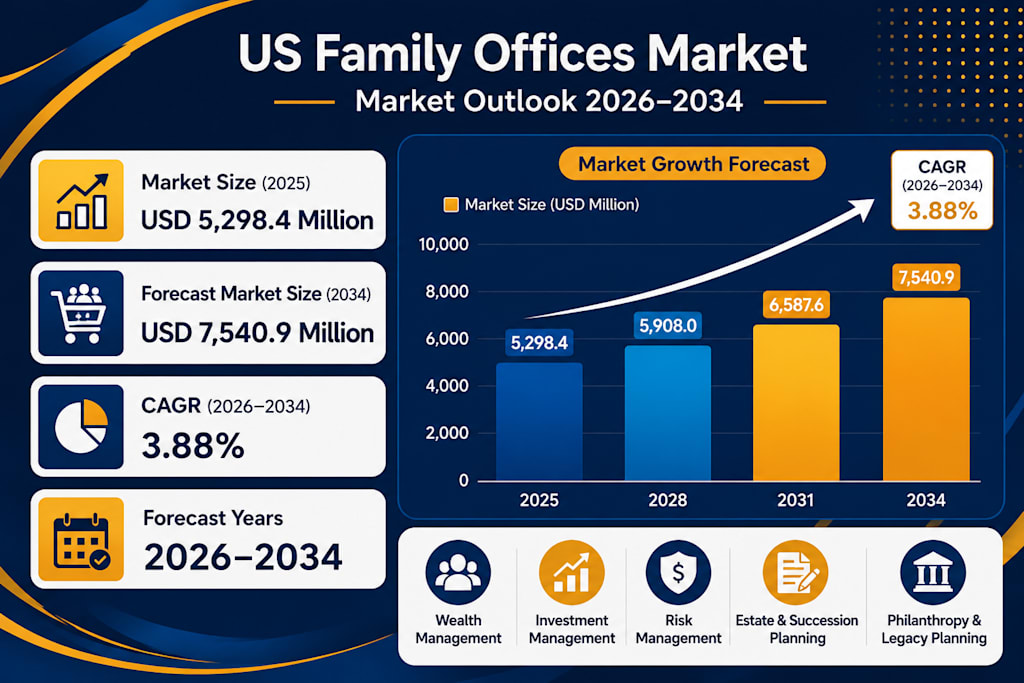
The US family offices market size reached USD 5,298.4 Million in 2025. The market is projected to reach USD 7,540.9 Million by 2034, exhibiting a growth rate (CAGR) of 3.88% during 2026-2034.

Why the US Family Offices Market Is Evolving: Trends & Future Outlook (2026–2034)
Managing significant wealth has become increasingly complex in today's rapidly changing economic environment. High-net-worth families are no longer focused solely on preserving assets; they are also seeking opportunities to create long-term value, support future generations, and align investments with personal values. This shift has fueled the growing importance of family offices across the United States.
In 2026, family offices are playing a larger role in wealth management than ever before. These organizations provide a centralized structure for managing investments, estate planning, philanthropy, tax strategies, and family governance. As financial markets evolve and investment opportunities expand, family offices are adapting to meet new challenges and expectations.
The US family offices market reached USD 5,298.4 Million in 2025 and is projected to grow to USD 7,540.9 Million by 2034, exhibiting a compound annual growth rate (CAGR) of 3.88% during 2026–2034. This steady growth reflects increasing demand for personalized wealth management and long-term financial planning solutions.
Request a Sample Report with Latest 2026 Data & Forecasts:
Understanding the Role of Family Offices
A family office is a private organization established to manage the financial and personal affairs of wealthy families. Unlike traditional wealth management firms, family offices often provide a comprehensive range of services tailored to a family's specific goals and priorities.
These services may include investment management, succession planning, philanthropy, tax planning, risk management, and family governance support. By centralizing these functions, family offices help families maintain greater control over their financial futures.
As wealth becomes more diversified and globalized, the need for specialized management expertise continues to increase.
Key Trends Shaping the US Family Offices Market
Several important trends are influencing the evolution of family offices across the country:
• Increasing allocation toward alternative investments
• Growing focus on environmental, social, and governance (ESG) strategies
• Expansion of direct investment opportunities
• Rising adoption of advanced financial technologies
• Greater emphasis on intergenerational wealth planning
These trends demonstrate how family offices are becoming more sophisticated and strategic in their approach to wealth management.
The Rise of Alternative Investments
One of the most notable developments in recent years has been the growing interest in alternative investments.
Family offices are increasingly exploring opportunities beyond traditional stocks and bonds. Private equity, venture capital, real estate, infrastructure projects, and private credit investments are becoming more common components of diversified portfolios.
These assets often offer the potential for long-term growth while providing greater flexibility and control. As market conditions continue to evolve during 2026–2034, alternative investments are expected to remain a significant focus for family offices.
Sustainability Is Influencing Investment Decisions
Sustainability has become an increasingly important consideration for wealthy families.
Many investors now seek opportunities that generate financial returns while supporting environmental and social objectives. As a result, ESG-focused investing is gaining traction across the family office landscape.
Families are aligning investment strategies with broader values related to climate responsibility, social impact, and ethical governance. This approach reflects changing priorities among younger generations who often play a growing role in long-term wealth planning.
The integration of sustainability considerations is expected to continue influencing investment decisions throughout the forecast period.
Technology Is Transforming Wealth Management
Technology is playing a critical role in the modernization of family office operations.
Advanced analytics platforms provide deeper insights into portfolio performance, risk exposure, and market opportunities. Artificial intelligence is helping improve data analysis and investment decision-making processes.
Cloud-based systems are streamlining operations while enhancing security and accessibility. Digital reporting tools allow families to monitor investments and financial activities more efficiently.
As technology continues advancing, family offices are expected to further embrace data-driven strategies and automation.
Direct Investments and Greater Control
Many family offices are increasingly pursuing direct investment opportunities rather than relying solely on traditional fund structures.
Direct investments allow families to participate more actively in business ventures, real estate projects, and private companies. This approach offers greater transparency and control while potentially improving long-term returns.
Collaboration among family offices is also becoming more common, enabling participants to share expertise, resources, and investment opportunities.
These developments are helping reshape how wealth is managed and deployed.
Challenges Facing the Industry
Despite positive growth prospects, family offices face several challenges.
Economic uncertainty, geopolitical risks, and market volatility continue to influence investment strategies. Regulatory changes and compliance requirements also require ongoing attention.
Succession planning remains another important concern. Ensuring a smooth transfer of wealth and responsibilities between generations can be a complex process.
In addition, balancing long-term objectives with short-term market fluctuations requires careful planning and disciplined decision-making.
Future Outlook (2026–2034)
Looking ahead, the US family offices market is expected to continue evolving as wealth management strategies become increasingly sophisticated.
Between 2026 and 2034, demand for personalized investment solutions, advanced analytics, and sustainable investment opportunities is likely to grow. Family offices are expected to place greater emphasis on technology, collaboration, and direct investments.
Generational wealth transfers will also play a significant role in shaping future priorities and investment approaches.
As families seek greater control, transparency, and flexibility, family offices will continue serving as an important framework for preserving and growing wealth.
Conclusion
The US family offices market is entering a period of steady growth and transformation. Driven by alternative investments, sustainability initiatives, technological innovation, and evolving family priorities, the sector is adapting to meet the demands of a changing financial landscape.
Although challenges such as market volatility and succession planning remain, ongoing innovation and strategic diversification are supporting long-term resilience. As wealth management continues evolving throughout 2026–2034, family offices are expected to remain a vital component of comprehensive financial planning and wealth preservation strategies.
About the Creator
Jackson Watson
I'm a market research analyst at Imarc group company delivering data-driven insights, industry analysis, and customized research solutions. We support businesses with market sizing, competitive analysis, and strategic decision-making.
Enjoyed the story? Support the Creator.
Subscribe for free to receive all their stories in your feed.
Comments
There are no comments for this story
Be the first to respond and start the conversation.