
US Co-Working Office Space Market Size Growth Share Industry Demand & Forecast 2034
US Co-Working Office Space Market Size Trends, Growth Demand & Forecast 2026-2034

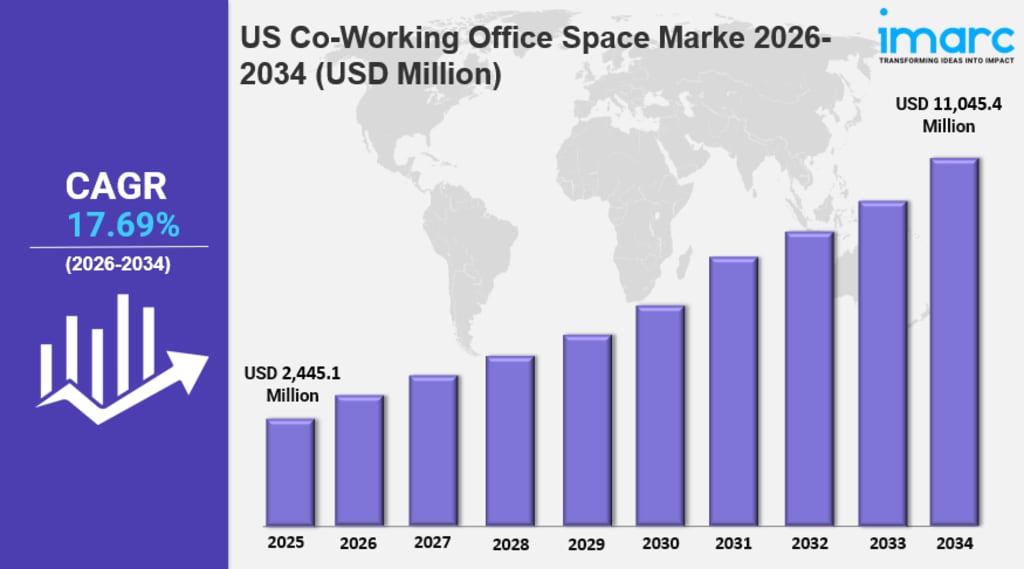
U.S. Co-Working Office Space Market Size, Share, and Forecast (2026–2034)
The way businesses use office space has changed significantly over the past decade. Flexible work arrangements, hybrid employment models, and the growth of startups have created strong demand for workspace solutions that offer both convenience and cost efficiency. As a result, co-working spaces have become an important part of the modern commercial real estate landscape.
The U.S. co-working office space market reached USD 2,445.1 million in 2025 and is expected to grow to USD 11,045.4 million by 2034, registering a CAGR of 17.69% during 2026–2034. This growth reflects a broader shift in workplace strategy, where businesses are seeking flexibility rather than committing to long-term office leases.
Co-working spaces are no longer used only by freelancers and entrepreneurs. Today, startups, small businesses, remote teams, and even large corporations are incorporating flexible office solutions into their workplace strategies. This expanding customer base is helping support long-term market growth across major cities and emerging business hubs.
Key Trends Shaping the U.S. Co-Working Office Space Market
• Growing adoption of hybrid work models: Organizations are increasingly combining remote and in-office work, driving demand for flexible workspace solutions.
• Expansion into suburban locations: Co-working operators are opening facilities outside major downtown areas to serve professionals seeking workplaces closer to home.
• Rising demand for flexible office arrangements: Businesses are preferring short-term and scalable workspace options over traditional long-term office leases.
• Increasing integration of workplace technology: Modern co-working spaces are incorporating digital access systems, mobile booking platforms, smart meeting rooms, and high-speed connectivity.
• Focus on enhancing user experience: Operators are investing in premium amenities, wellness features, and collaborative environments to attract and retain members.
• Growth of community-driven workspaces: Networking events, business workshops, and professional development programs are becoming important value-added services.
• Higher participation from corporate users: Large enterprises are increasingly utilizing co-working spaces for satellite offices, project teams, and hybrid workforce management.
• Development of customizable workspace solutions: Providers are offering private offices, dedicated desks, and tailored workspace configurations to meet diverse business requirements.
Growth Drivers in the U.S. Co-Working Industry
Several factors continue to support the expansion of the co-working market in the United States.
The growing startup ecosystem remains a major driver. New businesses often require professional office environments but may not have the resources or long-term stability needed for conventional commercial leases. Co-working spaces provide a practical alternative with lower upfront costs and greater flexibility.
The increasing number of remote and hybrid workers is another important growth factor. Professionals who do not need a permanent office often prefer flexible workspaces that provide reliable internet access, meeting facilities, and collaborative environments.
Cost management is also influencing demand. Businesses can reduce expenses associated with traditional office leasing, maintenance, utilities, and office administration by utilizing shared workspace models.
Large enterprises are increasingly adopting flexible workspace strategies as well. Many corporations are using co-working facilities to support distributed teams, enter new markets, or establish temporary project offices without significant capital commitments.
End-User Demand Across Startups, SMEs, and Enterprises
Demand for co-working office space varies across different business segments.
Startups continue to represent a significant portion of the customer base. Flexible membership plans, networking opportunities, and access to shared resources make co-working environments attractive for emerging businesses.
Small and medium-sized enterprises (SMEs) are also driving market growth. These organizations often require professional office space without the financial burden of long-term leases. Co-working facilities provide scalability, allowing businesses to expand or reduce space requirements as needed.
Enterprise users are becoming increasingly important to the industry. Large organizations are utilizing flexible office solutions to support hybrid work strategies, regional expansion, and project-based teams. In many cases, corporations are securing dedicated office suites within co-working facilities while still benefiting from shared amenities.
This diversification of end users is helping strengthen the overall stability of the market and reducing reliance on any single customer group.
Challenges in the U.S. Co-Working Market
Despite strong growth prospects, the industry faces several challenges.
Competition remains intense as numerous operators compete for tenants in major metropolitan areas. Providers must differentiate themselves through service quality, location advantages, and specialized offerings.
Economic uncertainty can also influence occupancy levels. During periods of reduced business activity, some organizations may scale back workspace requirements or delay expansion plans.
Rising operating expenses present another challenge. Property costs, utilities, staffing, and technology investments can affect profitability, particularly in premium urban markets.
Maintaining consistent occupancy rates is equally important. Since many memberships operate on flexible terms, operators must continuously attract and retain customers to sustain revenue growth.
Investment Opportunities in the U.S. Co-Working Office Space Industry
The market continues to present attractive opportunities for investors, property owners, and workspace operators.
Suburban co-working locations represent one area of growth as hybrid work patterns increase demand outside traditional city centers. These locations often benefit from lower operating costs while serving a growing customer base.
Technology-enabled workspace solutions also offer investment potential. Businesses increasingly value digital access systems, workplace analytics, and flexible booking platforms that improve operational efficiency.
Specialized co-working concepts are emerging as another opportunity. Facilities designed for specific industries such as technology, healthcare, finance, or creative services can attract targeted customer groups and strengthen member retention.
Partnerships between commercial property owners and workspace operators are creating additional growth opportunities. Many building owners are incorporating flexible workspace offerings into their portfolios to meet changing tenant requirements.
Competitive Landscape and Key Players in the U.S. Co-Working Market
The competitive landscape includes global operators, regional providers, and niche workspace companies competing across different market segments.
Companies are focusing on geographic expansion, technology integration, and service differentiation to strengthen their market positions. Many operators are investing in premium amenities, flexible membership structures, and customized office solutions to attract a broader customer base.
As workplace preferences continue to evolve, competition is expected to center on flexibility, user experience, location strategy, and operational efficiency. Providers that can successfully adapt to changing business requirements will be better positioned to capture future growth opportunities within the U.S. co-working office space market.
About the Creator
Kim Soo hyun
My name is Kim Soo hyun, and I am a research analyst at IMARC Group, specializing in market trends and data analysis to provide insights and support strategic decision-making.
Enjoyed the story? Support the Creator.
Subscribe for free to receive all their stories in your feed.
Comments
There are no comments for this story
Be the first to respond and start the conversation.