
US Assisted Living Facility Market Size Growth & Trends Industry Forecast 2034
The US assisted living facility market reached USD 1,083.81 million in 2025 and is expected to reach USD 2,010.04 million by 2034, growing at a CAGR of 7.10%.

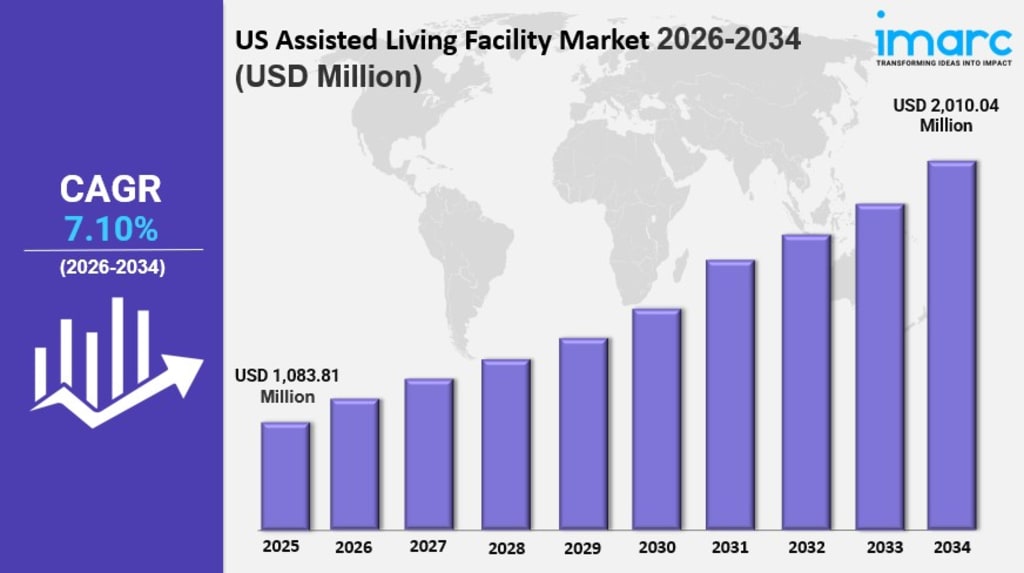
U.S. Assisted Living Facility Market Size, Share, and Forecast (2026–2034)
The U.S. assisted living facility market is witnessing steady growth due to increasing demand for long-term senior care services and changing healthcare needs among aging populations. The market reached USD 1,083.81 million in 2025 and is expected to reach USD 2,010.04 million by 2034, growing at a CAGR of 7.10% during 2026–2034.
Rising life expectancy and the growing population aged 85 and above are increasing demand for assisted living communities that provide personalized care, medical support, and daily living assistance. Families are also showing greater preference for community-based care solutions that balance independence with professional support.
Request a Sample Report with Latest 2026 Data & Forecasts:
Key Trends Shaping the U.S. Assisted Living Facility Market
• Growing focus on personalized care services: Assisted living facilities are expanding wellness programs, healthcare support, memory care, and lifestyle-based amenities.
• Increasing adoption of healthcare technologies: Digital monitoring systems, electronic health records, and remote patient management tools are improving operational efficiency and care quality.
• Shift toward community-based living environments: Residents and families are preferring home-like facilities that provide comfort, independence, and social engagement.
• Rising demand for memory care services: Increasing cases of dementia and Alzheimer’s disease are driving demand for specialized care units and dedicated support programs.
• Expansion of resident-centered care models: Operators are focusing on customized healthcare plans and improved daily living support services.
• Higher emphasis on safety and operational efficiency: Assisted living providers are investing in technologies, and facility upgrades to improve resident safety and healthcare management.
Growth Drivers in the U.S. Assisted Living Industry
The aging population remains the primary growth driver in the U.S. assisted living market. The growing number of older adults requiring long-term support services is increasing occupancy rates across assisted living facilities.
Changing family structures are also contributing to market growth. Many families are seeking professional care solutions for elderly relatives due to work commitments and the complexity of healthcare requirements.
Healthcare advancements are supporting longer life expectancy, which is increasing the need for senior care services over extended periods. This is encouraging investment in assisted living communities that can provide both healthcare assistance and lifestyle support.
Government initiatives promoting community-based care and partnerships with healthcare providers are also strengthening the market. Assisted living facilities are increasingly collaborating with healthcare organizations to improve patient outcomes and care coordination.
Additionally, growing awareness regarding quality senior care services is encouraging consumers to consider assisted living options earlier than in previous years.
Technology Adoption in the U.S. Assisted Living Facility Market
Technology is playing a larger role in improving both resident care and operational management within assisted living facilities. Providers are implementing digital systems to streamline communication, monitor patient health, and improve emergency response capabilities.
Remote health monitoring tools allow caregivers to track vital signs and health conditions more efficiently. These systems help reduce healthcare risks while improving resident safety and response times.
Artificial intelligence and data analytics are also being used to improve care planning and facility management. Predictive tools can help identify health risks, optimize staffing schedules, and improve operational efficiency.
Smart room technologies, automated lighting systems, and digital engagement platforms are enhancing resident comfort and convenience. Technology integration is becoming an important competitive factor for operators seeking to improve service quality and attract residents.
Challenges in the U.S. Assisted Living Industry: Staffing, Costs, and Regulatory Compliance
Despite strong growth potential, the assisted living industry faces several operational challenges. Staffing shortages remain one of the biggest concerns across the sector. Recruiting and retaining qualified caregivers, nurses, and healthcare staff continues to be difficult for many facility operators.
Rising labor costs are also affecting profitability. Wage increases, employee training requirements, and healthcare benefits are increasing operational expenses across the industry.
Regulatory compliance represents another challenge. Assisted living providers must comply with state-specific regulations related to resident safety, staffing standards, healthcare procedures, and facility operations. Managing these requirements can increase administrative complexity and operating costs.
In addition, inflation and rising healthcare expenses may affect affordability for residents and families. Operators must balance service quality with pricing strategies to remain competitive while maintaining occupancy levels.
Investment Opportunities in the U.S. Assisted Living Facility Market
The U.S. assisted living facility market presents long-term investment opportunities due to increasing demand for senior housing and healthcare support services. Investors are showing strong interest in facilities that combine healthcare services, lifestyle amenities, and technology-enabled care solutions.
Memory care communities and specialized senior care facilities are expected to see continued demand growth. Facilities that provide customized healthcare programs and wellness-focused services are attracting both residents and investors.
Technology integration also presents business opportunities across the market. Companies offering healthcare software, remote monitoring systems, and digital care management solutions are becoming important partners within the assisted living ecosystem.
Real estate investment in senior housing properties remains another key area of growth. Developers are focusing on modern communities designed to support aging populations while improving operational efficiency and resident experience.
As demand for long-term care services continues to increase, operators that focus on quality care, workforce management, and technology adoption are likely to strengthen their market position.
Competitive Landscape of the U.S. Assisted Living Industry
The U.S. assisted living market includes senior housing operators, healthcare service providers, real estate developers, and specialized care organizations competing across multiple care segments.
• Brookdale Senior Living – Operates assisted living and memory care communities across multiple U.S. states.
• Atria Senior Living – Focuses on senior living communities offering healthcare support and lifestyle services.
• Sunrise Senior Living – Provides assisted living, memory care, and personalized wellness programs.
• Five Star Senior Living – Offers senior housing and healthcare support services across residential communities.
• Holiday Retirement – Operates independent and assisted living communities focused on resident engagement and care support.
About the Creator
Kim Soo hyun
My name is Kim Soo hyun, and I am a research analyst at IMARC Group, specializing in market trends and data analysis to provide insights and support strategic decision-making.
Enjoyed the story? Support the Creator.
Subscribe for free to receive all their stories in your feed.
Comments
There are no comments for this story
Be the first to respond and start the conversation.