
Urea Market Remains Essential as Global Agriculture Faces Rising Food Demand
Growing pressure on food production, expanding agricultural activity, and industrial demand are keeping urea at the center of the global fertilizer and chemicals industry.

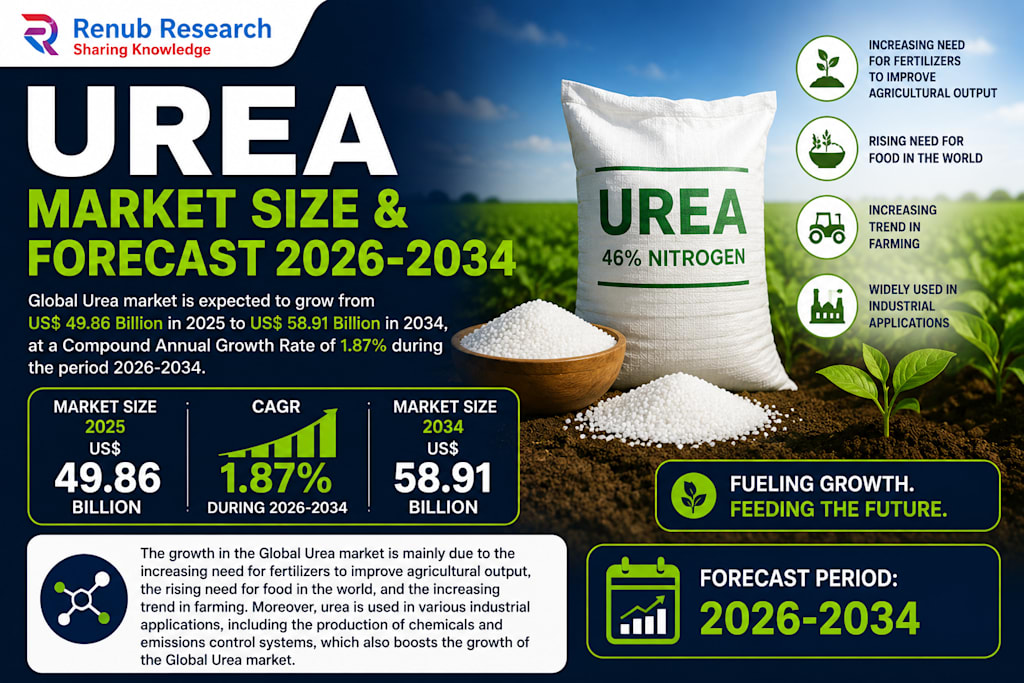
The global urea market continues to play a critical role in supporting agriculture, industrial production, and environmental management systems around the world. While many industries are undergoing rapid transformation, urea remains one of the most essential chemical compounds for maintaining global food production and industrial manufacturing. According to Renub Research, the global urea market is projected to increase from US$ 49.86 billion in 2025 to US$ 58.91 billion by 2034, expanding at a compound annual growth rate (CAGR) of 1.87% during 2026–2034. The market’s steady growth is being supported by increasing fertilizer demand, rising food consumption, expanding agricultural activity, and growing industrial applications such as chemical manufacturing and vehicle emission control systems.
Urea Continues to Be One of the World’s Most Important Fertilizers
Urea is a chemical compound composed of carbon, nitrogen, oxygen, and hydrogen, with the formula CO(NH2)2. It is widely recognized as one of the most commonly used nitrogen-based fertilizers because of its high nitrogen content, which is essential for plant growth and crop productivity. Urea is manufactured through the controlled reaction of ammonia and carbon dioxide. Once applied to soil, it breaks down and releases nitrogen, helping crops absorb nutrients more effectively.
Its importance in agriculture cannot be overstated. Farmers across the world rely heavily on urea fertilizers to improve soil fertility and increase yields for crops such as wheat, rice, corn, and vegetables. As the global population continues to rise, pressure on agricultural systems is intensifying, making fertilizers increasingly critical to ensuring food security.
Beyond agriculture, urea also serves as a raw material in industrial products including plastics, adhesives, resins, and diesel exhaust fluids used in vehicle emission control systems. Its versatility, affordability, and efficiency have helped establish urea as one of the world’s most widely utilized chemical compounds.
Rising Food Demand Is Strengthening the Need for Fertilizers
One of the strongest drivers behind the urea market is the increasing need to improve agricultural productivity. The world’s population is growing steadily, and with it comes higher demand for food production. Farmers are under increasing pressure to produce more crops using limited agricultural land, making efficient fertilizers like urea essential to modern farming practices.
Nitrogen plays a vital role in crop growth, and urea’s high nitrogen concentration makes it one of the most effective solutions available. Governments in many developing countries are actively supporting fertilizer adoption through subsidies and agricultural development programs to improve crop yields and strengthen food supply chains.
Global food demand is expected to rise sharply over the coming decades. Estimates suggest the world population could reach 9.7 billion by 2050, increasing pressure on agricultural systems already struggling with sustainability challenges. As intensive farming methods expand globally, nitrogen-based fertilizers such as urea are expected to remain indispensable to food production.
Expansion of Agriculture Is Fueling Market Growth
The ongoing expansion of agricultural activity across different regions is another important factor supporting the urea market. Many countries are investing heavily in irrigation systems, mechanized farming, precision agriculture, and advanced crop technologies to improve productivity. These investments naturally increase demand for fertilizers capable of supporting large-scale cultivation.
Urea remains one of the most widely used fertilizers because it is cost-effective, widely available, and highly efficient in delivering nitrogen to crops. Commercial farming activities, especially in developing economies, are increasing the importance of fertilizer usage as farmers seek to maximize yields and profitability.
According to the Food and Agriculture Organization (FAO), agriculture remains a major contributor to economic activity in many countries. Approximately 67% of the global population is engaged in agricultural activities in some form, while agricultural products continue to represent a major share of exports and GDP contributions in many developing economies.
As countries continue modernizing agricultural systems, fertilizers like urea are expected to remain central to boosting productivity and ensuring long-term food security.
Industrial Applications Are Expanding Beyond Agriculture
While agriculture remains the dominant segment, industrial applications are becoming increasingly important for the global urea market. Urea serves as a critical raw material in the production of chemical products including plastics, laminates, adhesives, and resins. Urea-formaldehyde resins, for example, are widely used in plywood and furniture manufacturing.
Another rapidly growing industrial use involves diesel exhaust fluid (DEF), which helps reduce nitrogen oxide emissions from diesel-powered vehicles through selective catalytic reduction systems. As environmental regulations become stricter around the world, demand for emission-control solutions is rising steadily, creating additional opportunities for urea manufacturers.
Industrial investments are also expanding production capacity in key regions. In February 2025, India announced plans to establish a new urea manufacturing unit in Assam with an annual production capacity of 1.27 million tonnes. This reflects both rising domestic demand and strategic efforts to strengthen fertilizer production capabilities.
Environmental Concerns Are Becoming a Major Challenge
Despite its importance, the urea market faces increasing scrutiny because of environmental concerns associated with fertilizer usage. Excessive application of urea-based fertilizers can contribute to water pollution and greenhouse gas emissions, raising concerns among environmental organizations and policymakers.
As sustainability becomes a larger global priority, governments are introducing stricter regulations aimed at reducing environmental damage linked to agricultural chemicals. These regulations could impact fertilizer consumption patterns in the future and encourage more efficient fertilizer management practices.
The challenge for the industry will be balancing agricultural productivity with environmental responsibility. Fertilizer manufacturers and agricultural sectors are increasingly exploring methods such as precision farming, controlled fertilizer application, and sustainable nutrient management to reduce environmental impact while maintaining crop yields.
Volatile Raw Material Prices Continue to Pressure Manufacturers
Another major challenge facing the urea industry is volatility in raw material costs. Urea production depends heavily on ammonia, which itself is produced using natural gas. As a result, fluctuations in natural gas prices can significantly affect manufacturing costs and profit margins for urea producers.
When energy prices rise, fertilizer production becomes more expensive, potentially increasing prices for farmers. In price-sensitive agricultural markets, higher fertilizer costs can reduce purchasing volumes and impact overall market growth.
This dependence on energy markets makes the urea industry particularly vulnerable to geopolitical tensions, supply disruptions, and fluctuations in global commodity pricing.
Fertilizer Urea Remains the Largest Market Segment
The fertilizer-grade urea segment continues to dominate the global market because of its extensive use in crop cultivation. Farmers rely on fertilizer urea to improve productivity across a wide variety of crops including wheat, rice, corn, and vegetables.
Its high nitrogen concentration, ease of transportation, and affordability have made urea one of the most preferred fertilizers globally. Government support programs in many countries further strengthen demand by subsidizing fertilizer purchases and encouraging agricultural productivity.
As food demand continues rising worldwide, fertilizer-grade urea is expected to remain the foundation of the global urea industry.
Feed Urea Is Supporting Livestock Production
The feed urea segment is another growing area of the market. Feed-grade urea is used as a nitrogen supplement for ruminant animals such as cattle, sheep, and goats. Microbes within the rumen convert urea into protein, supporting animal growth and milk production.
Feed urea offers livestock producers a cost-effective alternative to traditional protein supplements, particularly in regions where protein-rich feed ingredients are expensive. However, proper formulation and dosage management are critical because excessive urea intake can be harmful to animals.
As global demand for meat and dairy products increases, feed urea is expected to play a more important role in supporting efficient livestock production systems.
Chemical Synthesis Applications Continue to Grow
Urea’s role in chemical manufacturing remains highly significant. The chemical synthesis segment uses urea as a raw material for producing resins, laminates, plastics, adhesives, and industrial chemicals.
The construction and furniture industries are particularly important consumers of urea-based resins and wood products. At the same time, growing adoption of diesel exhaust fluids for emission reduction systems is further increasing industrial demand.
As industrial production and environmental compliance systems expand globally, chemical synthesis applications are expected to remain an important growth area for the market.
Regional Markets Continue to Evolve
The United States urea market remains heavily influenced by both agriculture and industrial demand. American farmers rely on nitrogen fertilizers for large-scale cultivation of crops such as corn, soybeans, and wheat, while industrial sectors continue using urea in plastics, resins, and diesel exhaust fluids. Environmental regulations aimed at reducing vehicle emissions are also supporting additional demand for DEF products.
The United Kingdom urea market is driven by both agricultural productivity and industrial applications. Farmers use urea to improve crop yields for products such as wheat and barley, while industries utilize urea for manufacturing adhesives, plastics, and emission-control products. Sustainable agriculture initiatives are also shaping the market’s future direction.
India represents one of the world’s largest urea markets because of the country’s strong agricultural dependence and massive population. Government fertilizer subsidies continue to play a critical role in ensuring accessibility for farmers. India is also investing heavily in expanding domestic urea production capacity to reduce import dependence. Under the country’s New Investment Policy, several large-scale urea plants have already been established or approved.
Saudi Arabia maintains a dominant position in the global urea industry because of its strong petrochemical sector and abundant natural gas resources used in ammonia production. The country exports significant quantities of urea worldwide while also supplying domestic agriculture and industrial sectors.
Competition and Global Expansion Continue
The global urea market includes major multinational companies competing across fertilizer production, industrial chemicals, and petrochemical applications. Key companies covered in the market analysis include BASF SE, Petrobras, SABIC, Bunge Limited, Nutrien Ltd., Sasol, and CF Industries Holdings, Inc.
Competition is centered around production efficiency, raw material access, sustainability initiatives, and expanding manufacturing capacity in high-demand regions.
Final Thoughts
The global urea market may not be the fastest-growing chemical industry, but it remains one of the most essential. Its role in supporting agriculture, food production, industrial manufacturing, and emission-control systems ensures continued global relevance. Rising population levels, expanding farming activities, and industrial demand will continue supporting steady market growth over the coming decade.
At the same time, the industry faces growing pressure to improve sustainability and manage environmental concerns related to fertilizer usage and emissions. The future of the urea market will likely depend on how effectively producers balance productivity, affordability, and environmental responsibility.
With the market expected to approach US$ 58.91 billion by 2034, urea will remain deeply connected to the global challenge of feeding populations, supporting industries, and adapting to a more sustainability-focused world economy.
About the Creator
Enjoyed the story? Support the Creator.
Subscribe for free to receive all their stories in your feed.
Comments
There are no comments for this story
Be the first to respond and start the conversation.