
Urea Market Growth Continues as Rising Global Food Demand Strengthens Agricultural Productivity
Increasing fertilizer consumption, expanding agricultural activities, and growing industrial applications are supporting steady growth in the global urea industry.

As the global population continues to expand, ensuring adequate food production has become one of the most important challenges facing governments, farmers, and agricultural organizations worldwide. Limited arable land, changing climate conditions, and increasing food consumption are placing significant pressure on agricultural systems to improve productivity and efficiency.
At the center of this effort is urea, one of the most widely used nitrogen-based fertilizers in the world. For decades, urea has played a critical role in supporting crop growth, enhancing soil fertility, and improving agricultural yields. Beyond agriculture, urea has also become an important raw material in various industrial applications, including chemical manufacturing, resins, plastics, adhesives, and emission control systems.
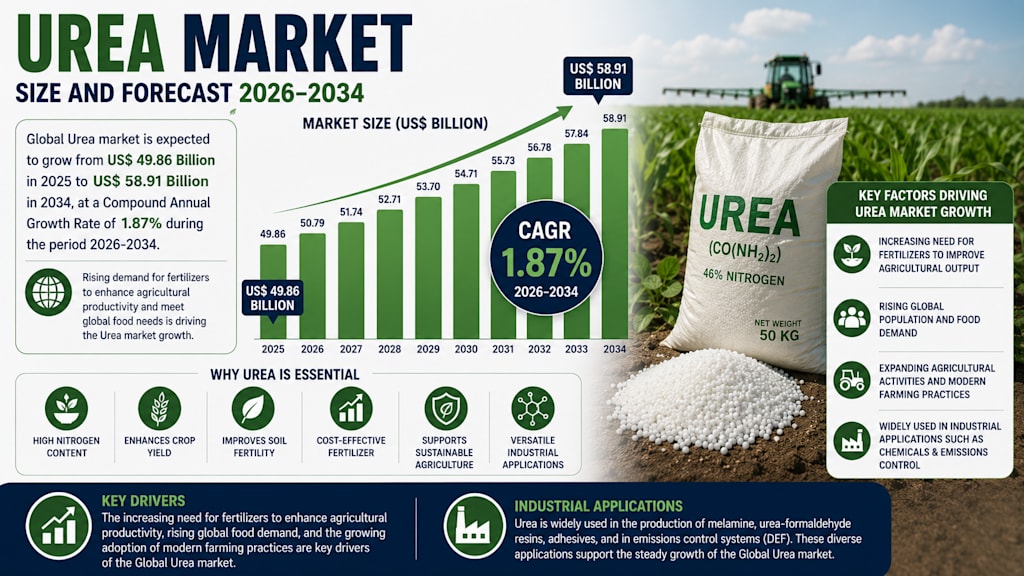
The growing need for food security, modern farming practices, and industrial development is creating stable opportunities for market expansion. According to Renub Research, the global Urea Market is expected to increase from US$ 49.86 billion in 2025 to US$ 58.91 billion by 2034, growing at a compound annual growth rate (CAGR) of 1.87% between 2026 and 2034. This growth reflects the continued importance of urea across both agricultural and industrial sectors worldwide.
Urea Remains Essential to Modern Agriculture
Urea is a nitrogen-rich chemical compound with the formula CO(NH₂)₂. Produced through the reaction of ammonia and carbon dioxide under controlled conditions, urea is valued primarily for its high nitrogen content, which is essential for plant growth and crop development.
When applied to soil, urea breaks down and releases nitrogen, providing plants with one of the most important nutrients required for healthy growth. This process helps improve soil fertility and supports higher agricultural productivity.
Farmers across the world rely on urea to cultivate major crops such as rice, wheat, corn, barley, sugarcane, vegetables, and various other agricultural products. Its effectiveness, affordability, and widespread availability have made it one of the most commonly used fertilizers in modern farming.
As global food production requirements continue increasing, urea remains a cornerstone of agricultural productivity and food security strategies.
Rising Food Demand Is Driving Market Growth
One of the primary factors supporting the growth of the urea market is the increasing global demand for food.
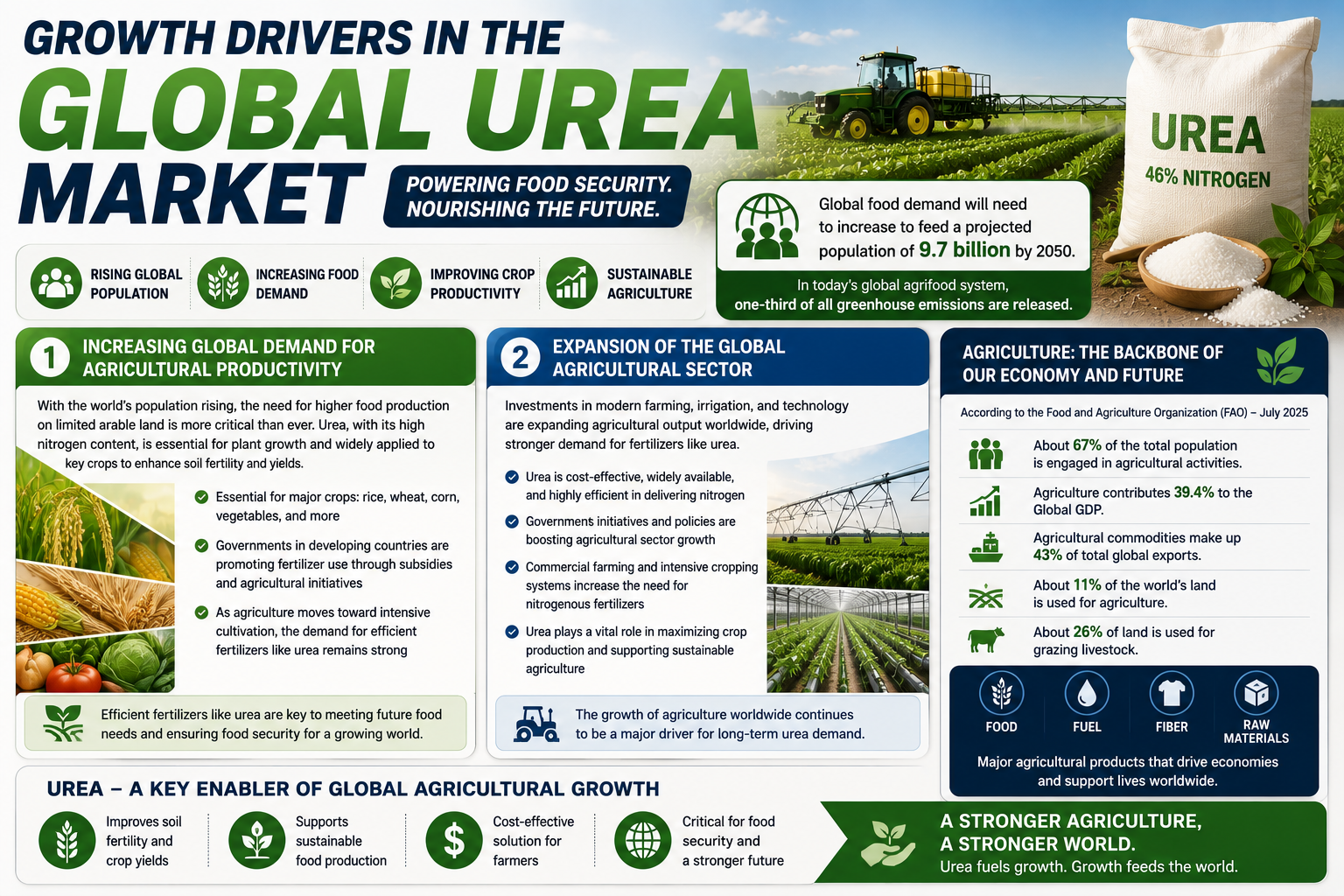
The world's population continues to expand rapidly, creating pressure on agricultural systems to produce more food using limited land resources. According to international projections, the global population could approach 9.7 billion people by 2050, significantly increasing the need for efficient agricultural practices and higher crop yields.
Farmers must maximize productivity from existing farmland while maintaining soil health and sustainability. Nitrogen-based fertilizers such as urea play a critical role in achieving these objectives because they provide essential nutrients that support plant growth.
Major agricultural economies continue investing heavily in crop productivity improvements to meet growing domestic and international food demand. This ongoing emphasis on agricultural efficiency is expected to sustain strong demand for urea throughout the forecast period.
Agricultural Expansion Continues to Support Demand
The continued expansion of agricultural activities across both developed and developing countries represents another important growth driver for the urea market.
Governments worldwide are investing in irrigation systems, modern farming technologies, mechanization, and agricultural infrastructure to improve productivity and strengthen food security. These investments often increase fertilizer usage because intensive farming practices require greater nutrient management.
Commercial farming operations, in particular, rely heavily on fertilizers to maximize output and maintain consistent crop quality. Urea remains one of the preferred fertilizer choices due to its effectiveness and relatively low cost compared to alternative nutrient sources.
In many developing economies, government subsidy programs help make fertilizers more accessible to farmers, further encouraging adoption. These initiatives continue to strengthen demand for urea across global agricultural markets.
Industrial Applications Are Expanding Market Opportunities
Although agriculture remains the dominant application area, industrial demand for urea is also contributing significantly to market growth.
Urea serves as a key raw material in the production of numerous industrial products, including adhesives, resins, plastics, laminates, and specialty chemicals. One of its most important industrial applications involves the production of urea-formaldehyde resins, which are widely used in wood products such as plywood, particleboard, and fiberboard.
The construction and furniture industries rely heavily on these materials, creating consistent demand for urea-based chemical products. As global industrial activity continues to expand, the need for chemical intermediates derived from urea is expected to remain strong.
Industrial diversification is helping reduce dependence on agricultural demand alone, creating a broader and more resilient market foundation.
Environmental Regulations Are Increasing Demand for Diesel Exhaust Fluid
Environmental sustainability initiatives are creating new opportunities for the urea market through emission control technologies.
Urea is a critical component in diesel exhaust fluid (DEF), a solution used in selective catalytic reduction (SCR) systems to reduce nitrogen oxide emissions from diesel-powered vehicles. As governments worldwide implement stricter environmental regulations, demand for emission-reduction technologies continues increasing.
SCR systems have become standard components in many commercial vehicles, trucks, buses, and industrial equipment. These systems rely on urea-based solutions to convert harmful pollutants into less harmful substances before they are released into the atmosphere.
The global push toward cleaner transportation and industrial operations is expected to support continued growth in urea consumption for emission control applications.
Fertilizer Grade Urea Dominates the Market
Among the various product categories, fertilizer-grade urea represents the largest segment of the global market.
Its widespread use in agriculture stems from its high nitrogen concentration, ease of storage, transportation efficiency, and compatibility with diverse farming systems. Fertilizer-grade urea supports crop production across both large-scale commercial operations and smallholder farms.
Governments frequently encourage fertilizer usage through agricultural support programs aimed at improving food production and rural development. These initiatives contribute significantly to the sustained demand for fertilizer-grade products.
As agricultural productivity remains a global priority, fertilizer-grade urea is expected to maintain its dominant position within the market.
Agriculture Remains the Largest Application Segment
The agriculture sector continues to account for the majority of global urea consumption.
Farmers apply urea at various stages of crop development to support root formation, leaf growth, and overall plant health. Its ability to provide readily available nitrogen makes it an essential component of modern nutrient management strategies.
Both commercial and small-scale farming operations depend on urea to achieve optimal crop yields. The product's affordability and effectiveness have made it a preferred fertilizer choice across diverse agricultural environments.
As food demand increases and governments prioritize agricultural development, the agriculture segment is expected to remain the primary driver of urea market growth.
Feed Urea Supports Livestock Production
Feed urea represents another important segment of the global market.
In livestock production, particularly for ruminant animals such as cattle, sheep, and goats, urea serves as a non-protein nitrogen source. Microorganisms within the rumen convert urea into protein, helping support animal growth and productivity.
Feed manufacturers often utilize urea as a cost-effective alternative to conventional protein sources, especially when feed costs are elevated. Proper formulation is essential to ensure safe and effective usage.
As global demand for meat, dairy products, and livestock production continues increasing, feed urea is expected to maintain steady market growth.
Chemical Synthesis Applications Continue Expanding
The chemical synthesis segment represents a valuable source of market diversification.
Urea serves as an essential ingredient in manufacturing resins, adhesives, laminates, melamine-based products, and other industrial chemicals. These materials are widely used across construction, furniture manufacturing, automotive production, and consumer goods industries.
The continued growth of manufacturing activity worldwide supports increasing demand for urea-derived chemical products. Industrial users value urea because of its versatility, availability, and compatibility with various production processes.
As global industrialization continues advancing, chemical synthesis applications are expected to remain an important contributor to market expansion.
Regional Markets Continue Driving Growth
United States
The United States remains one of the world's largest consumers of urea due to its extensive agricultural sector. Farmers rely heavily on nitrogen fertilizers to support crops such as corn, wheat, soybeans, and other staple commodities. Industrial applications and diesel exhaust fluid production also contribute significantly to market demand.
United Kingdom
The United Kingdom continues to utilize urea extensively within both agriculture and industrial sectors. Demand is supported by crop production activities, environmental sustainability initiatives, and the growing use of emission-control technologies.
India
India represents one of the largest urea markets globally due to its vast agricultural economy. Government fertilizer subsidies, food security initiatives, and expanding crop production activities continue supporting robust demand. Investments in domestic production facilities are also strengthening supply capabilities.
Saudi Arabia
Saudi Arabia plays a major role in global urea production and exports. The country's abundant natural gas resources provide a competitive advantage in ammonia and urea manufacturing. Strong petrochemical infrastructure supports continued market leadership within the region.
Challenges Facing the Market
Despite stable growth prospects, the urea market faces several challenges.
Environmental concerns regarding fertilizer usage have become increasingly important. Excessive fertilizer application can contribute to water pollution, soil degradation, and greenhouse gas emissions. As environmental awareness grows, governments may introduce stricter regulations governing fertilizer usage.
Another major challenge involves volatility in natural gas prices. Because natural gas is a critical feedstock for ammonia production, fluctuations in energy prices directly affect urea manufacturing costs. Rising production expenses can impact profitability and influence purchasing decisions throughout the agricultural sector.
Addressing these challenges will require continued innovation in fertilizer efficiency, sustainable agriculture practices, and production technologies.
Market Forecast: Steady Growth Through 2034
According to Renub Research, the global Urea Market is expected to increase from US$ 49.86 billion in 2025 to US$ 58.91 billion by 2034, reflecting a CAGR of 1.87% between 2026 and 2034. Growth will be supported by rising agricultural productivity requirements, expanding food demand, increasing industrial applications, and continued investments in farming modernization.
Although growth is expected to be moderate compared to some emerging industries, urea will remain a strategically important product for global food production and industrial development.
Final Thoughts
The global urea market continues to play a vital role in supporting agricultural productivity, food security, and industrial manufacturing. As populations grow and demand for agricultural output increases, urea remains one of the most essential inputs in modern farming systems.
With Renub Research forecasting market growth from US$ 49.86 billion in 2025 to US$ 58.91 billion by 2034, the industry is positioned for steady expansion. Advances in agricultural practices, industrial production, and emission control technologies will continue supporting demand across multiple sectors.
While environmental concerns and raw material price volatility present ongoing challenges, urea's importance in feeding the world's growing population ensures that it will remain a fundamental component of the global economy for years to come.
About the Creator
Enjoyed the story? Support the Creator.
Subscribe for free to receive all their stories in your feed.
Comments
There are no comments for this story
Be the first to respond and start the conversation.