
United States Vitiligo Market Set to Reach US$ 320.71 Million by 2033 as Advanced Therapies Transform Patient Care
Growing Awareness, Breakthrough Treatments, and Expanding Access to Dermatology Services Fuel Market Growth Across the United States

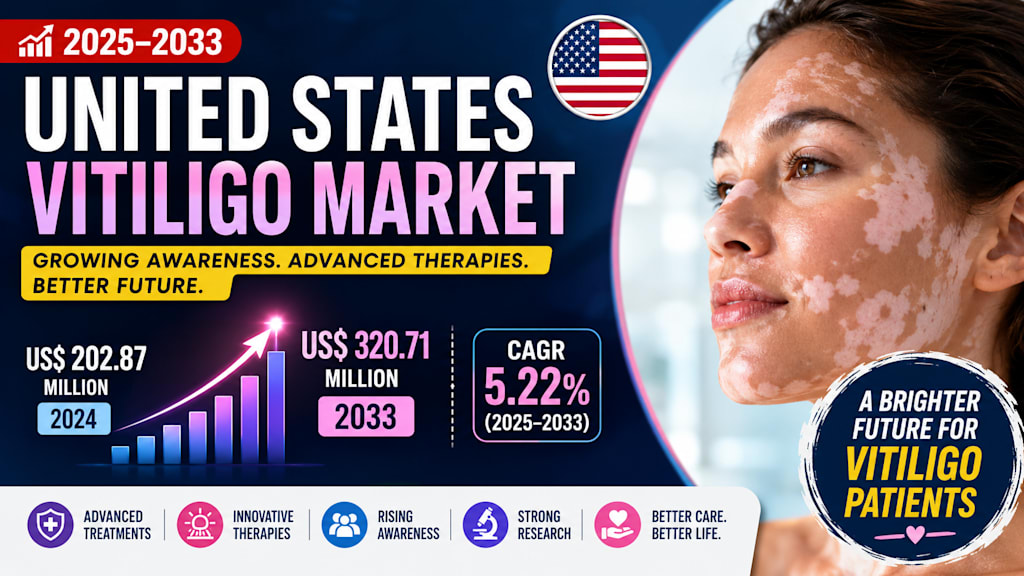
United States Vitiligo Market Outlook 2025–2033
The United States vitiligo market is entering a transformative phase as advancements in dermatological science continue to reshape treatment possibilities for millions of patients. According to Renub Research, the United States Vitiligo Market is projected to grow from US$ 202.87 million in 2024 to US$ 320.71 million by 2033, expanding at a CAGR of 5.22% during 2025–2033.
Vitiligo is a chronic autoimmune skin condition characterized by the loss of melanocytes, the cells responsible for skin pigmentation. The resulting white patches can appear anywhere on the body and often affect patients beyond physical symptoms, impacting emotional well-being, confidence, and quality of life.
For years, treatment options remained limited, with patients relying primarily on topical corticosteroids and light therapy. However, the market landscape has changed significantly due to breakthroughs in immunology, biologics, targeted therapies, and advanced phototherapy technologies. Increased public awareness and stronger patient advocacy have further accelerated diagnosis and treatment adoption.
As healthcare providers, pharmaceutical companies, and researchers continue investing in innovative therapies, the U.S. vitiligo market is expected to witness sustained growth throughout the forecast period.
Understanding Vitiligo and Its Rising Healthcare Importance
Vitiligo affects people of all ages, ethnicities, and genders. Although not physically painful in most cases, the condition often carries a substantial psychological burden. Visible depigmentation can contribute to anxiety, depression, low self-esteem, and social isolation.
The growing recognition of these challenges has encouraged healthcare systems to treat vitiligo as more than a cosmetic issue. Dermatologists increasingly emphasize comprehensive treatment plans that address both physical symptoms and emotional well-being.
In recent years, awareness campaigns conducted by healthcare organizations, advocacy groups, and social media influencers have significantly improved public understanding of vitiligo. Patients are now more likely to seek medical consultation early, leading to improved treatment outcomes and greater demand for effective therapies.
Market Growth Driven by Breakthrough Treatment Technologies
One of the strongest drivers of the U.S. vitiligo market is the rapid advancement of treatment technologies.
Traditional treatment approaches focused primarily on slowing disease progression and restoring pigmentation through topical medications and ultraviolet light therapy. While effective for many patients, these methods often required lengthy treatment durations and produced variable outcomes.
Today, innovative therapies are creating new opportunities for both patients and healthcare providers.
JAK Inhibitors Revolutionizing Treatment
The emergence of Janus Kinase (JAK) inhibitors represents one of the most significant developments in vitiligo treatment. These targeted therapies address underlying immune pathways responsible for melanocyte destruction.
Clinical studies have demonstrated encouraging repigmentation outcomes, particularly in patients with non-segmental vitiligo. As additional research validates long-term effectiveness and safety, JAK inhibitors are expected to become a major component of treatment protocols.
Advanced Phototherapy Solutions
Phototherapy continues to play a critical role in vitiligo management. Technological improvements, particularly excimer laser systems, have enhanced treatment precision and effectiveness.
Localized vitiligo lesions can now be treated more efficiently, reducing exposure to surrounding healthy skin while improving pigmentation recovery. Clinical evidence indicates substantial repigmentation benefits for many patients receiving targeted phototherapy treatments.
Personalized Medicine Approaches
Personalized treatment strategies are gaining momentum within dermatology. By evaluating genetic, immunological, and clinical factors, healthcare providers can tailor treatment regimens to individual patients.
This shift toward precision medicine is expected to improve treatment outcomes while increasing patient satisfaction and adherence.
Growing Prevalence of Autoimmune Disorders Supporting Market Expansion
Vitiligo is widely recognized as an autoimmune condition, placing it within a broader category of immune-mediated diseases that continue to increase across the United States.
The rising prevalence of autoimmune disorders has generated greater scientific interest in understanding immune system dysfunction and its relationship to skin diseases. Increased research funding and collaborative initiatives have accelerated discoveries related to vitiligo pathogenesis.
Organizations focused on autoimmune disease awareness continue to educate healthcare professionals and the public about the links between immune disorders and skin health. As awareness grows, more patients are seeking evaluation for symptoms that may have previously gone undiagnosed.
The result is a larger diagnosed patient population and increased demand for effective treatment options, contributing directly to market growth.
Public Awareness Campaigns Driving Earlier Diagnosis
Awareness has become one of the most powerful catalysts in the evolution of the vitiligo treatment market.
Historically, many individuals with vitiligo delayed seeking treatment due to limited knowledge about available therapies. Today, public education campaigns are changing that dynamic.
Social media platforms have played an especially important role by highlighting personal stories, reducing stigma, and encouraging conversations around skin diversity. Influential public figures and patient advocates have helped normalize discussions surrounding vitiligo and treatment options.
Healthcare organizations have also expanded educational outreach initiatives, promoting earlier diagnosis and intervention. As more individuals become aware that effective treatments exist, demand for dermatological services continues to rise.
This growing awareness is expected to remain a major market driver throughout the forecast period.
Challenges Limiting Market Growth
Despite promising opportunities, the U.S. vitiligo market continues to face several significant challenges.
Lack of Curative Treatments
Perhaps the most notable limitation is the absence of a definitive cure.
Current therapies primarily focus on restoring pigmentation, reducing disease activity, and improving cosmetic appearance. While many patients experience positive results, treatment responses vary considerably.
The chronic nature of vitiligo often requires long-term management, which can become burdensome for patients. Treatment fatigue and inconsistent outcomes may reduce adherence and limit overall effectiveness.
Consequently, researchers remain focused on identifying therapies capable of delivering more predictable and durable results.
High Treatment Costs
The cost of advanced treatments presents another major barrier.
Innovative therapies, particularly biologics and JAK inhibitors, can be expensive. Many patients face substantial out-of-pocket expenses, especially when insurance coverage is limited or inconsistent.
Access disparities are particularly evident among underserved populations, where financial barriers may delay diagnosis or treatment initiation.
Improving affordability and expanding reimbursement coverage will be essential for maximizing market potential and ensuring equitable patient access.
Disease Type Analysis
Non-Segmental Vitiligo Dominates the Market
Non-segmental vitiligo represents the largest segment within the United States market.
This form typically affects both sides of the body symmetrically and accounts for the majority of diagnosed cases. Because it is more widespread and often progressive, patients frequently require long-term treatment and ongoing monitoring.
The growing availability of targeted therapies has significantly enhanced treatment prospects for individuals with non-segmental vitiligo.
Segmental Vitiligo Maintains Specialized Demand
Segmental vitiligo affects specific areas of the body and generally progresses differently than non-segmental forms.
Although less common, this segment continues to generate demand for specialized treatment approaches, including surgical interventions and targeted phototherapy.
Treatment Type Analysis
Topical Treatments Remain Widely Used
Topical corticosteroids and calcineurin inhibitors continue to serve as first-line treatment options for many patients.
These therapies are often prescribed during the early stages of disease and remain important components of comprehensive treatment plans.
Light Therapy Experiencing Strong Growth
Phototherapy is increasingly recognized as an effective solution for promoting repigmentation.
Advances in ultraviolet treatment technologies have improved both convenience and efficacy, contributing to strong adoption across dermatology clinics nationwide.
Surgical Procedures for Select Cases
For stable vitiligo cases that do not respond adequately to medical therapy, surgical procedures such as skin grafting and melanocyte transplantation offer additional treatment possibilities.
Although representing a smaller market segment, these procedures continue to gain attention among specialized providers.
End User Analysis
Hospitals Lead Treatment Delivery
Hospitals remain the primary end users within the vitiligo treatment market.
Comprehensive dermatology departments, multidisciplinary care teams, and access to advanced technologies position hospitals as major providers of vitiligo care.
Ambulatory Clinics Expanding Rapidly
Ambulatory dermatology clinics are becoming increasingly important due to convenience, accessibility, and shorter waiting times.
Many clinics now offer advanced phototherapy equipment and specialized treatment programs, supporting market expansion outside traditional hospital settings.
State-Level Market Insights
California
California remains the largest regional market due to its substantial population, advanced healthcare infrastructure, and strong concentration of dermatology specialists.
The state's leadership in biotechnology research and pharmaceutical innovation further strengthens its position within the national vitiligo market.
Texas
Texas continues to emerge as a major growth center, supported by expanding healthcare access, rising awareness, and increasing availability of advanced dermatological services.
Telemedicine initiatives are helping extend specialist care to underserved rural communities.
New York
New York's extensive research ecosystem and highly developed healthcare network make it one of the country's most influential markets for vitiligo treatment innovation.
The state also benefits from active patient advocacy programs and robust clinical trial activity.
Florida
Florida's growing population and strong healthcare infrastructure are contributing to rising treatment demand.
Increasing awareness, favorable access to dermatology services, and a large aging population support continued market growth.
Competitive Landscape
Competition within the United States vitiligo market is intensifying as pharmaceutical companies invest heavily in research, development, and commercialization of innovative therapies.
Key market participants are focusing on clinical trials, regulatory approvals, strategic collaborations, and product portfolio expansion to strengthen their competitive positions.
Major companies operating in the market include:
Incyte Corporation
Bristol Myers Squibb
Clinuvel Pharmaceuticals
Astellas Pharma Inc.
Baxter International Inc.
Pfizer
Dr. Reddy's Laboratories
10 Recent Developments Shaping the Vitiligo Industry
1. Incyte Expands Opzelura Commercialization
Incyte continues expanding access to Opzelura (ruxolitinib cream), one of the most significant recent innovations in vitiligo treatment.
2. Increased Investment in JAK Inhibitor Research
Multiple pharmaceutical companies have intensified clinical research efforts targeting immune pathways associated with vitiligo.
3. Growth in Combination Therapy Studies
Researchers are increasingly evaluating combinations of topical therapies and phototherapy to improve treatment outcomes.
4. Expansion of Teledermatology Services
Virtual dermatology consultations are improving patient access to vitiligo diagnosis and management across rural America.
5. Rising Clinical Trial Activity
The number of clinical studies focused on autoimmune skin disorders continues to increase throughout the United States.
6. Clinuvel Advances Photomedicine Research
Clinuvel Pharmaceuticals remains focused on innovative approaches involving photoprotection and pigment restoration.
7. Personalized Dermatology Programs Gain Momentum
Healthcare providers are increasingly implementing individualized treatment protocols based on patient-specific disease characteristics.
8. Pharmaceutical Collaborations Accelerate Innovation
Strategic partnerships between biotechnology firms and research institutions are supporting faster therapy development.
9. Enhanced Patient Advocacy Initiatives
National advocacy organizations continue promoting education, awareness, and treatment accessibility for vitiligo patients.
10. Growing Insurance Discussions Around Advanced Therapies
Healthcare stakeholders are actively working toward broader reimbursement coverage for newer treatment options, including targeted immunotherapies.
Final Thoughts
The United States vitiligo market is experiencing a period of meaningful transformation driven by scientific innovation, increasing awareness, and improved access to specialized dermatological care. With the market forecast to rise from US$ 202.87 million in 2024 to US$ 320.71 million by 2033, stakeholders across the healthcare ecosystem have significant opportunities to contribute to future growth.
Although challenges related to treatment affordability and the lack of curative therapies remain, ongoing advancements in JAK inhibitors, biologics, phototherapy, and personalized medicine are steadily reshaping the treatment landscape. As research continues and awareness expands, patients are expected to benefit from more effective, accessible, and targeted solutions than ever before.
The coming decade may prove pivotal for vitiligo care in the United States, marking a transition from symptom management toward increasingly precise and patient-centered treatment approaches.
About the Creator
Enjoyed the story? Support the Creator.
Subscribe for free to receive all their stories in your feed.
Comments
There are no comments for this story
Be the first to respond and start the conversation.