
United States Video Game Market 2026–2034: Gaming Becomes a Dominant Entertainment Economy
Explosive growth in online gaming, cloud platforms, and immersive technologies is redefining how Americans play, connect, and spend.

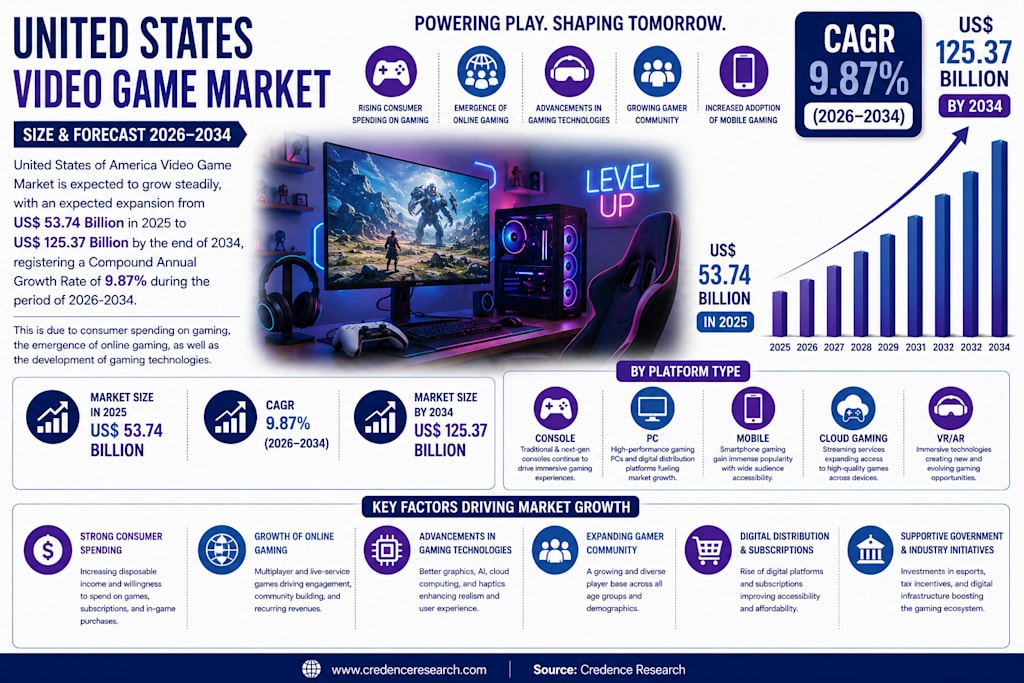
United States Video Game Market: From Hobby to Mainstream Economy
The video game industry in the United States is no longer just entertainment—it is a powerful economic force shaping digital culture, social interaction, and consumer spending. According to Renub Research, the United States Video Game Market is projected to grow from US$ 53.74 billion in 2025 to US$ 125.37 billion by 2034, expanding at a CAGR of 9.87% from 2026 to 2034.
This strong growth reflects the increasing integration of gaming into everyday life. From mobile games to console experiences and cloud-based platforms, gaming has become a central part of how people relax, compete, and connect.
What Defines the Modern Video Game Market
Video games are interactive digital experiences played on devices such as consoles, personal computers, smartphones, and tablets.
They span multiple genres, including:
- Action and adventure
- Sports and racing
- Role-playing games (RPGs)
- Simulation and strategy
- Casual and mobile games
Advancements in graphics, sound, and gameplay mechanics have transformed video games into highly immersive experiences. Continuous updates, downloadable content, and online features keep players engaged over long periods.
Key Growth Drivers Fueling the Market
Strong Consumer Spending and Multi-Platform Adoption
One of the biggest drivers of growth is the high level of consumer spending on gaming. A large portion of the U.S. population actively engages with video games, making it one of the largest gaming markets globally.
Key trends include:
- Multi-platform gaming across consoles, PCs, and mobile devices
- Increased digital purchases and subscriptions
- Growing acceptance of gaming as a mainstream activity
Gaming is no longer limited to a niche audience—it spans all age groups and demographics, driving sustained market expansion.
Expansion of Online Multiplayer, Esports, and Live Streaming
Online gaming has transformed video games into social and competitive experiences. Players can now interact with others globally, participate in tournaments, and watch live streams.
Esports and live streaming are particularly important growth drivers, creating new revenue streams through:
- Advertising
- Sponsorships
- Subscriptions
- In-game purchases
Major gaming events and streaming platforms have turned gaming into a spectator sport, further boosting engagement and visibility.
Technological Innovation and Cloud Gaming
Technological advancements continue to push the boundaries of gaming. Improvements in graphics, artificial intelligence, and game engines are enhancing realism and immersion.
Cloud gaming is one of the most transformative trends, allowing players to stream games without the need for expensive hardware. This increases accessibility and expands the potential audience.
Additionally, emerging technologies such as virtual reality (VR) and augmented reality (AR) are creating new gaming experiences that blend physical and digital worlds.
Market Segments Driving Growth
Cloud Gaming: The Future of Accessibility
Cloud gaming is rapidly gaining traction as it enables users to play high-quality games on various devices, including smartphones and smart TVs.
This model reduces hardware barriers and makes gaming more accessible to a broader audience.
Live Streaming and Esports
Live gaming and esports are reshaping the entertainment landscape. Players and viewers engage in real-time, creating interactive experiences that drive both engagement and revenue.
This segment is expected to continue growing as gaming becomes more integrated with social media and digital content platforms.
Mobile Gaming: Expanding the Player Base
Mobile gaming remains one of the fastest-growing segments, driven by smartphone adoption and easy accessibility.
Casual gamers and new users are entering the market through mobile platforms, expanding the overall player base.
Regional Insights: Key U.S. Gaming Hubs
California: Innovation and Industry Leadership
California is a major hub for the video game industry, with a strong presence of game developers, publishers, and esports organizations.
The state’s advanced technology ecosystem and high consumer spending make it a leading market for gaming innovation.
Texas: Rapid Growth and Community Engagement
Texas is emerging as a key gaming market, supported by a large player base and growing gaming communities.
Cities like Austin, Dallas, and Houston host gaming events, development studios, and esports activities.
New York: Digital and Social Gaming Culture
New York’s gaming market is driven by its dense population and digital connectivity. Players favor online multiplayer games, streaming platforms, and subscription-based services.
Washington: Technology-Driven Growth
Washington State benefits from a strong tech ecosystem, supporting innovation in cloud gaming, game development, and online platforms.
Challenges Facing the Market
Rising Development Costs and Market Saturation
Developing modern video games requires significant investment in technology, talent, and marketing.
The increasing cost of production makes it difficult for smaller developers to compete, while market saturation adds pressure to create standout titles.
Regulatory and Player Wellbeing Concerns
Issues such as gaming addiction, data privacy, and in-game spending are attracting regulatory attention.
Companies must balance innovation with responsible gaming practices to maintain consumer trust and comply with regulations.
Competitive Landscape
The U.S. video game market includes major players such as Activision Blizzard, Electronic Arts, Microsoft, Nintendo, Take-Two Interactive, Sony, Apple, and Bandai Namco Holdings.
These companies are focusing on:
- Game development and innovation
- Expansion of online services
- Cloud gaming platforms
- Strategic partnerships and acquisitions
Final Thoughts
The United States video game market is evolving into a dominant force in the global entertainment industry. With projections reaching US$ 125.37 billion by 2034, the market reflects strong and sustained growth driven by technology, consumer engagement, and innovation.
The future of gaming will be shaped by cloud technology, immersive experiences, and social connectivity. As gaming continues to expand beyond traditional boundaries, it is set to become an even more integral part of everyday life.
In a world increasingly defined by digital interaction, video games are not just entertainment—they are a cultural and economic powerhouse shaping the future of media and technology.
About the Creator
Enjoyed the story? Support the Creator.
Subscribe for free to receive all their stories in your feed.
Comments
There are no comments for this story
Be the first to respond and start the conversation.