
United States Ultrasound Device Market Outlook 2026–2034: How AI, Portability, and Point-of-Care Imaging Are Transforming Diagnostics
The growing adoption of handheld ultrasound devices, AI-powered imaging technologies, and non-invasive diagnostic solutions is reshaping healthcare delivery across the United States.

Medical imaging has become one of the most essential components of modern healthcare, enabling physicians to diagnose diseases, monitor treatments, and improve patient outcomes with greater accuracy than ever before. Among the various imaging technologies available today, ultrasound continues to stand out as one of the safest, most versatile, and cost-effective diagnostic tools.
Unlike imaging methods that rely on radiation exposure, ultrasound uses high-frequency sound waves to generate real-time images of internal organs, tissues, and blood flow. This non-invasive approach has made ultrasound an indispensable technology across multiple medical specialties, including cardiology, obstetrics, oncology, emergency medicine, vascular care, and primary healthcare.
The industry is now entering a new phase of growth fueled by technological innovation, artificial intelligence integration, and the rapid expansion of portable imaging systems.
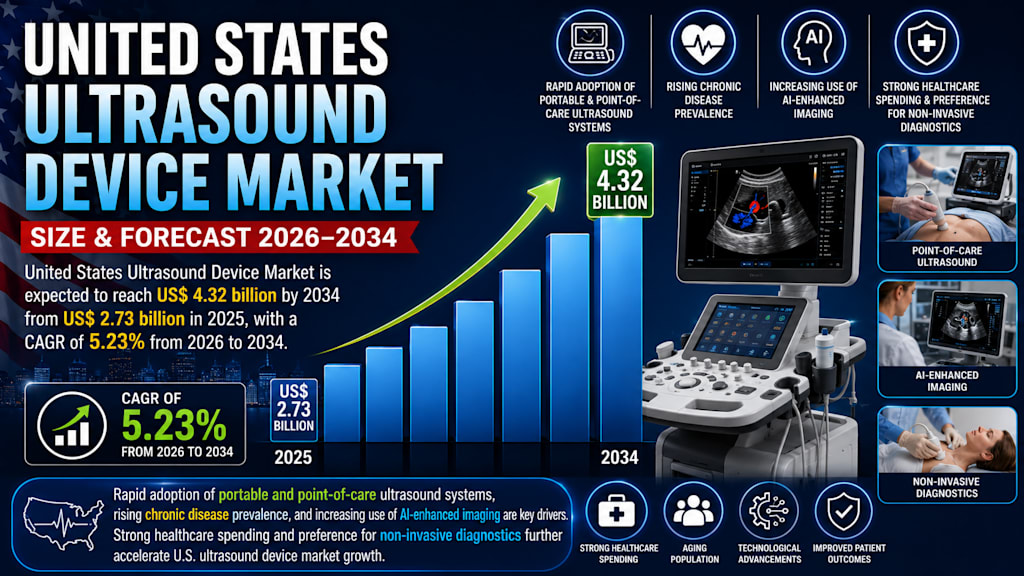
According to Renub Research, the United States Ultrasound Device Market is expected to grow from US$ 2.73 billion in 2025 to US$ 4.32 billion by 2034, expanding at a compound annual growth rate (CAGR) of 5.23% between 2026 and 2034. Rising chronic disease prevalence, increasing adoption of point-of-care ultrasound systems, and growing demand for non-invasive diagnostic imaging continue to support long-term market expansion.
As healthcare providers increasingly seek faster, more accessible, and more accurate diagnostic solutions, ultrasound technology is becoming a cornerstone of modern patient care across the United States.

The Growing Importance of Ultrasound in Modern Medicine
Ultrasound technology has evolved significantly since its introduction into clinical practice.
Today’s ultrasound systems provide high-quality, real-time visualization of organs, tissues, blood vessels, and developing fetuses without exposing patients to harmful radiation. This safety advantage makes ultrasound particularly valuable for routine examinations, prenatal monitoring, and repeated diagnostic assessments.
Healthcare providers appreciate ultrasound because it combines speed, affordability, and versatility. Physicians can perform examinations at the bedside, in outpatient clinics, emergency departments, ambulances, and even patients' homes.
Recent innovations have further expanded its clinical capabilities. Three-dimensional and four-dimensional imaging technologies provide more detailed visualization, while wireless connectivity and cloud-based systems improve data sharing and collaboration among healthcare professionals.
As medical facilities continue prioritizing efficient and patient-centered care, ultrasound remains one of the most widely used imaging modalities in the United States healthcare system.
Artificial Intelligence Is Revolutionizing Ultrasound Imaging
Artificial intelligence has emerged as one of the most influential developments in the ultrasound industry.
Traditionally, ultrasound image quality and interpretation depended heavily on operator expertise. Modern AI-powered systems are reducing this dependency by assisting clinicians with image acquisition, interpretation, and measurement.
Advanced algorithms can automatically identify anatomical structures, detect abnormalities, optimize imaging settings, and generate measurements with remarkable speed and consistency. These capabilities help improve diagnostic accuracy while reducing examination times.
Artificial intelligence also supports less experienced healthcare professionals, allowing them to perform ultrasound examinations with greater confidence.
By automating repetitive tasks and enhancing image quality, AI enables clinicians to focus more on patient care and clinical decision-making.
As healthcare systems increasingly adopt intelligent imaging solutions, AI integration is expected to remain one of the strongest drivers of ultrasound market growth throughout the forecast period.
Portable Ultrasound Devices Are Expanding Access to Care
One of the most transformative trends within the market is the rapid adoption of portable and handheld ultrasound systems.
Traditional cart-based ultrasound machines remain important in hospitals and imaging centers. However, advances in miniaturization and wireless technology have enabled manufacturers to develop compact devices that deliver impressive imaging capabilities while offering greater mobility.
Many handheld ultrasound probes now connect directly to smartphones and tablets, allowing healthcare providers to perform imaging examinations virtually anywhere.
This portability is particularly valuable in emergency medicine, rural healthcare settings, home health services, ambulances, and disaster-response environments.
Portable devices also support healthcare decentralization by bringing diagnostic capabilities closer to patients rather than requiring patients to travel to specialized facilities.
As healthcare providers increasingly prioritize accessibility and efficiency, handheld ultrasound systems are expected to become a major growth segment within the broader ultrasound device market.
Rising Chronic Diseases Are Increasing Imaging Demand
The growing prevalence of chronic diseases across the United States continues to generate substantial demand for diagnostic imaging services.
Cardiovascular disease remains one of the leading causes of death nationwide, requiring frequent monitoring through ultrasound examinations. Echocardiography plays a critical role in evaluating heart function, diagnosing structural abnormalities, and guiding treatment decisions.
Cancer diagnosis and monitoring also rely heavily on ultrasound technology. Physicians use ultrasound for tumor detection, biopsy guidance, and treatment evaluation across multiple cancer types.
Additionally, conditions such as diabetes, kidney disease, vascular disorders, and musculoskeletal injuries frequently require ultrasound assessments during diagnosis and follow-up care.
Because ultrasound is safe, non-invasive, and relatively affordable, it is particularly well-suited for repeated examinations and long-term patient monitoring.
As chronic disease rates continue rising, demand for advanced ultrasound technologies is expected to grow accordingly.
An Aging Population Is Driving Market Growth
Demographic trends are also contributing significantly to ultrasound device adoption.
The United States is experiencing a steady increase in its elderly population. Older adults are more likely to develop cardiovascular disease, vascular conditions, kidney disorders, musculoskeletal problems, and other health issues that require frequent diagnostic imaging.
Ultrasound plays a vital role in managing many age-related conditions due to its safety profile and diagnostic versatility.
In addition to geriatric care, ultrasound remains essential in women's health services. Prenatal monitoring, reproductive health evaluations, breast imaging, and gynecological examinations all depend heavily on ultrasound technology.
As healthcare providers focus increasingly on preventive care and early diagnosis, imaging utilization across diverse patient populations is expected to continue expanding.
Point-of-Care Ultrasound Is Changing Clinical Practice
Point-of-care ultrasound (POCUS) represents one of the fastest-growing applications within the industry.
POCUS allows clinicians to perform imaging examinations directly at the patient's bedside, providing immediate diagnostic information that supports faster decision-making.
Emergency physicians, intensivists, anesthesiologists, family practitioners, and critical-care specialists increasingly rely on POCUS to guide procedures, evaluate injuries, and assess medical conditions in real time.
The ability to obtain instant visual information reduces delays associated with traditional imaging workflows and can significantly improve patient outcomes.
Wireless probes, cloud-based reporting systems, and tele-ultrasound capabilities further enhance POCUS functionality by enabling remote consultation and specialist support.
As healthcare shifts toward value-based and decentralized care models, point-of-care ultrasound is expected to become an increasingly important component of clinical practice.
Challenges Facing the Ultrasound Device Market
Despite strong growth prospects, the industry faces several important challenges.
Regulatory complexity remains a significant obstacle, particularly for manufacturers developing AI-enhanced imaging systems. New technologies require extensive validation and regulatory review before they can be commercialized.
Smaller manufacturers often face difficulties managing compliance costs and documentation requirements, potentially slowing innovation.
Interoperability also presents challenges. Integrating ultrasound data seamlessly with electronic health records and healthcare information systems remains difficult in some settings.
Cybersecurity concerns have become increasingly important as ultrasound devices become more connected and reliant on cloud-based technologies.
Healthcare organizations must invest in security measures and software updates to protect patient data and maintain regulatory compliance.
Competition from Alternative Imaging Technologies
Ultrasound devices also face competition from other imaging modalities such as computed tomography (CT), magnetic resonance imaging (MRI), and positron emission tomography (PET).
These technologies often provide higher-resolution images and greater anatomical detail for complex diagnostic applications.
In specialties such as neurology, oncology, and advanced cardiovascular imaging, physicians may prefer alternative modalities when highly detailed imaging is required.
Additionally, advanced ultrasound systems equipped with premium features can be expensive, creating affordability concerns for smaller healthcare providers and rural clinics.
Maintenance expenses and reimbursement variability further influence purchasing decisions.
While ultrasound maintains significant advantages in safety and convenience, competitive pressures remain an important consideration within the market.
State-Level Market Opportunities
California continues to lead ultrasound adoption due to its advanced healthcare infrastructure, strong medical research environment, and early embrace of emerging technologies. Hospitals and healthcare systems throughout Los Angeles, San Francisco, and San Diego frequently invest in AI-powered imaging tools and portable ultrasound solutions to improve patient care. The state's large elderly population and growing chronic disease burden further support sustained demand.
Texas represents another rapidly expanding market driven by population growth, healthcare infrastructure expansion, and increasing utilization of diagnostic imaging across both urban and rural communities. Healthcare providers throughout Houston, Dallas-Fort Worth, and Austin continue integrating ultrasound technologies into routine clinical practice.
New York benefits from world-renowned medical institutions, extensive diagnostic networks, and strong adoption of advanced imaging technologies. Hospitals and imaging centers across the state regularly invest in innovative ultrasound systems that improve workflow efficiency and diagnostic precision.
Florida's growing elderly population, expanding healthcare infrastructure, and increasing demand for cardiovascular and preventive healthcare services continue supporting strong ultrasound utilization. The state's thriving medical tourism industry further contributes to market growth.
Recent Industry Developments
The U.S. ultrasound industry continues to experience significant innovation and investment.
In March 2025, MedShare partnered with Becton, Dickinson and Company and the National Association of Free and Charitable Clinics to distribute ninety-two portable ultrasound units across thirty states. This initiative aims to improve diagnostic access in underserved rural and low-income communities.
During the same month, Vave Health introduced a wireless handheld ultrasound system designed for whole-body imaging using a single transducer. The device focuses on improving mobility, efficiency, and diagnostic accuracy across clinical and educational settings.
GE HealthCare also launched its Automated Breast Ultrasound Premium platform featuring advanced artificial intelligence capabilities that support faster and more consistent breast cancer screening, particularly for patients with dense breast tissue.
Earlier in January 2025, the U.S. Food and Drug Administration granted 510(k) clearance for GE HealthCare's upgraded Voluson Expert Series, including the Expert 22, 20, and 18 systems. These approvals further strengthen innovation within the ultrasound market and support broader clinical adoption.
Market Segmentation and Competitive Landscape
The ultrasound device market encompasses both diagnostic and therapeutic ultrasound systems. Product categories include traditional trolley-based systems as well as compact handheld devices designed for mobile healthcare applications.
Applications span numerous specialties including radiology, cardiology, gynecology, vascular medicine, urology, and general imaging. Hospitals remain the largest end-user segment, although surgical centers, diagnostic facilities, maternity centers, ambulatory care providers, and academic institutions also contribute significantly to market demand.
Leading companies operating within the U.S. ultrasound market include GE HealthCare, Butterfly Network, Hologic, Samsung Electronics, Hitachi Healthcare Americas, Fujifilm Holdings Corporation, and other major imaging technology providers. These organizations continue investing heavily in artificial intelligence, portable imaging systems, cloud connectivity, and workflow optimization technologies.
Final Thoughts
The United States ultrasound device market is entering a period of sustained growth driven by technological innovation, rising healthcare demands, and the ongoing shift toward decentralized care delivery. Artificial intelligence, portable imaging systems, cloud connectivity, and point-of-care ultrasound applications are fundamentally changing how healthcare providers diagnose and manage disease.
As chronic illnesses become more prevalent and healthcare systems prioritize efficiency, accessibility, and patient-centered care, ultrasound technology will continue expanding its role across virtually every medical specialty. With the market expected to reach US$ 4.32 billion by 2034, ultrasound devices are positioned to remain among the most valuable and widely adopted diagnostic tools in modern healthcare.
About the Creator
Enjoyed the story? Support the Creator.
Subscribe for free to receive all their stories in your feed.
Comments
There are no comments for this story
Be the first to respond and start the conversation.