
United States Tumor Profiling Market Set to Reach US$ 7.44 Billion by 2033 as Precision Oncology Transforms Cancer Care
Advances in Genomic Technologies, Rising Cancer Cases, and Personalized Medicine Drive Strong Growth Across the U.S. Tumor Profiling Industry

The Future of Cancer Treatment Is Becoming More Personalized
Cancer remains one of the most significant health challenges in the United States, affecting millions of individuals and families every year. While conventional cancer treatments such as chemotherapy, radiation therapy, and surgery continue to play essential roles in patient care, a new era of oncology is emerging—one driven by precision medicine and advanced molecular diagnostics.
At the heart of this transformation lies tumor profiling, a sophisticated diagnostic approach that examines the genetic, molecular, and biological characteristics of tumors. By identifying specific mutations and biomarkers, physicians can tailor treatment strategies to individual patients, significantly improving therapeutic outcomes.
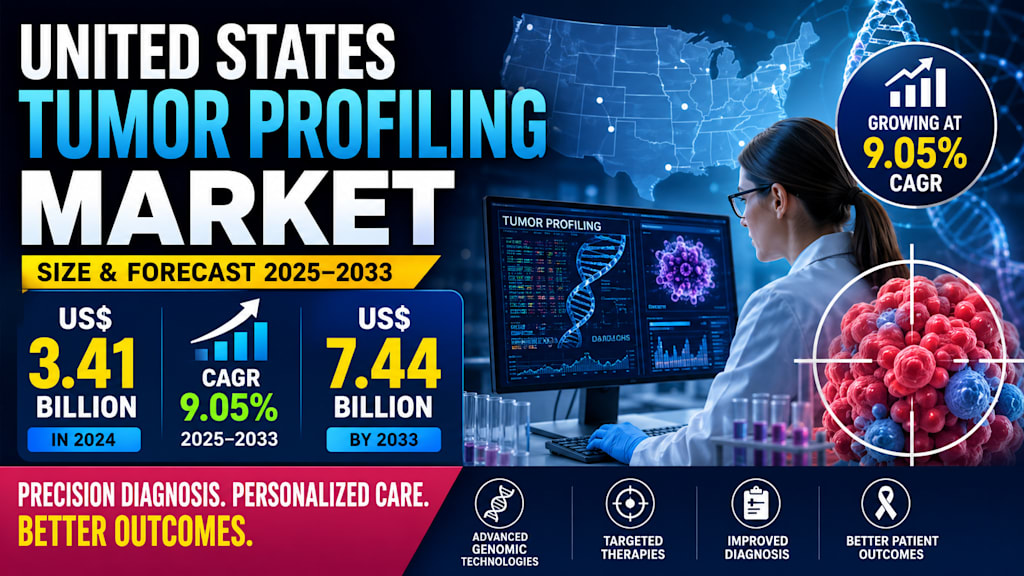
According to Renub Research, the United States Tumor Profiling Market is expected to grow from US$ 3.41 billion in 2024 to US$ 7.44 billion by 2033, expanding at a CAGR of 9.05% during the forecast period from 2025 to 2033.
As healthcare providers increasingly embrace personalized cancer care, tumor profiling is becoming a critical component of modern oncology practice across the nation.
Understanding Tumor Profiling and Its Importance
Tumor profiling involves comprehensive molecular analysis of cancerous tissues to identify genetic mutations, protein expressions, metabolic pathways, and other biological markers associated with disease progression.
Using technologies such as:
Next-Generation Sequencing (NGS)
Polymerase Chain Reaction (PCR)
Mass Spectrometry
Immunohistochemistry (IHC)
In Situ Hybridization (ISH)
healthcare professionals can gain deep insights into the molecular makeup of a patient's tumor.
These insights help oncologists:
Select targeted therapies
Predict treatment responses
Monitor disease progression
Avoid ineffective treatments
Improve patient survival rates
Rather than applying a one-size-fits-all approach, tumor profiling enables physicians to develop personalized treatment plans tailored to each patient's cancer biology.
Rising Cancer Burden Continues to Fuel Market Growth
One of the strongest drivers behind the growth of the U.S. tumor profiling market is the increasing prevalence of cancer.
According to estimates from the American Cancer Society, more than 2 million new cancer cases are expected to be diagnosed in the United States in 2025. As cancer incidence rises due to factors such as aging populations, lifestyle changes, and environmental influences, the demand for advanced diagnostic tools continues to expand.
Healthcare providers are under growing pressure to deliver faster diagnoses and more effective treatments. Tumor profiling addresses both needs by enabling clinicians to identify actionable genetic mutations and select therapies with greater precision.
As patients become more informed about personalized medicine options, demand for molecular testing and tumor characterization is expected to increase significantly throughout the coming decade.
Precision Medicine Is Reshaping Oncology
Precision medicine has rapidly become one of the most influential trends in healthcare.
Traditional cancer therapies often rely on generalized treatment protocols. However, not all patients respond similarly to the same treatment because tumors can differ dramatically at the molecular level.
Tumor profiling bridges this gap by helping physicians understand the unique biological signatures of each cancer.
Benefits of precision oncology include:
Higher treatment success rates
Reduced adverse side effects
Improved patient quality of life
Better allocation of healthcare resources
Faster identification of effective therapies
As pharmaceutical companies continue developing targeted drugs and immunotherapies, tumor profiling is becoming increasingly important for matching patients with appropriate treatments.
This growing emphasis on individualized care is expected to remain a major growth catalyst for the market through 2033.
Technological Advancements Are Accelerating Adoption
Rapid innovation in molecular diagnostics has dramatically improved the capabilities of tumor profiling technologies.
Next-generation sequencing, in particular, has revolutionized cancer diagnostics by enabling comprehensive genomic analysis at lower costs and faster turnaround times than ever before.
Modern tumor profiling platforms can now analyze hundreds of genes simultaneously, providing clinicians with detailed information regarding:
Gene mutations
Gene fusions
Copy number variations
Microsatellite instability
Tumor mutational burden
Additionally, advances in artificial intelligence and bioinformatics are helping healthcare providers interpret complex molecular datasets more efficiently.
Machine learning algorithms are increasingly being integrated into diagnostic workflows to identify clinically relevant biomarkers and generate actionable treatment recommendations.
As technology continues to evolve, tumor profiling solutions are becoming more accurate, accessible, and cost-effective.
Investments and Collaborations Are Driving Innovation
The U.S. tumor profiling ecosystem benefits from a strong network of collaborations among:
Biotechnology companies
Pharmaceutical manufacturers
Academic institutions
Research laboratories
Healthcare providers
Significant investments are being directed toward biomarker discovery, companion diagnostics, and targeted therapy development.
Many pharmaceutical companies now rely on tumor profiling data to support clinical trial recruitment and drug development initiatives.
Academic research centers are also partnering with diagnostic companies to accelerate the commercialization of innovative profiling technologies.
Government-supported precision medicine initiatives continue to encourage research and foster innovation, helping maintain the United States' leadership position in oncology diagnostics.
Key Challenges Facing the Market
High Cost of Advanced Profiling Technologies
Despite impressive growth prospects, cost remains one of the biggest barriers to widespread adoption.
Sophisticated technologies such as NGS require substantial investments in:
Laboratory infrastructure
Skilled personnel
Bioinformatics capabilities
Quality assurance systems
These costs can make testing expensive for healthcare providers and patients.
Although reimbursement policies have improved in recent years, access to tumor profiling remains inconsistent across different healthcare systems and geographic regions.
Smaller hospitals and rural healthcare facilities often face greater challenges in adopting advanced molecular diagnostic technologies.
Data Interpretation Complexity
Tumor profiling generates massive volumes of genomic and molecular data.
Interpreting these datasets requires specialized expertise, advanced software tools, and standardized reporting frameworks.
Variability among testing platforms can sometimes create inconsistencies in clinical interpretations, making treatment decisions more complex.
While artificial intelligence and machine learning are helping address these challenges, continued efforts toward standardization and workforce training will be essential for maximizing the value of tumor profiling technologies.
State-Level Market Analysis
California: America's Precision Oncology Powerhouse
California remains one of the most influential markets for tumor profiling in the United States.
The state benefits from:
A thriving biotechnology industry
Leading academic research institutions
World-class cancer treatment centers
Significant venture capital investment
California's robust innovation ecosystem has made it a global leader in precision medicine research and commercialization.
Strong collaboration among biotech firms, healthcare providers, and pharmaceutical companies continues to drive adoption of advanced tumor profiling solutions.
Texas: Expanding Oncology Infrastructure Fuels Growth
Texas has emerged as a rapidly growing market for tumor profiling.
The state's expanding healthcare infrastructure includes some of the nation's largest cancer treatment facilities and research institutions.
Growing investments in molecular diagnostics, clinical trials, and personalized medicine programs have strengthened Texas' position within the precision oncology landscape.
The state's large and diverse patient population further supports ongoing demand for advanced cancer diagnostic technologies.
New York: Research Excellence Supports Innovation
New York remains a critical center for cancer research and molecular diagnostics.
The state hosts numerous prestigious medical institutions that actively integrate tumor profiling into clinical practice.
Strong pharmaceutical and biotechnology activity contributes to biomarker discovery and targeted therapy development.
New York's commitment to precision medicine continues to support widespread adoption of advanced oncology diagnostics.
Florida: Rapid Adoption Driven by Aging Population
Florida's growing tumor profiling market is largely supported by its large aging population, which faces elevated cancer risks.
Healthcare providers throughout the state are increasingly incorporating molecular diagnostics into oncology care pathways.
The presence of specialized cancer centers, clinical trial networks, and research institutes further enhances market growth opportunities.
As awareness of personalized cancer treatment increases, Florida is expected to remain an important contributor to nationwide market expansion.
10 Recent Developments in the U.S. Tumor Profiling Market
1. Illumina Expands Comprehensive Oncology Testing (2024)
Illumina received FDA approval for its TruSight Oncology Comprehensive test, capable of assessing more than 500 genes and supporting multiple companion diagnostic claims.
2. Guardant Health Strengthens Liquid Biopsy Portfolio
Guardant Health expanded its blood-based cancer testing capabilities to improve non-invasive tumor profiling and treatment monitoring.
3. Exact Sciences Enhances Precision Oncology Solutions
Exact Sciences increased investments in molecular diagnostics and biomarker-driven cancer detection technologies.
4. QIAGEN Advances Companion Diagnostic Partnerships
QIAGEN expanded collaborations with pharmaceutical companies to support targeted therapy development through companion diagnostics.
5. NeoGenomics Expands Comprehensive Genomic Testing
NeoGenomics introduced additional oncology testing services focused on personalized treatment selection.
6. Bruker Spatial Biology Enhances Spatial Genomics Capabilities
Bruker continued advancing spatial biology technologies to provide deeper insights into tumor microenvironments.
7. Multi-Cancer Early Detection Research Accelerates
Several U.S. healthcare institutions increased investment in profiling technologies aimed at detecting multiple cancers earlier.
8. AI Integration Improves Molecular Data Analysis
Leading diagnostic companies implemented artificial intelligence tools to streamline genomic data interpretation.
9. Academic-Industry Partnerships Expand Nationwide
Major cancer centers formed new collaborations with biotechnology firms to accelerate biomarker discovery programs.
10. Increased Reimbursement Support for Genomic Testing
Expanded insurance coverage for molecular diagnostics improved patient access to advanced tumor profiling services.
Competitive Landscape
The U.S. tumor profiling market is highly competitive, characterized by continuous innovation and strategic partnerships.
Major companies are focusing on:
Product development
Regulatory approvals
AI integration
Companion diagnostics
Strategic acquisitions
Precision oncology expansion
Key market participants include:
Illumina Inc.
Qiagen N.V.
Exact Sciences Corporation
NeoGenomics Laboratories
Oxford Gene Technology IP Limited
Bruker Spatial Biology, Inc.
GenomeDX
Guardant Health
These organizations continue investing heavily in research and development to strengthen their positions in the rapidly evolving precision medicine ecosystem.
Market Segmentation Overview
By Technique
Genomics
Proteomics
Metabolomics
Epigenetics
By Technology
Immunoassays
Next-Generation Sequencing
Polymerase Chain Reaction
In Situ Hybridization
Microassays
Mass Spectrometry
Others
By Application
Personalized Cancer Medicine
Oncological Diagnostics
Research
By Geography
California
Texas
New York
Florida
Illinois
Pennsylvania
Ohio
Georgia
New Jersey
Washington
North Carolina
Massachusetts
Virginia
Michigan
Maryland
Colorado
Tennessee
Indiana
Arizona
Minnesota
Wisconsin
Missouri
Connecticut
South Carolina
Oregon
Louisiana
Alabama
Kentucky
Rest of United States
Final Thoughts
Tumor profiling is no longer a niche diagnostic tool—it is rapidly becoming the foundation of modern cancer treatment in the United States. As precision medicine gains momentum, healthcare providers are increasingly relying on genomic and molecular insights to guide therapeutic decisions and improve patient outcomes.
With cancer incidence continuing to rise, advancements in next-generation sequencing, artificial intelligence, and biomarker research are expected to further strengthen market growth. Supported by robust research investments, expanding reimbursement coverage, and ongoing innovation from industry leaders, the United States Tumor Profiling Market is positioned for substantial expansion over the coming decade.
By reaching an estimated US$ 7.44 billion by 2033, the market reflects the growing importance of personalized oncology and the transformative role that tumor profiling will play in shaping the future of cancer care.
About the Creator
Enjoyed the story? Support the Creator.
Subscribe for free to receive all their stories in your feed.
Comments
There are no comments for this story
Be the first to respond and start the conversation.