
United States Transportation Battery Market Set to Reach US$ 83.20 Billion by 2033 as EV Adoption Accelerates Nationwide
Government Incentives, Battery Innovation, and Electrification of Mobility Drive Robust Growth Across the U.S.

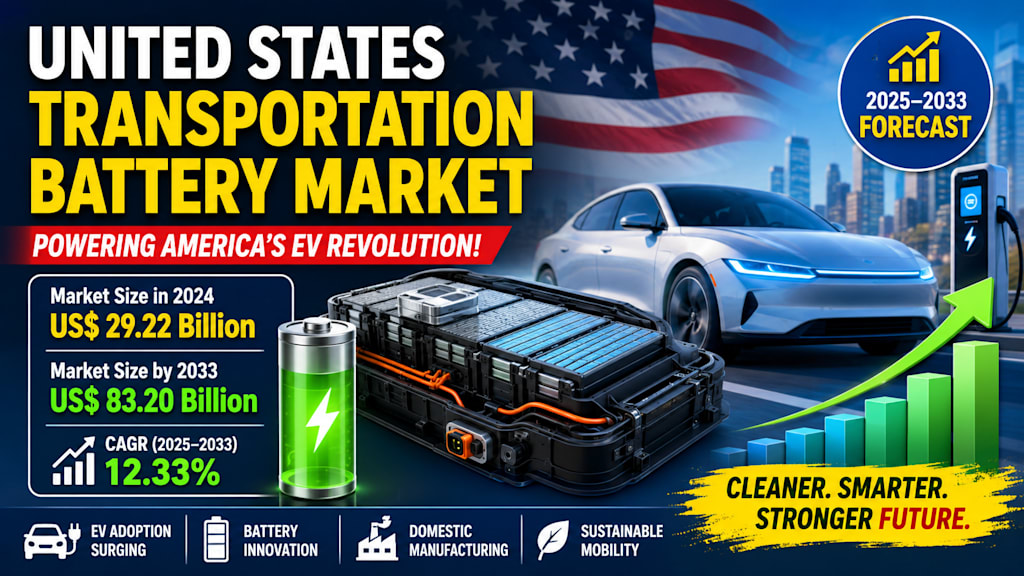
United States Transportation Battery Market Outlook 2025–2033
The United States transportation battery market is entering a transformative era as electric mobility reshapes the future of transportation. According to Renub Research, the United States Transportation Battery Market is expected to grow from US$ 29.22 billion in 2024 to US$ 83.20 billion by 2033, expanding at a CAGR of 12.33% between 2025 and 2033.
This remarkable growth reflects the rapid electrification of passenger vehicles, commercial fleets, public transportation systems, and emerging mobility solutions. Transportation batteries have become the backbone of modern mobility, enabling cleaner transportation alternatives while helping the nation reduce greenhouse gas emissions and dependence on fossil fuels.
As governments, automakers, technology firms, and consumers increasingly embrace sustainability, transportation batteries are no longer viewed merely as vehicle components. They are now strategic assets shaping the future of energy, transportation, and economic competitiveness.
Transportation Batteries Powering America’s Mobility Revolution
The transportation sector has historically been one of the largest contributors to carbon emissions in the United States. However, the ongoing shift toward electric transportation is fundamentally changing this landscape.
Electric vehicles (EVs), hybrid vehicles, electric buses, delivery vans, and commercial trucks all rely heavily on advanced battery technologies. Transportation batteries store energy efficiently, provide power for propulsion, and determine factors such as driving range, charging speed, and overall vehicle performance.
Among various battery technologies, lithium-ion batteries continue to dominate the market because of their superior energy density, longer lifespan, and reliability. These batteries are widely used in passenger EVs, commercial vehicles, and public transportation fleets.
At the same time, research into next-generation battery technologies is accelerating. Solid-state batteries, silicon-anode batteries, and advanced lithium-metal technologies are attracting significant investments as manufacturers seek to improve safety, reduce charging times, and increase driving ranges.
The growing role of transportation batteries extends beyond automobiles. Aviation, maritime transport, logistics fleets, and urban mobility platforms are increasingly exploring electrification, creating additional growth opportunities for battery manufacturers.
Rising Electric Vehicle Adoption Fueling Market Expansion
One of the strongest growth drivers for the U.S. transportation battery market is the rapid adoption of electric vehicles.
Consumer attitudes toward transportation are changing significantly. Increasing awareness of climate change, rising fuel prices, and improved EV performance are encouraging buyers to choose electric alternatives over conventional gasoline-powered vehicles.
Major automotive manufacturers have committed billions of dollars to EV development. New electric models are entering the market every year, offering improved affordability, longer ranges, and advanced technological features.
Commercial fleet operators are also embracing electrification. Delivery companies, logistics providers, ride-sharing services, and public transportation agencies are investing heavily in electric fleets to reduce operational costs and meet sustainability goals.
As EV sales continue to rise across the country, demand for high-capacity transportation batteries is expected to grow proportionally, supporting long-term market expansion.
Government Policies Creating a Favorable Growth Environment
Government support remains one of the most influential factors driving transportation battery adoption throughout the United States.
Federal and state governments have introduced numerous initiatives designed to accelerate the transition toward clean transportation. These initiatives include:
Tax credits for electric vehicle purchases
Grants for battery research and development
Incentives for domestic battery manufacturing
Investments in charging infrastructure
Policies supporting clean transportation adoption
The Inflation Reduction Act and other clean-energy programs have further strengthened investment in domestic battery supply chains. These measures aim to reduce reliance on foreign suppliers while boosting American manufacturing capabilities.
Several states have established aggressive emissions reduction targets and zero-emission vehicle mandates, creating additional momentum for battery demand.
This supportive regulatory environment provides confidence to manufacturers, investors, and consumers, ensuring continued growth across the transportation battery ecosystem.
Battery Technology Innovation Driving Industry Advancement
Technology remains at the center of the transportation battery market's evolution.
Battery manufacturers are continuously improving performance through advancements in:
Energy density
Fast-charging capabilities
Battery lifespan
Thermal management systems
Recycling technologies
Safety features
Modern lithium-ion batteries now offer significantly improved efficiency compared to previous generations. Consumers can travel longer distances while spending less time charging their vehicles.
The industry is also investing heavily in solid-state battery technology, which promises transformative benefits. Solid-state batteries could provide:
Greater energy storage capacity
Enhanced safety
Faster charging speeds
Reduced fire risks
Longer operational life
If successfully commercialized at scale, these technologies could significantly accelerate electric vehicle adoption and expand the transportation battery market even further.
Domestic Manufacturing Becomes a National Priority
Recent global supply chain disruptions highlighted the importance of domestic battery production.
To strengthen energy security and reduce dependence on overseas suppliers, the United States is rapidly expanding its battery manufacturing capacity. New gigafactories are being constructed across multiple states, creating thousands of jobs while strengthening domestic supply chains.
Automakers and battery producers are partnering to localize battery production and critical mineral processing. This strategy aims to improve supply stability while ensuring long-term competitiveness.
Investments in lithium extraction, battery recycling facilities, and advanced manufacturing technologies are helping establish a more resilient domestic battery ecosystem.
As local production capacity expands, the United States is positioning itself as a major global player in transportation battery manufacturing.
Challenges Facing the Transportation Battery Industry
Despite strong growth prospects, several challenges continue to affect the industry.
High Raw Material Costs
Battery production relies heavily on critical minerals such as lithium, cobalt, nickel, and graphite. Price volatility in these materials can significantly impact manufacturing costs.
Growing global demand for battery materials has intensified competition for resources, creating pricing uncertainty throughout the supply chain.
Manufacturers are actively pursuing alternative chemistries and recycling solutions to reduce dependence on expensive raw materials.
Infrastructure Gaps
While charging infrastructure continues to expand, significant gaps remain, particularly in rural areas.
Many consumers still express concerns about charging availability, travel convenience, and charging times. Addressing these concerns requires continued investment in nationwide charging networks.
Sustainability and Recycling Concerns
As battery usage increases, responsible recycling and disposal become increasingly important.
Industry stakeholders are developing closed-loop recycling systems that recover valuable materials from used batteries. These initiatives help reduce environmental impact while supporting long-term resource availability.
State-Level Market Analysis
California: The Undisputed Market Leader
California remains the largest transportation battery market in the United States.
The state's aggressive climate policies, extensive EV incentives, and well-developed charging infrastructure have created a highly favorable environment for battery adoption.
California also serves as a major center for battery research, clean technology innovation, and electric vehicle manufacturing.
Strong consumer demand and regulatory support continue to make California the benchmark for transportation battery growth nationwide.
Texas: Rapidly Emerging as a Battery Powerhouse
Texas is becoming an increasingly important transportation battery market.
The state's growing population, expanding EV adoption, and substantial investments in charging infrastructure are driving demand for transportation batteries.
Texas also benefits from a strong industrial base and significant investments in battery manufacturing facilities, making it a strategic location for future industry growth.
As more consumers and businesses embrace electric mobility, Texas is expected to play a larger role in the national battery landscape.
New York: Advancing Sustainable Transportation
New York has positioned itself as a leader in clean transportation initiatives.
The state's focus on emissions reduction, public transportation electrification, and EV incentives is generating strong demand for advanced battery solutions.
Urban density and extensive public transit networks create unique opportunities for battery-powered transportation systems, including electric buses and commercial fleets.
Partnerships between government agencies, research institutions, and private companies continue to strengthen New York's transportation battery ecosystem.
Florida: Expanding Opportunities Through Consumer Demand
Florida's transportation battery market is experiencing steady growth.
Population growth, tourism-related transportation activity, and increasing consumer interest in electric vehicles are supporting market expansion.
The state is investing in charging infrastructure while encouraging broader adoption of electric mobility solutions.
Florida's strategic geographic location and logistics infrastructure also support battery distribution and supply chain operations, enhancing its importance within the national market.
Recent Developments in the U.S. Transportation Battery Market
The industry continues to witness significant strategic developments that are reshaping competition and innovation.
10 Recent Industry Developments
Tesla announced EV price reductions across the United States and Europe in January 2024 to stimulate demand and strengthen market share.
Gotion High-Tech revealed plans in January 2024 to establish a major battery manufacturing facility in Michigan, expanding North American production capacity.
Panasonic Energy continued expanding battery production partnerships with leading EV manufacturers to support growing vehicle demand.
LG Energy Solution accelerated investments in U.S.-based battery manufacturing plants and supply chain localization initiatives.
Samsung SDI advanced research programs focused on next-generation solid-state battery technologies.
Robert Bosch GmbH increased investment in battery management systems designed to improve performance and safety.
Hitachi Group expanded energy storage and battery technology solutions supporting transportation electrification.
VARTA strengthened its advanced battery development efforts for mobility and industrial applications.
General Motors and battery partners continued scaling domestic battery production facilities to support future EV launches.
Ford Motor Company expanded battery sourcing and manufacturing partnerships aimed at strengthening long-term EV production capabilities.
Competitive Landscape
The United States transportation battery market remains highly competitive, with global manufacturers competing through innovation, strategic partnerships, manufacturing expansion, and technology development.
Major companies operating in the market include:
Panasonic Corporation
Exide Industries
VARTA
Hitachi Group Ltd
Robert Bosch GmbH
Samsung SDI Co. Ltd
LG Chem Ltd
These organizations are investing heavily in research and development to improve battery efficiency, lower production costs, and maintain competitive advantages in an increasingly dynamic marketplace.
Future Outlook: A Decade of Electrified Growth
The future of the United States transportation battery market appears exceptionally promising. Growing environmental awareness, supportive government policies, rapid technological innovation, and increasing EV adoption are creating powerful growth momentum.
As charging infrastructure expands, battery technologies become more efficient, and manufacturing capacity increases, transportation batteries will play an even more critical role in the country's mobility transformation.
The industry's evolution extends beyond automobiles. Electric trucks, buses, ships, aircraft, and emerging mobility platforms are expected to create new opportunities for battery manufacturers throughout the forecast period.
With strong investment, innovation, and policy support, the United States is well-positioned to become one of the world's leading transportation battery markets by 2033.
Final Thoughts
Transportation batteries have become the foundation of America's transition toward cleaner, smarter, and more sustainable transportation systems. From powering electric vehicles to supporting public transportation electrification, batteries are transforming how people and goods move across the country.
With the market projected to reach US$ 83.20 billion by 2033, the United States transportation battery industry stands at the forefront of the clean-energy revolution. Companies that invest in innovation, domestic manufacturing, and sustainable supply chains will be best positioned to capitalize on the immense opportunities emerging over the next decade.
About the Creator
Enjoyed the story? Support the Creator.
Subscribe for free to receive all their stories in your feed.
Comments
There are no comments for this story
Be the first to respond and start the conversation.