
United States Soybean Oil Market Size & Forecast 2025-2033
A steadily expanding edible oil market is gaining momentum from home cooking, processed foods, plant-based demand, and industrial uses.

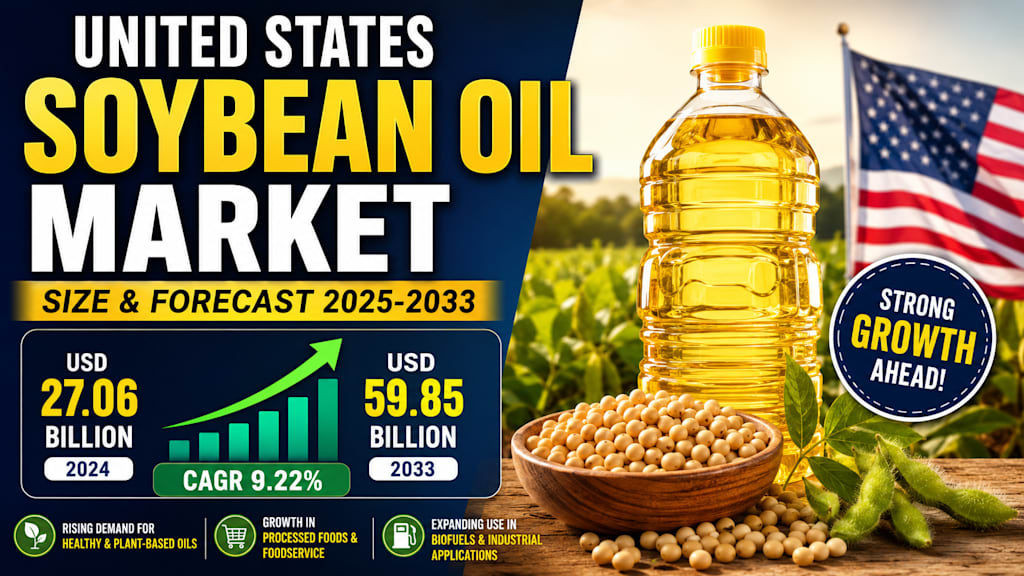
The United States Soybean Oil Market is projected in the supplied Renub Research brief to rise from US$ 27.06 billion in 2024 to US$ 59.85 billion by 2033, registering a CAGR of 9.22% from 2025 to 2033. That outlook reflects more than just a pantry staple. Soybean oil sits at the intersection of household cooking, food manufacturing, and renewable industrial demand, which gives it a broader growth runway than many other edible oils. U.S. Soy highlights the crop’s reach across food, fuel, feed, and industrial applications, while Cargill notes soybean oil’s neutral taste, light texture, and strong suitability for frying, baking, mayonnaise, margarine, and other food uses.
At the core of the market story is versatility. Soybean oil is one of the most widely used cooking oils in the United States because it fits everyday cooking habits so well. Its neutral flavor makes it easy to use in recipes without overpowering other ingredients, and its performance at higher heat keeps it relevant for frying and sautéing. Beyond household kitchens, it is deeply embedded in processed foods and foodservice menus, where consistency, affordability, and supply reliability matter as much as taste. That wide functional role is a major reason soybean oil remains central to the U.S. edible oil category.
The first major growth engine is the consumer shift toward healthier and more plant-based eating patterns. Soy products continue to benefit from health-conscious positioning, and soybeans remain important in vegan and vegetarian diets as a flexible, renewable crop. In the broader food system, U.S. Soy is also being promoted as a solution for manufacturers seeking ingredients that support cleaner formulations and sustainable sourcing goals. This is helping soybean oil retain relevance in a market where consumers increasingly read labels and compare oils on both function and perception.
The second driver is the continued expansion of processed foods and foodservice. Soybean oil is a practical ingredient for snacks, baked goods, sauces, dressings, margarine, and frying applications, which makes it especially valuable to food processors and quick-service restaurants. Cargill’s soybean oil product page shows how broadly the oil is used across bakery, biscuits, snacks, confectionery, fillings, convenience foods, frying, mayonnaise, and margarine. That breadth matters because it links soybean oil demand to the scale of the American packaged-food economy, not just retail cooking oil sales.
A third growth pillar is industrial demand, especially biodiesel and other renewable applications. U.S. Soy describes soy as a renewable solution for food, feed, fuel, and industrial markets, and that framing is increasingly important as companies and policymakers look for lower-carbon inputs. In other words, soybean oil is no longer valued only as a kitchen ingredient; it is also a feedstock for cleaner fuel systems and industrial formulations. That diversification supports demand resilience even when consumer cooking habits fluctuate.
Still, the market is not without pressure points. Soybean oil faces competition from alternative edible oils such as olive oil and other premium oils that benefit from strong health branding and cleaner-label positioning. The U.S. olive oil market itself is on a growth path, which shows how consumers are giving more shelf space to oils that are marketed around lifestyle, origin, and perceived heart-health advantages. Soybean oil can remain competitive, but it must keep emphasizing affordability, functionality, and its broad industrial footprint.
Supply-side volatility remains another challenge. Soybean oil prices depend heavily on soybean crop output, weather conditions, trade flows, and processing capacity, so the market can move quickly when input costs or logistics shift. That is why large agribusiness players keep investing in crushing, refining, traceability, and sustainability systems. These investments are not just corporate messaging; they are strategic tools to protect long-term supply stability.
Within the market, conventional soybean oil still holds the biggest share because of its price advantage and broad everyday use. It remains the default option for households, restaurants, and large-scale food processors that need a dependable and economical oil for frying, baking, and blending. Organic soybean oil, by contrast, is growing from a smaller base but has a strong story in clean-label foods, premium retail, and natural personal-care products. The split between these two segments reflects a familiar U.S. consumer trend: price and convenience still dominate the mass market, while organic options win where health and sustainability branding are powerful.
Application trends are equally important. Cooking and frying remain the backbone of demand because soybean oil handles heat well and performs consistently in both home kitchens and commercial fryers. Bakery products are another important outlet because soybean oil helps improve softness, moisture retention, and shelf life without adding a strong flavor. Margarine and shortening also remain steady demand centers because manufacturers rely on soybean oil’s functional fat profile and economical sourcing. These uses make soybean oil more than a single-purpose commodity; they make it a functional ingredient platform.
Regionally, large population centers and foodservice-heavy states are key demand zones. California stands out because of its huge consumer base, diverse food culture, and strong natural-food retail presence. New York remains important because of its dense urban foodservice market and steady demand from bakeries, restaurants, and packaged-food manufacturers. Washington is emerging as a niche growth state where sustainability, non-GMO positioning, and biodiesel-linked demand add an extra layer of momentum. These state-level patterns show that soybean oil demand is shaped as much by lifestyle and industry structure as by price alone.
Recent Developments by Companies
ADM updated its soy strategy in 2025 and said it is streamlining and strengthening its global soy protein production network, including its recently recommissioned soy protein facility in Decatur, Illinois. That move points to the company’s focus on efficiency and the wider value of soy-linked ingredients.
ADM also reported continued progress on its corporate sustainability agenda, including a target to move toward a deforestation-free supply chain by the end of 2025 and broader traceability efforts across soy sourcing. This reinforces how sustainability is now built into soybean-based supply chains.
Bunge said in its 2024 annual report that a U.S. soy protein concentrate plant was scheduled to go online in 2025 and would be the world’s largest single-line food SPC plant. That kind of investment supports the broader soybean economy and signals confidence in soy-derived demand.
Bunge’s 2025 annual report highlighted the completion of its business combination with Viterra, expanding its global footprint and strengthening its role across food, feed, and fuel markets. For soybean oil, bigger scale often means stronger processing and logistics power.
Bunge’s Global Sustainability Report said the company is drawing closer to achieving deforestation-free supply chains in 2025. That matters because buyers increasingly want traceable, lower-risk vegetable oil sourcing.
Cargill completed an expansion and modernization project at its integrated soybean crush and refined oils facility in Sidney, Ohio in 2023. The company said the upgrade was designed to help meet growing demand across food, feed, and renewable fuel markets.
Cargill’s 2025 Impact Report and company reporting continue to emphasize supply-chain resilience, sustainability, and responsible sourcing across its agricultural business. That matters because soybean oil demand increasingly depends on scale and traceability as much as on price.
Louis Dreyfus Company announced construction of a soybean processing plant in Upper Sandusky, Ohio, with integrated crushing, vegetable oil refining, and lecithin packaging capabilities. The project underscores how U.S. processing capacity is still being built out to serve food and ingredient markets.
AAK said it is committed to achieving 100 percent verified deforestation-free soy supply chains by 2025, and its sustainability progress updates show soy remains part of its responsible-sourcing agenda. This is a clear sign that major oils-and-fats companies are competing on sustainability credentials.
Unilever’s 2025 Sustainability Statement identifies soy oil as one of its key agricultural crops and says those key crops account for more than 77 percent of its agricultural sourcing by volume, excluding ice cream. That is important because large consumer brands help shape downstream demand for soybean oil through sourcing decisions.
One more signal worth noting is the broader U.S. soybean sustainability push. In early 2025, U.S. soybean industry groups updated national 2030 sustainability goals that include lowering land-use impact, soil erosion, energy use, and greenhouse-gas emissions. Those goals matter for soybean oil because oil demand starts with soybean supply, and supply is increasingly being measured by climate and land-use performance as well as yield.
Final Thoughts
The U.S. soybean oil market has a strong and unusually diverse growth profile. It is supported by everyday cooking demand, processed-food manufacturing, bakery and dressing applications, and an expanding industrial role in renewable fuels. At the same time, the market is becoming more disciplined, more traceable, and more sustainability-focused, which should help top producers defend share and improve long-term pricing power.
In practical terms, the winners in this market will be the companies that combine scale with flexibility: able to serve retail cooking oil buyers, food processors, and biofuel customers at the same time, while keeping supply chains transparent and resilient. That is why the U.S. soybean oil story is not just about volume growth; it is about strategic relevance across the modern food and energy system.
About the Creator
Enjoyed the story? Support the Creator.
Subscribe for free to receive all their stories in your feed.
Comments
There are no comments for this story
Be the first to respond and start the conversation.