
United States Smartphone Market Size Growth Share Trends Demand & Forecast 2034
The United States smartphone market reached 160.6 million units in 2025 and is projected to grow to 227.4 million units by 2034

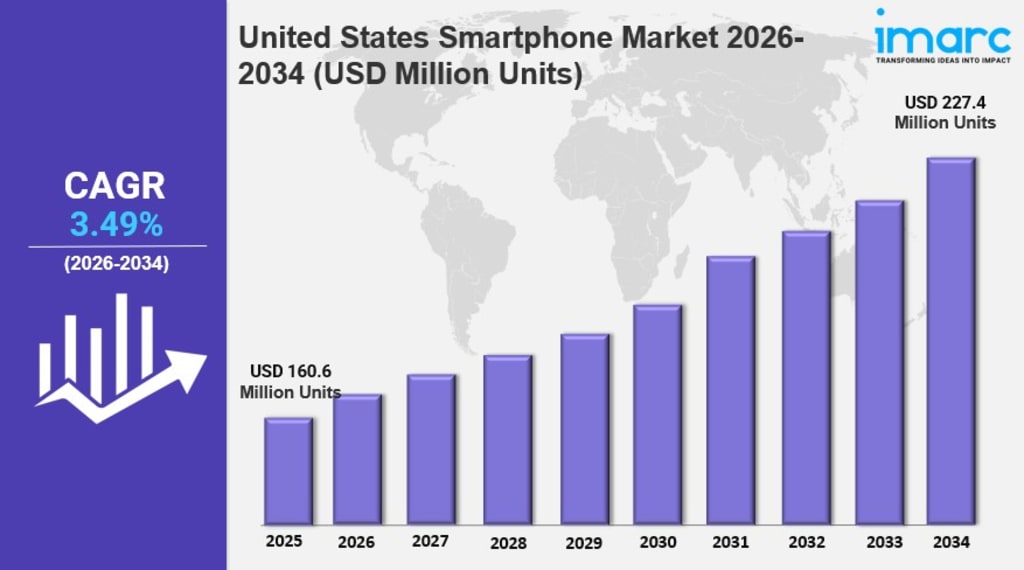
United States Smartphone Market Size, Share, and Growth Forecast (2026–2034)
The United States smartphone market continues to represent one of the most advanced and competitive consumer electronics sectors globally. The market reached 160.6 million units in 2025 and is projected to grow to 227.4 million units by 2034, registering a CAGR of 3.94% during 2026–2034.
Growth in the market is supported by continuous technology upgrades, expanding 5G infrastructure, and rising demand for premium mobile devices. Consumers are increasingly prioritizing performance, camera quality, battery efficiency, and ecosystem integration when purchasing smartphones. At the same time, manufacturers are focusing on innovation-driven product launches to strengthen brand positioning and maintain customer loyalty.
Request the Latest Market Report with 2026–2034 Forecast Insights
Key Trends Shaping the United States Smartphone Market
• In 2026, growing adoption of premium smartphones with advanced processors and AI-enabled features is expected to remain a major trend in the United States smartphone market.
• Consumers are increasingly investing in devices that offer long-term performance, faster connectivity, and enhanced user experience.
• Foldable smartphones and advanced display technologies are gaining attention among early adopters and premium consumer segments.
• Smartphone manufacturers are focusing on product differentiation through innovative designs and high-performance features in a competitive market environment.
• Integration of smartphones with broader digital ecosystems, including smart homes, wearables, cloud platforms, and entertainment services, continues to expand.
• Cross-device connectivity and seamless synchronization are becoming important factors influencing consumer purchasing decisions.
• Sustainability trends are also shaping the market, with increasing consumer interest in trade-in programs, recycling initiatives, and longer device lifecycle support.
• Brands are emphasizing software updates, repair programs, and environmentally focused strategies to strengthen customer retention and brand value.
Growth Drivers in the U.S. Smartphone Industry: 5G Adoption and Premium Device Demand
The expansion of 5G networks remains a major growth driver for the U.S. smartphone market. Telecommunications providers are continuing to invest in network infrastructure, encouraging consumers to upgrade to 5G-compatible devices.
Faster connectivity and lower latency are supporting higher demand for smartphones capable of handling streaming, gaming, remote work, and cloud-based applications. This transition is accelerating replacement cycles across different consumer segments.
Demand for premium devices is another important growth factor. High-end smartphones equipped with advanced cameras, AI features, enhanced security systems, and powerful chipsets continue to attract consumers seeking improved user experiences.
In addition, rising digital engagement across banking, shopping, education, and entertainment platforms is reinforcing the importance of smartphones in daily life, supporting stable long-term demand.
Challenges in the United States Smartphone Market: Pricing Pressure, Supply Chain, and Market Saturation
Despite continued growth, the smartphone market in the United States faces several challenges. Pricing pressure remains a major concern, especially as premium smartphone prices continue to rise. Consumers are becoming more selective and extending replacement cycles, particularly in mature market segments.
Supply chain disruptions also continue to impact the industry. Semiconductor shortages, logistics costs, and dependency on global manufacturing networks can affect product availability and production timelines.
Market saturation is another challenge for manufacturers. Smartphone penetration in the United States is already high, making it difficult to achieve rapid expansion through first-time users. As a result, brands are focusing more on upgrades, ecosystem services, and customer retention strategies.
Competition is also intensifying as companies compete on pricing, innovation, software integration, and financing programs.
Distribution Channel Trends in the U.S. Smartphone Market: Online, Retail, and Carrier Sales
Distribution strategies in the U.S. smartphone market are evolving alongside changing consumer purchasing behavior. Online channels continue to gain traction due to convenience, price comparison features, and direct-to-consumer sales models.
E-commerce platforms and official brand websites are enabling manufacturers to improve customer engagement while reducing dependency on intermediaries. Online-exclusive launches and financing options are further supporting digital sales growth.
Traditional retail stores remain important, especially for consumers who prefer hands-on product experiences before purchasing. Electronics retailers continue to play a major role in showcasing premium devices and accessories.
Carrier sales also remain a critical distribution channel. Telecom operators frequently bundle smartphones with data plans, upgrade programs, and financing offers, making premium devices more accessible to consumers.
For manufacturers and distributors, maintaining a balanced omnichannel strategy is becoming essential for market expansion and customer retention.
Competitive Landscape and Leading Smartphone Brands in the United States
• Apple Inc. Maintains strong market leadership through premium devices, ecosystem integration, and brand loyalty in the U.S. smartphone market.
• Samsung Electronics – Competes across premium and mid-range smartphone segments with a broad product portfolio and foldable device innovation.
• Google LLC – Expands its smartphone presence through AI-powered Pixel devices and deep Android ecosystem integration.
• Motorola Mobility LLC – Focuses on affordable and mid-range smartphones targeting value-conscious consumers.
• OnePlus Technology – Strengthens its position with performance-focused smartphones and competitive pricing strategies.
• Xiaomi Corporation – Expands global smartphone reach through feature-rich devices and cost-efficient product offerings.
About the Creator
Kim Soo hyun
My name is Kim Soo hyun, and I am a research analyst at IMARC Group, specializing in market trends and data analysis to provide insights and support strategic decision-making.
Enjoyed the story? Support the Creator.
Subscribe for free to receive all their stories in your feed.
Comments
There are no comments for this story
Be the first to respond and start the conversation.