
United States Semiconductor Manufacturing Equipment Market Size Growth Demand & Forecast 2034
United States Semiconductor Manufacturing Equipment Market Size, Share & Opportunity Analysis 2034

United States Semiconductor Manufacturing Equipment Market: Key Growth Drivers, Industry Trends, and Future Opportunities
The semiconductor industry plays a central role in the modern economy, supporting everything from consumer electronics and automobiles to cloud computing infrastructure and industrial automation systems. As demand for advanced chips continues to expand, the need for sophisticated semiconductor manufacturing equipment is also increasing across the United States.
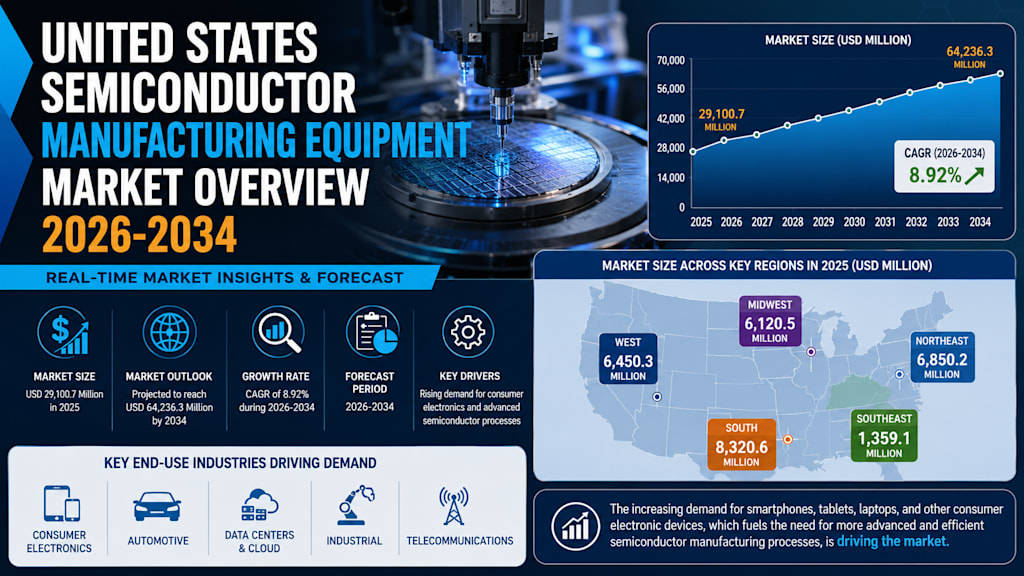
According to industry estimates, the United States semiconductor manufacturing equipment market reached USD 29,100.7 million in 2025. The market is projected to grow to USD 64,236.3 million by 2034, registering a CAGR of 8.92% during 2026–2034. Rising demand for smartphones, laptops, connected devices, and advanced computing applications is encouraging investments in semiconductor fabrication facilities and production technologies.
Key Factors Driving Growth in the United States Semiconductor Manufacturing Equipment Market
Several factors are contributing to the expansion of the semiconductor manufacturing equipment industry in the United States. One of the most important drivers is the growing consumption of electronic devices. Consumers and businesses increasingly rely on connected technologies, creating sustained demand for high-performance semiconductor components.
The expansion of 5G networks, electric vehicles, industrial automation systems, and Internet of Things (IoT) applications is also supporting semiconductor production growth. As chip manufacturers seek higher production efficiency and improved precision, investments in advanced equipment continue to rise.
In addition, efforts to strengthen domestic semiconductor production capabilities have encouraged the development of new fabrication facilities and manufacturing capacity. These developments create opportunities for equipment suppliers that support wafer fabrication, testing, assembly, inspection, and packaging processes.
Why Semiconductor Manufacturing Equipment Is Essential for Advanced Chip Production
Semiconductor manufacturing equipment forms the foundation of modern chip production. The fabrication process involves numerous highly specialized steps, including deposition, lithography, etching, cleaning, metrology, inspection, and packaging.
As semiconductor designs become more complex, manufacturers require equipment capable of achieving greater precision and consistency. Advanced nodes demand tighter tolerances and higher production yields, making sophisticated manufacturing tools increasingly important.
Equipment innovations help improve production efficiency, reduce defects, and support the development of smaller and more powerful semiconductor devices. These capabilities are essential for meeting the performance requirements of emerging technologies across multiple industries.
The growing complexity of semiconductor manufacturing also increases the importance of process control and quality assurance systems, further driving demand for advanced manufacturing equipment.
AI, Data Centers, and High-Performance Computing Creating New Equipment Demand
Artificial intelligence applications are becoming a major source of semiconductor demand. AI workloads require powerful processors capable of handling complex calculations and large volumes of data. As organizations expand their use of machine learning and generative AI technologies, semiconductor manufacturers are increasing production capacity to meet growing requirements.
Data centers are another important growth area. Cloud service providers continue investing in infrastructure to support digital transformation initiatives, streaming services, enterprise applications, and AI deployments. These facilities rely on advanced processors, memory devices, and networking chips that require sophisticated manufacturing processes.
High-performance computing systems used in scientific research, engineering simulations, and financial modeling also contribute to semiconductor demand. The need for more powerful computing capabilities is encouraging chipmakers to adopt advanced manufacturing technologies, creating opportunities for equipment suppliers throughout the value chain.
U.S. Semiconductor Manufacturing Investments Supporting Market Expansion
Investment activity remains a significant contributor to market growth. Semiconductor manufacturers are expanding production capacity to address rising demand and improve supply chain resilience.
New fabrication facilities require substantial investments in production equipment, process technologies, and automation systems. As facilities move toward larger-scale and more technologically advanced operations, equipment spending often represents a major portion of overall capital expenditures.
Federal and state-level initiatives supporting domestic semiconductor manufacturing have also contributed to increased investment activity. These efforts aim to strengthen local production capabilities and reduce supply chain vulnerabilities, creating a favorable environment for equipment providers.
Growing investments in research and development further support equipment demand as manufacturers pursue next-generation semiconductor technologies.
Technology Advancements Transforming the Semiconductor Manufacturing Equipment Industry
Technological progress continues to shape the semiconductor manufacturing equipment landscape. Equipment manufacturers are introducing solutions that improve accuracy, efficiency, and process control.
Automation has become increasingly important in semiconductor fabrication environments. Automated systems help reduce operational errors, improve throughput, and maintain consistent production quality. Manufacturers are also integrating advanced analytics and data-driven monitoring tools to optimize production performance.
Artificial intelligence and machine learning technologies are being incorporated into equipment management systems to support predictive maintenance and process optimization. These capabilities help manufacturers reduce downtime and improve operational efficiency.
Advanced packaging technologies are another area of development. As semiconductor architectures evolve, packaging solutions play a greater role in enhancing device performance and functionality. This trend creates additional opportunities for equipment suppliers focused on packaging and assembly technologies.
Opportunities for Equipment Manufacturers and Semiconductor Supply Chain Companies
The continued growth of semiconductor production presents opportunities for equipment manufacturers, component suppliers, technology providers, and service organizations.
Demand for advanced fabrication tools is expected to increase as manufacturers pursue higher production volumes and more sophisticated chip designs. Companies offering inspection systems, process control solutions, automation technologies, and manufacturing software may benefit from ongoing industry investments.
There are also opportunities in equipment maintenance, upgrades, technical support services, and specialized manufacturing solutions. As semiconductor facilities become more complex, manufacturers often seek partners that can help improve productivity and operational reliability.
Organizations involved in research and development collaborations may also find opportunities as the industry explores emerging semiconductor technologies and production methods.
Challenges Affecting the United States Semiconductor Manufacturing Equipment Market
Despite favorable growth prospects, the industry faces several challenges. Semiconductor manufacturing equipment is highly sophisticated and often requires substantial capital investment. The high cost of equipment can create financial pressures, particularly during periods of market uncertainty.
Supply chain disruptions can also affect equipment availability and production schedules. Since semiconductor manufacturing relies on globally interconnected supply networks, disruptions in one region may influence operations elsewhere.
Workforce development remains another challenge. Advanced semiconductor manufacturing requires highly skilled engineers, technicians, and specialists. As industry investments increase, competition for qualified talent may intensify.
In addition, rapid technological changes require continuous innovation and research spending, creating pressure on companies to maintain competitiveness while managing costs.
Future Outlook of the United States Semiconductor Manufacturing Equipment Market Through 2034
The long-term outlook for the United States semiconductor manufacturing equipment market remains positive. Continued growth in consumer electronics, artificial intelligence applications, cloud computing infrastructure, automotive electronics, and industrial automation is expected to support semiconductor demand over the coming years.
Investments in domestic manufacturing capacity, combined with ongoing technological advancements, are likely to create new opportunities throughout the semiconductor ecosystem. Equipment manufacturers that focus on innovation, automation, and advanced process technologies may be well positioned to benefit from these developments.
As semiconductor devices become increasingly important across industries, manufacturing equipment will continue to play a critical role in enabling efficient, reliable, and scalable chip production. The market's projected expansion through 2034 reflects the growing importance of semiconductor technologies in supporting digital transformation and technological progress across the United States.
About the Creator
Kim Soo hyun
My name is Kim Soo hyun, and I am a research analyst at IMARC Group, specializing in market trends and data analysis to provide insights and support strategic decision-making.
Enjoyed the story? Support the Creator.
Subscribe for free to receive all their stories in your feed.
Comments
There are no comments for this story
Be the first to respond and start the conversation.