
United States Secondhand Luxury Goods Market to Reach USD 16,240.23 Million by 2034
The United States secondhand luxury goods market size was valued at USD 8,714.44 Million in 2025 and is projected to reach USD 16,240.23 Million by 2034, exhibiting a CAGR of 7.16% during the forecast period 2026-2034.

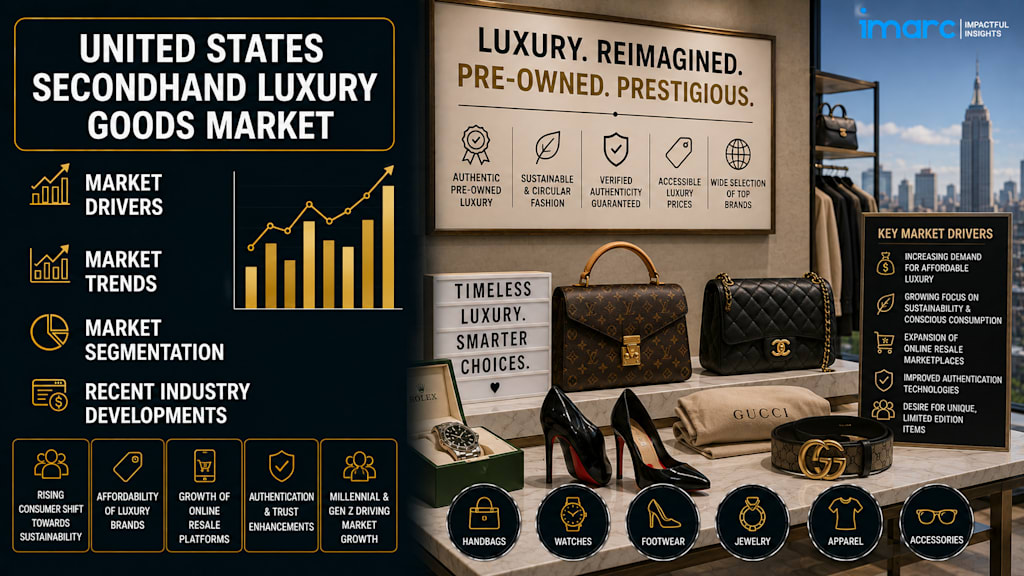
United States Secondhand Luxury Goods Market Size, Growth, and Forecast (2026–2034)
Luxury shopping is undergoing a significant transformation. For many years, purchasing luxury products was mainly associated with buying brand-new items directly from high-end retailers. Today, however, changing consumer attitudes and digital innovation are creating a new approach to luxury ownership. In 2026, secondhand luxury products are increasingly becoming part of mainstream consumer behavior.
The United States secondhand luxury goods market was valued at USD 8,714.44 Million in 2025 and is projected to reach USD 16,240.23 Million by 2034, expanding at a compound annual growth rate (CAGR) of 7.16% during 2026–2034. This growth reflects increasing interest in sustainable consumption, digital resale platforms, and more accessible luxury experiences.
Secondhand luxury goods include products such as designer handbags, watches, jewelry, apparel, footwear, and accessories that are resold through online and offline channels.
Request a Sample Report with Latest 2026 Data & Forecasts:
Key Trends Shaping the United States Secondhand Luxury Goods Market
Several important trends are influencing the development of the market:
• Growing focus on sustainability and responsible consumer behavior
• Rising popularity of AI-powered digital resale platforms
• Increasing demand for authenticated pre-owned luxury products
• Expansion of online luxury marketplaces and mobile shopping experiences
• Growing interest in affordable access to premium brands
These trends indicate how consumer preferences are shifting toward value, convenience, and environmental awareness.
Major Growth Drivers in the United States Secondhand Luxury Goods Industry
Several factors continue supporting market growth.
One of the major drivers is the rising sustainability consciousness among younger consumers, particularly Gen Z and millennials. Many consumers increasingly prioritize environmentally responsible purchasing decisions and prefer extending the life cycle of products.
Another significant factor is the rapid expansion of digital resale platforms. Technology is making the process of buying and selling luxury goods easier, safer, and more convenient.
The democratization of luxury access is also influencing growth. Consumers who previously considered luxury products unaffordable now have opportunities to purchase premium brands at lower price points.
Consumer demographics are also playing an important role. Women represented 58.0% of the demographic segment in 2025, highlighting strong participation within the market.
Additionally, changing attitudes toward ownership and value continue supporting industry expansion.
Role of Technology in the Secondhand Luxury Market
Technology continues to transform the resale landscape.
Artificial intelligence is helping platforms authenticate products and improve trust among buyers and sellers.
Data analytics enables platforms to understand customer behavior and provide personalized recommendations.
Digital tools are improving pricing strategies and inventory management.
Mobile commerce and user-friendly applications are also making luxury resale more accessible.
These innovations continue improving customer experiences and operational efficiency.
Investment Opportunities in the United States Secondhand Luxury Goods Market
The growth of the market presents several attractive opportunities for investors and businesses.
Companies are investing in digital resale platforms, authentication technologies, and customer engagement solutions to strengthen competitive positioning.
There is also increasing interest in luxury resale categories including designer fashion, accessories, and collectibles.
Online channels continue dominating distribution, accounting for 60.0% of market activity in 2025, creating significant opportunities for digital commerce expansion.
The South region, which held 34.6% of national revenue in 2025, continues presenting notable opportunities for market growth.
With expansion expected through 2034, the market offers promising long-term potential.
Challenges Impacting the United States Secondhand Luxury Goods Industry
Despite positive growth prospects, several challenges remain.
One challenge is counterfeit product concerns, which can influence consumer confidence.
Another issue is pricing variability, as product values may fluctuate depending on demand and condition.
Maintaining product authenticity and transparency also remains important.
Additionally, increasing competition among resale platforms may affect market dynamics.
Future Outlook (2026–2034)
Looking ahead, the United States secondhand luxury goods market is expected to continue its strong growth trajectory.
Between 2026 and 2034, demand for accessible, sustainable, and digitally enabled luxury experiences is likely to increase significantly.
Future developments may focus on improved authentication systems, personalized recommendations, and enhanced online shopping experiences.
The increasing preference for sustainable lifestyles and changing consumer attitudes toward ownership are also expected to support long-term expansion.
Overall, the market appears positioned for sustained growth driven by technology innovation, changing consumer values, and expanding luxury accessibility.
Conclusion
The United States secondhand luxury goods market is evolving rapidly as sustainability awareness, technology, and changing consumer preferences continue reshaping purchasing behavior. Supported by digital platforms and broader access to premium products, the market is expected to experience substantial growth during 2026–2034.
Although challenges such as authentication and competition remain, ongoing innovation and investment are likely to support future development. As consumers increasingly embrace value-driven and environmentally conscious purchasing choices, secondhand luxury goods are expected to remain an important part of the retail landscape.
About the Creator
Jackson Watson
I'm a market research analyst at Imarc group company delivering data-driven insights, industry analysis, and customized research solutions. We support businesses with market sizing, competitive analysis, and strategic decision-making.
Enjoyed the story? Support the Creator.
Subscribe for free to receive all their stories in your feed.
Comments
There are no comments for this story
Be the first to respond and start the conversation.