
United States Secondhand Luxury Goods Market Size to Worth USD 16,240.23 Million by 2034
The United States secondhand luxury goods market size was valued at USD 8,714.44 Million in 2025 and is projected to reach USD 16,240.23 Million by 2034, exhibiting a CAGR of 7.16% during the forecast period 2026-2034.

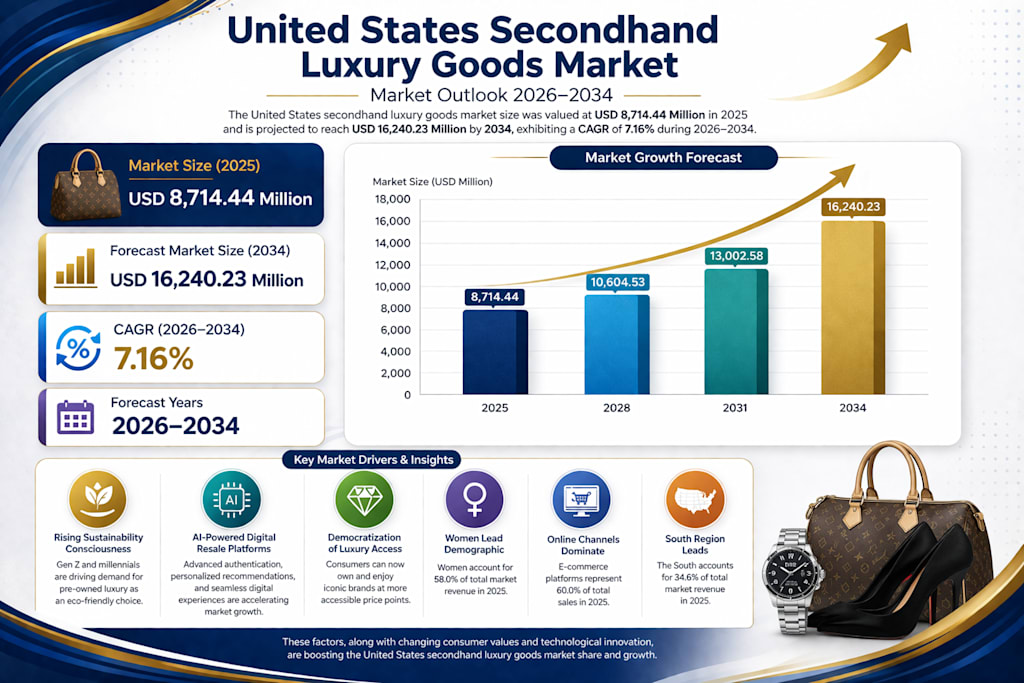
United States Secondhand Luxury Goods Market Size, Growth, and Forecast (2026–2034)
The United States secondhand luxury goods market is witnessing strong growth as consumers increasingly embrace resale platforms and sustainable consumption. In 2026, the market reflects a shift toward more accessible and environmentally conscious luxury shopping.
The market was valued at USD 8,714.44 Million in 2025 and is projected to reach USD 16,240.23 Million by 2034, expanding at a compound annual growth rate (CAGR) of 7.16% during 2026–2034. This growth highlights the rising popularity of pre-owned luxury items among a wide range of consumers.
Secondhand luxury goods include products such as designer clothing, handbags, watches, and accessories. These items offer consumers the opportunity to access premium brands at relatively lower prices while promoting sustainability.
Request a Sample Report with Latest 2026 Data & Forecasts:
Key Trends Shaping the United States Secondhand Luxury Goods Market
Several important trends are influencing the development of the market:
• Increasing focus on sustainability and circular fashion
• Rising adoption of AI-powered digital resale platforms
• Growing demand for affordable access to luxury products
• Expansion of online marketplaces and mobile applications
• Increasing trust in authentication and quality verification systems
These trends reflect a shift toward more responsible and technology-driven consumption.
Major Growth Drivers in the United States Secondhand Luxury Goods Industry
The growth of the market is supported by several key factors.
One of the primary drivers is the rising sustainability consciousness among younger consumers, particularly Gen Z and millennials. These groups are more inclined to purchase pre-owned items to reduce environmental impact.
Another important factor is the democratization of luxury, which allows more consumers to access high-end products at lower prices.
The rapid growth of digital resale platforms is also contributing to market expansion. These platforms provide convenience, transparency, and a wide selection of products.
Additionally, the increasing acceptance of secondhand goods is changing traditional perceptions and encouraging broader adoption.
Consumer and Distribution Insights
Consumer and distribution patterns provide valuable insights into the market.
Women represent the largest demographic segment, accounting for 58.0% of the market in 2025, reflecting strong interest in categories such as fashion and accessories.
Online channels dominate distribution, holding 60.0% of the market share, highlighting the importance of digital platforms in driving sales.
Regionally, the Southern United States accounts for 34.6% of total revenue, making it the largest regional market. This reflects strong consumer demand and expanding access to resale platforms in the region.
Role of Technology in Resale Platforms
Technology is playing a central role in transforming the secondhand luxury market.
AI-powered platforms are improving product recommendations, pricing accuracy, and fraud detection. These technologies enhance user experience and build trust among buyers and sellers.
Authentication technologies are ensuring the authenticity of luxury items, which is critical for maintaining consumer confidence.
Mobile applications and digital marketplaces are making it easier for users to browse, buy, and sell products.
These technological advancements are driving efficiency and expanding market reach.
Investment Opportunities in the United States Secondhand Luxury Goods Market
The strong growth of the market is creating significant investment opportunities.
Companies are investing in digital resale platforms, authentication technologies, and logistics solutions to improve operations and scalability.
There is also growing interest in circular fashion initiatives and sustainable business models.
Investments in marketing and brand partnerships are helping platforms reach new audiences and expand their user base.
With continued growth expected through 2034, the market offers promising opportunities for long-term development.
Challenges Impacting the United States Secondhand Luxury Goods Industry
Despite strong growth, the market faces several challenges.
One of the key issues is concerns about product authenticity, which can affect consumer confidence.
Another challenge is the logistics of managing inventory and returns, particularly for online platforms.
Pricing transparency and competition among platforms can also impact profitability.
Additionally, maintaining quality standards across a wide range of products remains a critical concern.
Future Outlook (2026–2034)
Looking ahead, the United States secondhand luxury goods market is expected to continue its strong growth as sustainability and digital adoption increase.
Between 2026 and 2034, the demand for pre-owned luxury products is likely to rise significantly. Consumers will continue to prioritize affordability, sustainability, and variety.
Technological advancements will further enhance the market. The integration of AI, authentication tools, and digital platforms will improve efficiency and user experience.
The expansion of circular economy practices will also support long-term growth.
Overall, the market is poised for substantial expansion, driven by changing consumer attitudes, technological innovation, and sustainability trends.
Conclusion
The United States secondhand luxury goods market is evolving rapidly, supported by growing sustainability awareness, advancements in digital platforms, and increasing demand for affordable luxury. With projected growth from 2026 to 2034, the market is expected to play a key role in the future of retail.
While challenges such as authenticity concerns and logistics persist, ongoing innovation and investment are likely to support long-term growth. As consumer preferences continue to shift, secondhand luxury goods will become an increasingly important part of the fashion and retail landscape.
About the Creator
Jackson Watson
I'm a market research analyst at Imarc group company delivering data-driven insights, industry analysis, and customized research solutions. We support businesses with market sizing, competitive analysis, and strategic decision-making.
Enjoyed the story? Support the Creator.
Subscribe for free to receive all their stories in your feed.
Comments
There are no comments for this story
Be the first to respond and start the conversation.