
United States School Furniture Market Expected to Reach US$3.66 Billion by 2034 as Schools Prioritize Flexible Learning Spaces
Rising investments in educational infrastructure, ergonomic classroom designs, and collaborative learning environments are reshaping the future of school furniture across America

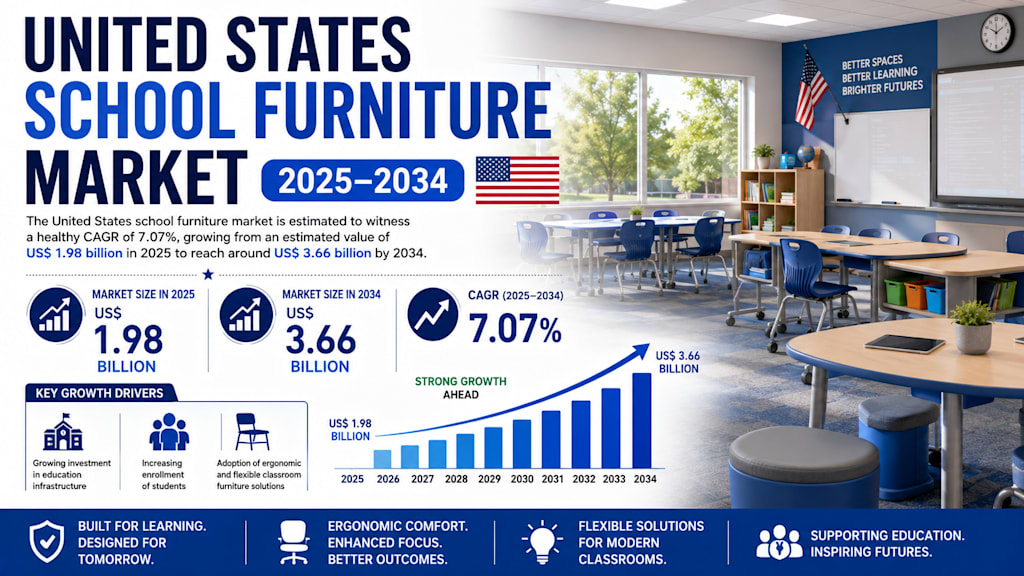
The United States school furniture market is undergoing a major transformation as educational institutions increasingly modernize classrooms to support collaborative learning, student well-being, and technology integration. Traditional classroom layouts featuring rigid rows of desks are rapidly giving way to flexible, ergonomic, and student-centered learning environments.
According to Renub Research, the United States school furniture market is projected to grow from US$1.98 billion in 2025 to approximately US$3.66 billion by 2034, expanding at a healthy CAGR of 7.07% between 2026 and 2034.
The market’s growth is being fueled by rising investments in education infrastructure, increasing student enrollment, and growing awareness of the importance of ergonomic and adaptable classroom furniture. As schools across the country rethink how learning spaces should function in the modern era, furniture is becoming a central part of educational strategy rather than simply a classroom necessity.
School Furniture Is Becoming Essential to Modern Learning Environments
School furniture includes desks, chairs, tables, lockers, boards, library furnishings, laboratory setups, and technology-integrated classroom equipment designed to support teaching and learning activities.
In recent years, the role of furniture in education has evolved significantly. Schools are no longer focused solely on durability and affordability. Instead, they are prioritizing furniture solutions that improve concentration, support physical comfort, encourage collaboration, and adapt to multiple teaching methods.
Modern classroom furniture is increasingly designed with:
- Ergonomic support
- Flexibility and mobility
- Space optimization
- Technology integration
- Collaborative learning layouts
- Student wellness considerations
As educational models continue evolving, classroom environments are being redesigned to support active participation and engagement rather than passive learning.
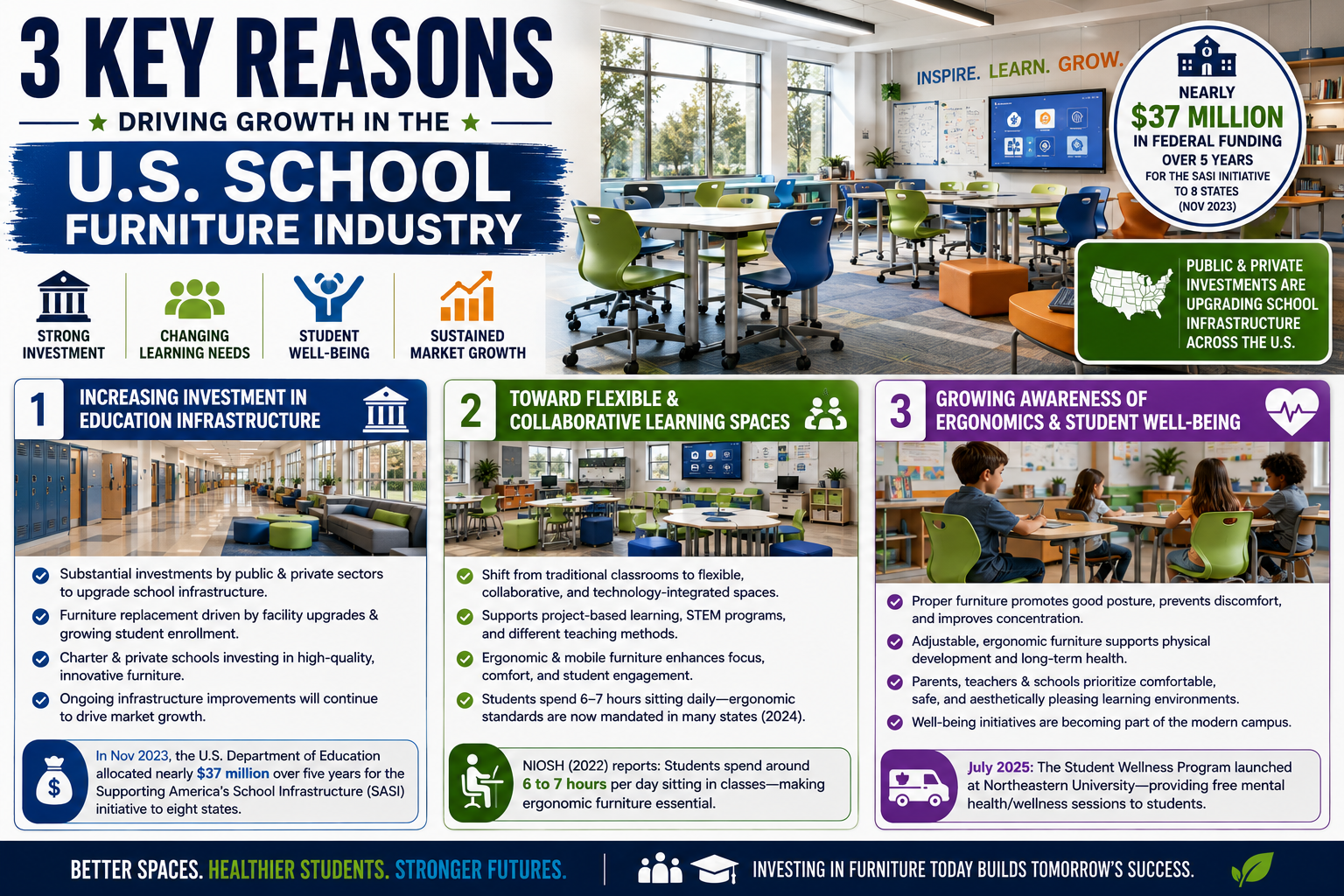
Massive Investment in Education Infrastructure Is Driving Growth
One of the biggest drivers behind the U.S. school furniture market is the growing investment in educational infrastructure from both public and private sectors.
Government agencies and school districts are spending heavily to modernize school facilities, replace aging furniture, and create more effective learning environments for students.
A significant milestone occurred in November 2023 when the U.S. Department of Education allocated nearly US$37 million over five years for the Supporting America’s School Infrastructure (SASI) initiative across eight states.
Growing student enrollment in several states is also increasing the need for additional desks, seating solutions, and storage furniture. Private schools and charter institutions are further contributing to market growth by investing in premium and innovative classroom environments designed to attract students and families.
This nationwide infrastructure upgrade trend is expected to sustain long-term demand for modern educational furniture solutions.
Flexible Learning Spaces Are Redefining Classroom Design
Perhaps the most important trend reshaping the market is the growing shift toward flexible and collaborative learning environments.
Traditional classrooms with fixed desks arranged in rows are increasingly being replaced by dynamic spaces that can be quickly reconfigured based on teaching styles and learning activities.
Project-based learning, STEM education, and technology-integrated teaching methods require furniture that supports movement, interaction, and adaptability.
As a result, schools are increasingly purchasing:
- Movable desks and tables
- Mobile seating solutions
- Collaborative workstation furniture
- Modular classroom systems
- Adjustable-height desks
- Flexible storage units
Furniture manufacturers are responding with innovative designs intended to improve student focus, mobility, and engagement.
The rise of student-centered learning approaches has made furniture flexibility an essential requirement rather than an optional feature.
Ergonomic Furniture Is Becoming a Major Priority
Awareness surrounding student health and well-being is significantly influencing furniture purchasing decisions across the United States.
Students often spend six to seven hours per day sitting in classrooms, making posture and comfort increasingly important concerns for educators and parents alike.
Poorly designed furniture can contribute to:
- Back pain
- Poor posture
- Physical discomfort
- Reduced concentration
- Long-term health issues
To address these concerns, schools are increasingly investing in ergonomic chairs, adjustable desks, and standing desk solutions that promote better posture and physical movement.
Several state governments introduced ergonomic standards for public school furniture in 2024, further accelerating adoption of wellness-oriented classroom designs.
The growing focus on student wellness extends beyond physical comfort. Educational institutions increasingly recognize that classroom design directly impacts concentration, engagement, and academic performance.
The launch of wellness-focused student initiatives, such as the Student Wellness Program introduced at Northeastern University in 2025, reflects the broader institutional emphasis on student health and support services.
Budget Constraints Continue Challenging Public Schools
Despite strong growth potential, financial limitations remain one of the most pressing challenges within the school furniture market.
Many public schools face tight budget restrictions that limit their ability to replace outdated furniture or invest in high-quality modern solutions.
Educational institutions often prioritize spending on:
- Technology infrastructure
- Building repairs
- Staff hiring
- Learning materials
- Safety improvements
As a result, furniture replacement projects are sometimes delayed or scaled back.
Smaller schools and underfunded districts may struggle to afford premium ergonomic furniture, leading them to rely on lower-cost products with shorter lifespans.
Economic uncertainty and shifting funding priorities can further complicate long-term purchasing plans.
Durability and Maintenance Remain Critical Concerns
School furniture experiences heavy daily usage, making durability one of the most important considerations for buyers.
Furniture must withstand:
- Constant movement
- Frequent cleaning
- Wear and tear
- Student misuse
- Environmental factors
Although schools prefer long-lasting furniture, higher durability often comes with increased costs.
Manufacturers must balance affordability with quality while also meeting safety regulations and maintenance requirements.
Many companies are now designing furniture using hybrid materials such as metal-wood combinations and reinforced plastics to improve strength and longevity while maintaining modern aesthetics.
Seating Furniture Is Seeing Strong Demand
Among product categories, seating furniture represents one of the fastest-growing segments within the market.
Schools are increasingly purchasing ergonomic chairs, stools, benches, and active seating solutions designed to support posture and movement during extended learning sessions.
The rise of collaborative learning environments has also increased demand for lightweight and movable seating arrangements that can be easily adjusted for group activities.
Standing desks and active seating concepts are becoming especially popular as educators encourage movement and flexibility within classrooms.
Smart and Modular Storage Solutions Are Gaining Popularity
Storage furniture is also evolving rapidly in response to changing classroom needs.
Modern schools increasingly require multifunctional storage systems capable of maximizing limited classroom space. Lockers, cabinets, shelves, and mobile storage units are now designed with greater adaptability and customization options.
Some schools are even integrating smart storage systems with digital locking capabilities and enhanced security features.
Mobile storage solutions are becoming particularly valuable because they allow schools to quickly reorganize classrooms for different activities and teaching methods.
Wood and Metal Continue Dominating Material Preferences
Material selection remains a major factor in school furniture design and purchasing decisions.
Wood Furniture
Wood furniture remains highly popular because of its durability, natural appearance, and sustainability appeal. Materials such as plywood and medium-density fiberboard (MDF) offer cost-effective alternatives while maintaining strength and design flexibility.
Many schools also favor sustainably sourced wood products to align with environmental goals.
Metal Furniture
Metal furniture continues playing a major role due to its strength, corrosion resistance, and low maintenance requirements. Powder-coated metal furniture is especially common in desks, lockers, and laboratory settings.
Hybrid furniture combining metal with wood or plastic materials is increasingly popular because it balances durability with modern aesthetics.
Technology Integration Is Influencing Classroom Furniture Design
As smart classrooms become more common, educational institutions are seeking furniture compatible with modern technology needs.
Schools increasingly require:
- Desks with charging ports
- Interactive workstations
- Technology-friendly collaborative tables
- Cable management systems
- Furniture compatible with digital learning devices
Multi-functional classroom furniture is becoming increasingly important as schools adopt hybrid learning models and digital education tools.
Manufacturers are focusing heavily on innovation to create products that support evolving educational technologies while maintaining comfort and functionality.
Offline Sales Channels Still Dominate the Market
Despite the growth of online procurement options, offline purchasing channels remain highly important within the school furniture market.
Educational institutions often prefer purchasing furniture through physical showrooms and local suppliers because they can directly evaluate product quality, durability, and comfort before making large-volume purchases.
Offline suppliers also offer:
- Customized furniture solutions
- Installation services
- Faster local delivery
- Direct vendor communication
- Bulk negotiation opportunities
However, online purchasing platforms are gradually gaining popularity because of broader product availability and pricing transparency.
California, Texas, New York, and Florida Lead Regional Demand
Regional demand patterns vary significantly across the United States.
California
California’s school furniture market is driven by sustainability initiatives and investments in modern learning infrastructure. Eco-friendly materials, adjustable desks, and collaborative classroom setups are especially popular.
Texas
Texas continues seeing strong demand because of rapid population growth and increasing student enrollment. Schools prioritize affordable and durable furniture solutions capable of accommodating expanding classroom sizes.
New York
Urban schools in New York emphasize space-saving and mobile furniture designs that maximize classroom efficiency and support collaborative learning environments.
Florida
Florida’s humid climate has increased demand for moisture-resistant and easy-to-maintain furniture. Technology-compatible classroom furniture is also gaining traction across the state.
Major Companies Intensify Market Competition
Competition within the U.S. school furniture market remains strong as companies focus on innovation, ergonomics, and flexible classroom solutions.
Key companies include:
- Steelcase
- MillerKnoll
- The HON Company
- Virco
- Fleetwood Group
- VS America
- Hertz Furniture
- Paragon Furniture
- Haskell Education
- Marco Group
Manufacturers are increasingly differentiating themselves through ergonomic innovation, sustainability practices, and modular classroom solutions.
Final Thoughts
The United States school furniture market is evolving rapidly as educational institutions embrace modern classroom philosophies centered around flexibility, collaboration, student wellness, and technology integration.
With the market projected to reach US$3.66 billion by 2034, the industry is expected to remain a critical part of America’s broader educational modernization efforts.
However, long-term success will depend on balancing affordability with innovation while ensuring furniture durability, adaptability, and ergonomic value.
About the Creator
Enjoyed the story? Support the Creator.
Subscribe for free to receive all their stories in your feed.
Comments
There are no comments for this story
Be the first to respond and start the conversation.