
United States School Bus Market Size and Forecast 2025–2033: Electric Fleets, Safety Innovations, and Sustainability Goals Reshape Student Transportation
America's Largest Public Transportation Network Enters a New Era of Electrification, Smart Safety Systems, and Fleet Modernization

For decades, the iconic yellow school bus has been a symbol of education and community across the United States. Every school day, hundreds of thousands of buses transport millions of students safely to classrooms, making the school bus system one of the most important public transportation networks in the country.
Today, however, the industry is undergoing a significant transformation. Driven by environmental concerns, government incentives, technological innovations, and growing student populations, school districts are investing heavily in modern transportation solutions. Electric school buses, advanced safety technologies, real-time monitoring systems, and sustainable fleet management strategies are rapidly changing how students travel.
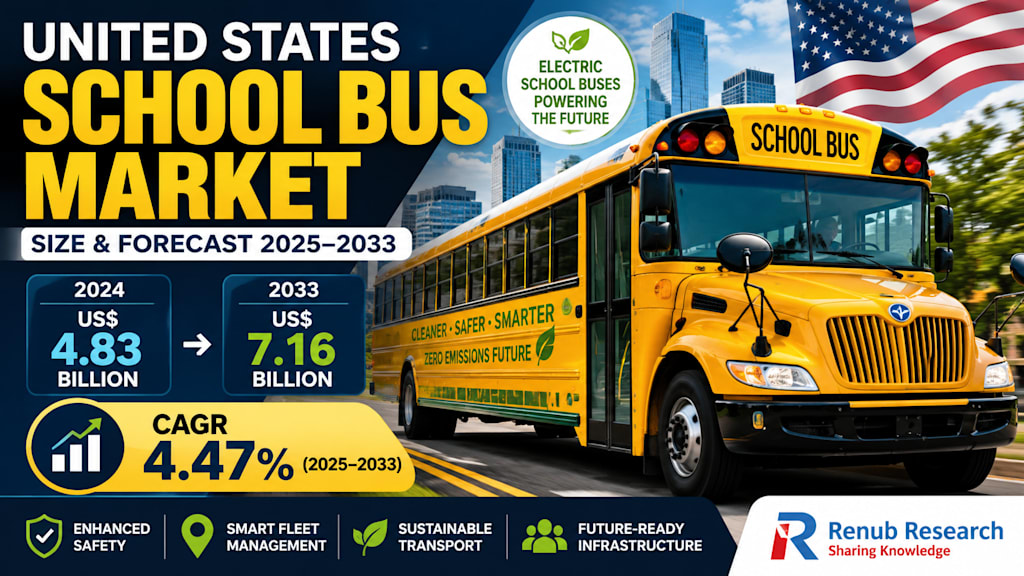
According to Renub Research, the United States School Bus Market is projected to grow from US$ 4.83 billion in 2024 to US$ 7.16 billion by 2033, expanding at a CAGR of 4.47% during 2025–2033.
The growth reflects increasing investments in fleet modernization, emissions reduction initiatives, and enhanced student safety measures. As school districts nationwide balance budget limitations with sustainability objectives, the school bus market is becoming a critical component of America's transportation and environmental strategies.
The Backbone of Student Transportation
The United States operates the world's largest school transportation network. Nearly 480,000 school buses transport approximately 26 million students every day, making school buses the most widely used form of public transportation in the country.
School buses offer several advantages beyond student mobility. They reduce traffic congestion around schools, lower transportation costs for families, and contribute significantly to road safety. Studies consistently show that school buses remain among the safest modes of transportation for children.
Yet much of the current fleet is aging. Thousands of buses remain in service well beyond their intended lifespan, creating challenges related to maintenance costs, emissions, fuel efficiency, and safety compliance.
As districts seek to replace older vehicles, demand for advanced school buses continues to rise, creating strong opportunities for manufacturers and technology providers.
Fleet Modernization Driving Market Expansion
One of the strongest growth catalysts for the industry is the nationwide effort to modernize aging fleets.
Many school buses currently operating across the United States are more than a decade old. These older vehicles often require costly repairs, consume more fuel, and produce higher emissions compared to newer models.
Fleet modernization programs are enabling school districts to replace outdated buses with vehicles that deliver:
Improved fuel efficiency
Enhanced passenger safety
Lower maintenance expenses
Better environmental performance
Advanced connectivity capabilities
Federal and state governments are supporting these upgrades through grants, incentive programs, and infrastructure investments designed to accelerate fleet replacement.
As districts prioritize long-term operational savings and sustainability goals, modernization efforts are expected to remain a major growth driver through 2033.
Electric School Buses Revolutionizing Transportation
The most significant trend shaping the market is the rapid adoption of electric school buses.
Currently, more than 95% of school buses in the United States rely on diesel fuel. While diesel buses have long been the industry standard, concerns regarding emissions and public health are encouraging districts to pursue cleaner alternatives.
Children are particularly vulnerable to air pollution exposure. Research has linked diesel exhaust emissions to respiratory illnesses, asthma complications, and other health concerns.
The transition toward electric buses offers several benefits:
Reduced Greenhouse Gas Emissions
Industry estimates suggest that converting the entire U.S. school bus fleet to electric vehicles could eliminate approximately 5.3 million metric tons of greenhouse gas emissions annually.
Improved Student Health
Zero-emission buses reduce children's exposure to harmful pollutants during daily transportation.
Lower Operating Costs
Although electric buses require higher initial investment, they often provide lower fuel and maintenance costs over their operational lifespan.
Energy Efficiency
Electric drivetrains convert energy more efficiently than conventional internal combustion engines, reducing overall energy consumption.
Government initiatives such as the Environmental Protection Agency's Clean School Bus Program continue accelerating electric bus adoption nationwide.
Student Enrollment and Urban Growth Fuel Demand
Demographic changes remain another important factor influencing market growth.
Rapid urbanization and suburban expansion are increasing demand for reliable student transportation services. Growing school districts must expand bus fleets to accommodate larger student populations and longer transportation routes.
Several factors are contributing to increased transportation requirements:
Population growth in suburban communities
Expansion of school districts
Consolidation of educational institutions
Increased transportation coverage requirements
Rising enrollment levels
Even in rural regions, school buses remain essential due to long travel distances between students' homes and educational facilities.
As population shifts continue across the country, transportation systems must evolve to support changing educational infrastructure needs.
Smart Technologies Enhancing Student Safety
Safety remains the highest priority within the school bus industry.
Manufacturers are integrating advanced technologies designed to improve both driver awareness and student protection.
Modern school buses increasingly include:
GPS Fleet Tracking
Real-time location tracking allows transportation departments and parents to monitor bus routes more effectively.
Stop-Arm Cameras
Automated camera systems help identify drivers who illegally pass stopped school buses, improving student safety during boarding and unloading.
Collision Avoidance Systems
Advanced sensors can detect obstacles and provide warnings to drivers, reducing accident risks.
Lane Departure Alerts
Driver assistance systems help prevent unintended lane changes and roadway departures.
Onboard Surveillance Systems
Video monitoring provides additional security and incident documentation.
RFID Student Tracking
Student identification technologies improve accountability and ensure students board and exit at appropriate locations.
These innovations are transforming school buses into connected transportation platforms capable of delivering higher levels of safety and operational efficiency.
Budget Constraints Continue to Challenge Adoption
Despite favorable growth prospects, the industry faces significant financial challenges.
The acquisition cost of new school buses—particularly electric models—can place substantial strain on school district budgets.
Electric school buses often cost significantly more than traditional diesel buses, creating affordability concerns for many districts.
Budget pressures are especially severe for:
Rural school districts
Small municipalities
Underfunded educational systems
Communities facing declining tax revenues
Although federal and state incentive programs help offset costs, funding limitations continue to delay fleet replacement projects in many regions.
Balancing educational priorities with transportation investments remains a difficult challenge for school administrators nationwide.
Infrastructure Limitations Slow Electrification
The shift toward electric school transportation also introduces infrastructure-related challenges.
Successful deployment of electric buses requires:
Charging stations
Electrical grid upgrades
Energy management systems
Maintenance training programs
Fleet scheduling optimization
Many districts lack the necessary infrastructure to support large-scale electric bus operations.
Rural areas often face additional difficulties due to limited electrical capacity and longer transportation routes.
Furthermore, charging schedules must be carefully coordinated to ensure vehicle availability during peak operating periods.
As electrification accelerates, investments in charging infrastructure will become increasingly important for sustaining market growth.
California Leads the Electric School Bus Movement
California remains the nation's most influential school bus market for clean transportation initiatives.
Aggressive climate policies, air quality regulations, and substantial funding programs have positioned the state as a leader in school bus electrification.
School districts throughout California are replacing diesel fleets with electric alternatives while simultaneously investing in charging infrastructure.
Major metropolitan regions such as Los Angeles, San Diego, and San Francisco are driving adoption through sustainability commitments and environmental mandates.
The state's leadership continues to influence transportation policies nationwide.
Texas Expands Capacity to Meet Population Growth
Texas represents one of the largest school transportation markets in the United States.
Rapid population growth, expanding suburban communities, and large rural districts create strong demand for new buses and fleet upgrades.
Although diesel buses remain dominant, Texas districts are increasingly exploring alternative fuel technologies and pilot electric bus programs.
The state's vast geographic size creates unique transportation challenges, making reliable fleet capacity and route optimization essential priorities.
Continued population growth is expected to sustain long-term market demand.
New York Prioritizes Sustainability and Smart Transportation
New York's school transportation market is heavily influenced by sustainability objectives and urban transportation requirements.
The state is actively promoting electric bus adoption through policy initiatives and funding programs aimed at reducing emissions.
New York City and surrounding metropolitan areas are investing in:
Electric bus fleets
Smart routing systems
Real-time monitoring technologies
Advanced safety solutions
Meanwhile, rural districts continue to rely on school buses for essential student transportation services across long travel distances.
Strong government support positions New York as a key growth market for next-generation school transportation solutions.
Market Segmentation Analysis
By Power Train Type
IC Engine
Internal combustion engine buses continue to dominate the market due to established infrastructure and lower acquisition costs.
Hybrid and Electric
Hybrid and electric buses are experiencing the fastest growth, driven by sustainability initiatives and government funding support.
By Design Type
Type A
Smaller buses often used for special transportation requirements and lower-capacity routes.
Type B
Mid-sized vehicles designed for moderate passenger capacity.
Type C
The most widely used conventional school bus configuration in the United States.
Type D
Transit-style buses commonly used for high-capacity urban transportation routes.
Competitive Landscape
The United States school bus market remains highly competitive, with established manufacturers investing heavily in electric vehicle technologies, connectivity systems, and safety innovations.
Leading companies are focusing on strategic partnerships, production expansion, and research and development to strengthen their market positions.
Major participants include:
Blue Bird Corporation
Navistar Inc. (IC Bus)
Daimler AG (Thomas Built Buses)
Collins Bus Corporation
Van-Con Inc.
Starcraft Bus
Trans Tech
Lion Electric Company
GreenPower Motor Company
10 Recent Developments from Key School Bus Manufacturers
1. Blue Bird Corporation
Blue Bird expanded production capacity for electric school buses while increasing partnerships with charging infrastructure providers across multiple states.
2. IC Bus (Navistar)
IC Bus enhanced its electric vehicle portfolio and expanded connected fleet management capabilities for school transportation operators.
3. Thomas Built Buses
Thomas Built Buses strengthened deployment of electric school buses through its Jouley platform and continued collaboration with energy infrastructure partners.
4. Lion Electric Company
Lion Electric expanded electric school bus deliveries to numerous U.S. school districts and increased manufacturing capabilities to support rising demand.
5. GreenPower Motor Company
GreenPower introduced new zero-emission school transportation solutions aimed at improving operational efficiency and sustainability.
6. Blue Bird Corporation
The company expanded advanced driver-assistance technologies across multiple school bus models to improve safety performance.
7. Thomas Built Buses
Thomas Built increased adoption of battery-electric buses among public school districts participating in clean transportation initiatives.
8. IC Bus
IC Bus continued integrating telematics and route optimization solutions to enhance fleet efficiency and maintenance management.
9. Lion Electric Company
The company expanded partnerships with utility providers to support charging infrastructure deployment for electric school bus fleets.
10. GreenPower Motor Company
GreenPower accelerated commercialization of electric vehicle platforms designed specifically for educational transportation applications.
Future Outlook
The future of the United States school bus market will be defined by electrification, connectivity, sustainability, and safety innovation.
Federal funding programs, stricter emissions regulations, and increasing environmental awareness are expected to accelerate the transition from diesel-powered buses to cleaner transportation alternatives. At the same time, technological advancements will continue improving operational efficiency and student safety.
As school districts seek to balance financial realities with modernization goals, manufacturers that provide cost-effective, reliable, and environmentally sustainable transportation solutions will be best positioned for success.
With millions of students depending on school transportation every day, the industry will remain a critical component of America's educational infrastructure.
Final Thoughts
The United States School Bus Market is entering a transformative period characterized by fleet modernization, electric vehicle adoption, and advanced safety technologies. Valued at US$ 4.83 billion in 2024 and projected to reach US$ 7.16 billion by 2033, the market is expected to maintain steady growth as districts invest in safer, cleaner, and smarter transportation solutions.
From California's aggressive electrification programs to Texas's capacity expansion and New York's sustainability initiatives, school transportation is evolving into a technologically advanced and environmentally responsible sector. As innovation continues to reshape the industry, the iconic yellow school bus is set to become cleaner, smarter, and more efficient than ever before.
About the Creator
Enjoyed the story? Support the Creator.
Subscribe for free to receive all their stories in your feed.
Comments
There are no comments for this story
Be the first to respond and start the conversation.