
United States Rice Market Size Growth Share Trends Demand & Forecast 2034
The United States rice market reached USD 7.1 billion in 2025 and is projected to grow to USD 8.9 billion by 2034.

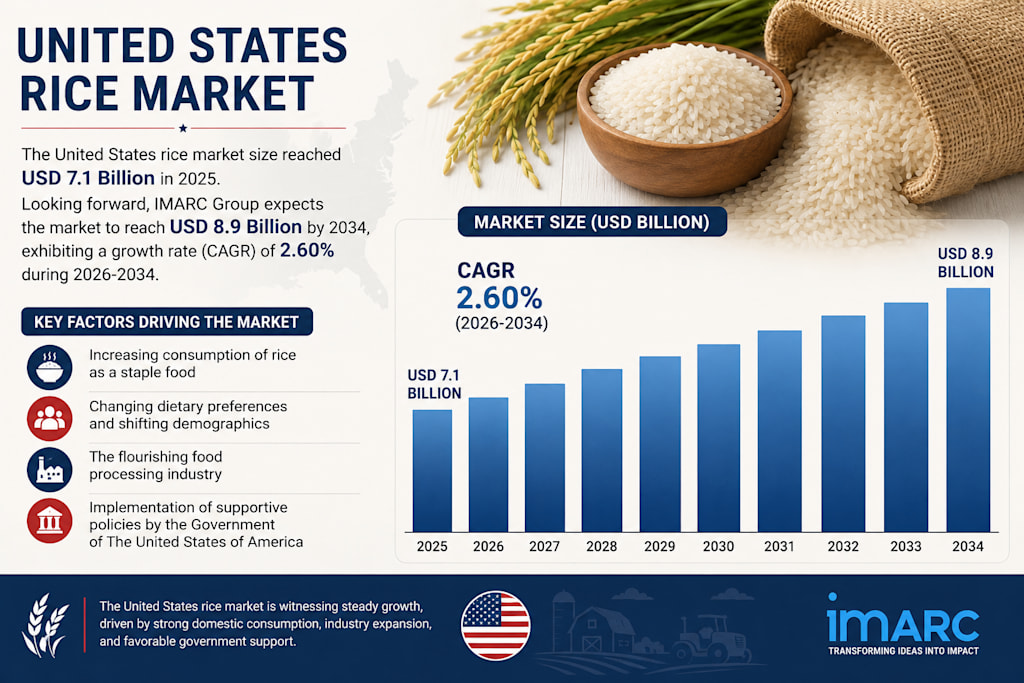
United States Rice Market Size, Share, and Growth Forecast (2026–2034)
The United States rice market continues to play an important role in the country’s agricultural and food processing sectors. The market reached USD 7.1 billion in 2025 and is projected to grow to USD 8.9 billion by 2034, registering a CAGR of 2.60% during 2026–2034.
Rice remains a staple food product across households, restaurants, and food manufacturing industries. Demand is supported by changing dietary habits, population diversity, and growing interest in convenient and versatile meal options. In addition, the food processing industry is increasing the use of rice in packaged foods, snacks, ready-to-eat meals, and health-focused product categories.
Request a Sample Report with Latest 2026 Data & Forecasts:
Key Trends Shaping the United States Rice Market
Several trends are influencing the direction of the U.S. rice industry. One of the most significant is the growing consumer preference for healthier and diversified diets. Brown rice, organic rice, and specialty rice varieties are gaining popularity among consumers seeking nutritional value and premium food products.
Convenience is another major trend. Consumers increasingly prefer products that require less preparation time, which is encouraging the expansion of ready-to-cook and microwaveable rice products. Food manufacturers are responding by introducing value-added offerings tailored to busy lifestyles.
In addition, sustainability is becoming more important across the agricultural sector. Producers are adopting water management practices, precision farming technologies, and sustainable cultivation methods to improve productivity and address environmental concerns.
The export market also remains a key trend area, as U.S. rice producers continue to supply international markets where demand for high-quality rice products remains stable.
Growth Drivers in the U.S. Rice Industry: Changing Consumption Patterns and Export Demand
Changing consumption patterns are one of the primary drivers supporting market growth. Rising multicultural populations and evolving food preferences are increasing rice consumption across different cuisines and meal categories.
Health-conscious consumers are also contributing to demand growth by seeking gluten-free and plant-based food alternatives, where rice-based products play a major role. This trend is encouraging food companies to expand rice-based product portfolios.
Export demand remains another important growth driver. The United States exports rice to multiple international markets, supported by consistent product quality and established trade relationships. Global demand for staple food products continues to create opportunities for U.S. rice suppliers and exporters.
Government support programs and agricultural policies are also helping stabilize production and encourage long-term industry development.
Supply Chain and Pricing Analysis in the U.S. Rice Market
Supply chain management is a critical factor in the rice industry due to the agricultural nature of production and the importance of efficient distribution networks. Weather conditions, transportation costs, and storage infrastructure directly influence market performance.
Pricing trends in the rice market are affected by production yields, export demand, input costs, and global commodity movements. Fluctuations in fuel, fertilizer, and labor costs can impact overall profitability for producers and processors.
Food manufacturers and distributors are increasingly focusing on supply chain optimization to reduce operational risks and improve efficiency. Investments in logistics, warehousing, and inventory management are becoming more important as companies seek to maintain stable supply and competitive pricing.
Challenges in the United States Rice Industry: Climate Impact, Production Costs, and Trade Volatility
The rice industry faces several operational and economic challenges. Climate conditions remain a major concern, as droughts, flooding, and unpredictable weather patterns can affect crop yields and production quality.
Rising production costs are also creating pressure across the value chain. Expenses related to labor, irrigation, fertilizers, and transportation continue to impact profitability for growers and suppliers.
Trade volatility presents another challenge, particularly for export-oriented businesses. Changes in trade policies, tariffs, and global market conditions can influence export competitiveness and pricing stability.
In addition, maintaining sustainability standards while controlling costs is becoming increasingly important for industry participants seeking long-term growth and market access.
Investment Opportunities in the United States Rice Market for Producers and Food Companies
The U.S. rice market presents several investment opportunities across farming, processing, and value-added product development. Growing demand for premium and specialty rice varieties is creating opportunities for producers to diversify product offerings and improve margins.
Food companies are also investing in rice-based snacks, ready meals, and health-focused products to capture changing consumer preferences. Innovation in packaging and convenience-oriented formats is further supporting growth potential.
Technology adoption represents another area of opportunity. Precision agriculture, automated irrigation systems, and advanced supply chain solutions are helping improve operational efficiency and crop management.
For investors and businesses, opportunities are strongest in segments that combine product differentiation, efficient production, and strong distribution capabilities.
Competitive Landscape and Leading Players in the United States Rice Industry
Competition in the United States rice market is shaped by production capacity, product quality, distribution networks, and export capabilities. Major players are focusing on improving operational efficiency while expanding their presence across domestic and international markets.
Companies are also investing in sustainable farming practices and product innovation to strengthen brand positioning. Partnerships with food manufacturers, retailers, and distributors are helping market participants expand reach and improve supply chain integration.
As consumer demand continues to evolve, businesses that can balance pricing, quality, and supply reliability are expected to maintain a competitive advantage in the market.
About the Creator
Kim Soo hyun
My name is Kim Soo hyun, and I am a research analyst at IMARC Group, specializing in market trends and data analysis to provide insights and support strategic decision-making.
Enjoyed the story? Support the Creator.
Subscribe for free to receive all their stories in your feed.
Comments
There are no comments for this story
Be the first to respond and start the conversation.