
United States Proton Therapy Market Expands Rapidly with Precision Oncology Advancements
Driven by rising cancer incidence and cutting-edge radiation technologies, the U.S. proton therapy market is projected to grow from US$ 1.11 billion in 2025 to US$ 2.64 billion by 2034, registering a CAGR of 10.12% from 2026 to 2034.

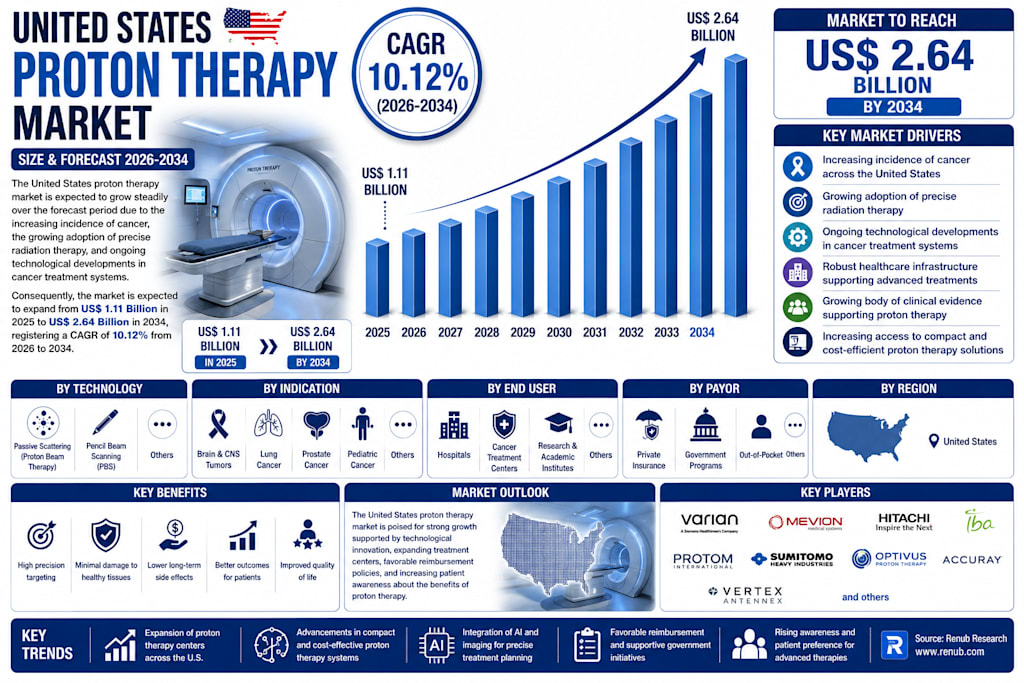
The United States proton therapy market is emerging as one of the most advanced segments in global oncology, fueled by technological innovation, rising cancer incidence, and a growing focus on precision medicine. As healthcare providers increasingly prioritize targeted and patient-centric treatments, proton therapy is gaining widespread adoption as a superior alternative to traditional radiation therapy.
According to Renub Research, the U.S. proton therapy market is expected to grow from US$ 1.11 billion in 2025 to US$ 2.64 billion by 2034, reflecting a compound annual growth rate (CAGR) of 10.12% between 2026 and 2034. This strong growth underscores the increasing role of advanced radiation therapies in modern cancer care.
Proton therapy represents a significant evolution in radiation treatment. Unlike conventional X-ray–based therapies, it uses high-energy proton beams to deliver radiation directly to cancerous cells. This precision allows clinicians to administer higher doses to tumors while minimizing exposure to surrounding healthy tissues. As a result, patients experience fewer side effects and improved treatment outcomes, particularly in complex and sensitive cancer cases.
Rising Cancer Burden Driving Market Growth
The increasing prevalence of cancer in the United States is a major driver of the proton therapy market. Prostate cancer, lung cancer, brain tumors, and pediatric cancers are among the most common types requiring advanced treatment solutions.
Estimates suggest that in 2025 alone, the United States will witness over 2 million new cancer cases and more than 600,000 cancer-related deaths. This growing burden is driving demand for precise and effective treatment options that can improve survival rates while minimizing side effects.
Proton therapy’s ability to target tumors with high accuracy makes it particularly valuable for cancers located near critical organs such as the brain, spinal cord, heart, and eyes. As the population ages and cancer incidence rises, the need for advanced radiation therapies is expected to increase significantly.
Advanced Healthcare Infrastructure Supporting Adoption
The United States benefits from one of the most advanced healthcare infrastructures in the world, enabling rapid adoption of innovative technologies like proton therapy. Leading academic hospitals and cancer centers are at the forefront of implementing cutting-edge treatment systems.
Technological advancements such as pencil beam scanning, real-time imaging, and single-room proton therapy systems are enhancing treatment precision and accessibility. These innovations allow clinicians to tailor treatments more effectively and improve patient outcomes.
Additionally, strong research and development capabilities, along with access to highly skilled medical professionals, support continuous innovation in proton therapy. The presence of numerous proton therapy centers across the country further strengthens market growth.
Clinical Evidence and Reimbursement Boosting Adoption
The growing body of clinical evidence supporting proton therapy is playing a crucial role in its adoption. Studies have demonstrated its effectiveness in reducing long-term side effects and improving quality of life, particularly in pediatric and complex cancer cases.
Selective insurance coverage for specific indications is also improving accessibility. While reimbursement policies vary, increasing recognition of proton therapy’s benefits is encouraging broader acceptance among healthcare providers and patients.
Infrastructure expansion is another key factor. For example, the University of Florida Health Proton Therapy Institute expanded its capacity by adding a fifth treatment room, increasing its ability to treat more patients with advanced technologies.
As clinical evidence continues to evolve and reimbursement policies improve, proton therapy is expected to become more widely accessible across the United States.
Challenges: High Costs and Reimbursement Barriers
Despite its advantages, the U.S. proton therapy market faces significant challenges. The high cost of establishing and operating proton therapy centers is one of the primary barriers. These facilities require substantial investment in equipment, infrastructure, and specialized personnel.
Operational costs, including maintenance and technology upgrades, further add to the financial burden. As a result, proton therapy is currently concentrated in large academic institutions and specialized cancer centers.
Reimbursement uncertainty is another major challenge. Insurance coverage varies widely, and some providers require extensive documentation or may not cover certain treatments due to limited comparative data. This can delay treatment decisions and limit patient access.
Addressing these challenges will be critical for ensuring broader adoption and long-term sustainability of the market.
Expanding Applications Across Cancer Types
Proton therapy is being increasingly used across a wide range of cancer indications, each benefiting from its precision and safety profile.
Head and Neck Cancer
Proton therapy enables precise targeting of tumors located near critical structures, reducing side effects such as difficulty swallowing and dry mouth.
Prostate Cancer
The therapy offers targeted radiation delivery with minimal exposure to surrounding organs, reducing complications and improving patient outcomes.
Lung Cancer
For lung cancer patients, proton therapy minimizes damage to healthy lung tissue, which is particularly important for those with compromised respiratory function.
Pediatric Cancer
Proton therapy is especially valuable in pediatric oncology, where minimizing radiation exposure is crucial for long-term health and development.
Single-Room Systems
The rise of single-room proton therapy systems is improving accessibility by reducing installation costs and space requirements, enabling more hospitals to adopt the technology.
Regional Insights Within the United States
Within the United States, several states are leading the adoption of proton therapy due to strong healthcare infrastructure and high cancer incidence rates.
California stands out as a major hub, supported by top-tier medical institutions and a large patient population. Texas is also experiencing growth, driven by expanding oncology infrastructure and increasing awareness.
New Jersey benefits from its proximity to leading research institutions, while Washington is advancing through strong research initiatives and a focus on precision medicine.
These regional dynamics highlight the importance of infrastructure, research, and patient demand in shaping the growth of the proton therapy market across the country.
Competitive Landscape and Key Players
The U.S. proton therapy market is dominated by a select group of technology providers specializing in advanced radiation systems. Key players include IBA, Varian Medical Systems, Hitachi Ltd., Mevion Medical Systems, and Mitsubishi Electric Corporation.
These companies are focusing on innovation, system efficiency, and cost reduction to expand adoption. Investments in compact systems, improved imaging technologies, and automation are helping make proton therapy more accessible to a broader range of healthcare providers.
Strategic partnerships, research collaborations, and continuous technological advancements are expected to further strengthen the competitive landscape and drive market growth.
Final Thoughts
The United States proton therapy market is poised for significant growth as the healthcare industry continues to embrace precision oncology and advanced treatment technologies. With its ability to deliver highly targeted radiation while minimizing side effects, proton therapy represents a major advancement in cancer care.
Renub Research’s forecast of US$ 2.64 billion by 2034 highlights the strong growth potential of the market.
However, overcoming challenges such as high costs and reimbursement barriers will be essential for unlocking its full potential.
About the Creator
Enjoyed the story? Support the Creator.
Subscribe for free to receive all their stories in your feed.
Comments
There are no comments for this story
Be the first to respond and start the conversation.