
United States Property Management Software Market Size, Share, Trends, and Growth Outlook 2034
United States Property Management Software Market Size Growth Demand & Outlook 2034

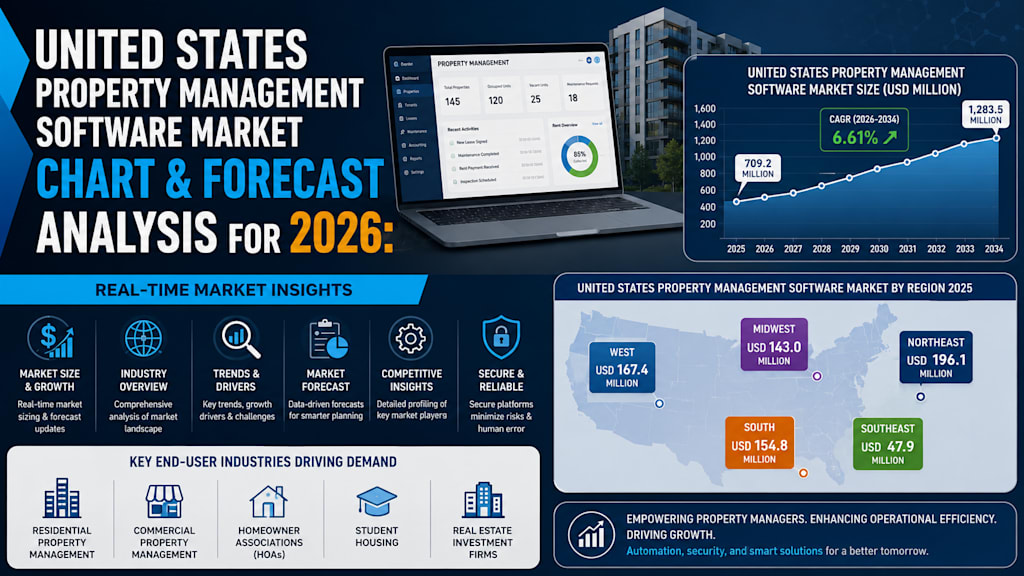
United States Property Management Software Market Current Industry Landscape
The United States property management software market has become an important part of the real estate technology ecosystem. Property owners, real estate companies, facility managers, and housing operators are increasingly relying on digital tools to manage daily operations, improve efficiency, and streamline communication with tenants.
According to industry estimates, the United States property management software market size reached USD 709.2 Million in 2025 and is expected to grow steadily through 2034. The increasing need for automation, centralized data management, and secure digital platforms is encouraging wider adoption across residential, commercial, and mixed-use properties.
As the real estate sector becomes more data-driven, software solutions are helping organizations handle leasing, maintenance requests, rent collection, accounting, reporting, and tenant engagement through a single platform. These developments continue to influence United States property management software market growth across multiple property categories.
Why Property Owners Are Adopting Property Management Software
Property owners are under growing pressure to manage operations efficiently while maintaining a positive tenant experience. Traditional manual processes often require significant time and resources, particularly when managing large property portfolios.
Property management software helps simplify many routine tasks by providing centralized access to operational data. Users can track payments, manage lease agreements, monitor maintenance activities, and communicate with tenants through a single system.
The ability to access real-time information is another factor encouraging adoption. Property owners can review occupancy levels, financial performance, and maintenance schedules without relying on multiple spreadsheets or disconnected systems. As a result, many organizations view software adoption as a practical step toward improving operational visibility and efficiency.
The Shift Toward Digital Property Operations in the United States
The real estate industry is experiencing a broader shift toward digital operations. Property management companies are investing in technologies that reduce paperwork, improve record management, and support remote access to business information.
Digital leasing processes are becoming increasingly common. Applications, contracts, approvals, and renewals can now be completed electronically, reducing administrative workloads and improving convenience for both property managers and tenants.
Mobile access is also changing the way properties are managed. Managers can review reports, respond to service requests, and communicate with residents while away from the office. This flexibility is helping organizations maintain operational continuity and improve response times.
These developments continue to influence United States property management software market trends as businesses seek more efficient ways to manage growing property portfolios.
How Automation Is Changing Property and Facility Management
Automation has become one of the most important developments within property management technology. Tasks that once required significant manual effort can now be completed automatically through integrated software platforms.
Automated rent reminders, invoice generation, maintenance scheduling, and reporting functions help reduce administrative burdens while minimizing the risk of human error. This allows property management teams to focus more on tenant relationships and strategic planning.
Facility management operations are also benefiting from automation. Work orders can be assigned, tracked, and completed through digital systems, improving transparency and accountability throughout the maintenance process.
As organizations continue to pursue operational efficiency, automation remains an important contributor to United States property management software market growth.
Cloud-Based Property Management Platforms Gain Momentum
Cloud technology has significantly changed how property management solutions are deployed and maintained. Instead of relying on locally installed systems, many organizations are choosing cloud-based platforms that can be accessed through internet-connected devices.
Cloud solutions provide greater flexibility for property managers operating across multiple locations. Teams can access information from different offices, properties, or remote work environments without requiring complex infrastructure investments.
Software updates and security improvements can also be implemented more efficiently through cloud environments. This reduces maintenance requirements while helping organizations maintain access to the latest features and functionality.
The increasing adoption of cloud platforms continues to contribute to United States property management software market share as businesses prioritize scalability and operational flexibility.
Key Challenges Facing Property Management Software Providers
Despite growing demand, software providers continue to face several challenges. One of the primary concerns involves data security and privacy protection. Property management platforms often handle sensitive financial and personal information, requiring strong cybersecurity measures.
System integration can also present difficulties. Many organizations use multiple business applications for accounting, customer relationship management, and facility operations. Ensuring seamless integration between these systems remains an important requirement.
Cost considerations may influence adoption decisions as well. Smaller property owners and independent operators may be cautious about investing in new software solutions if implementation costs appear too high.
In addition, ongoing user training and change management efforts are necessary to ensure successful software adoption across organizations.
New Business Opportunities Across the United States Property Management Software Market
The evolving needs of property owners are creating new opportunities for software developers and technology providers. Demand is increasing for solutions that offer advanced reporting, tenant engagement tools, predictive maintenance capabilities, and integrated financial management features.
Artificial intelligence, data analytics, and smart building technologies are also opening new areas for innovation. Property managers are seeking platforms that provide deeper operational insights and help support more informed decision-making.
The growth of multifamily housing, commercial real estate, and mixed-use developments is creating additional demand for scalable software solutions capable of managing complex property portfolios.
These developments continue to create opportunities for companies participating in the United States property management software market.
Competition and Innovation Among Property Management Software Vendors
Competition within the market remains active as software providers introduce new features and capabilities to meet changing customer requirements. Companies are focusing on user experience, mobile functionality, automation, and integration capabilities to strengthen their offerings.
Innovation is becoming an important differentiator. Vendors are investing in digital payment solutions, tenant communication tools, maintenance management systems, and data analytics features that improve overall platform value.
Customer support, implementation services, and product reliability also play important roles in purchasing decisions. Organizations increasingly evaluate software providers based on long-term usability and operational benefits rather than simply comparing feature lists.
These competitive factors continue to shape United States property management software market trends as technology providers seek to strengthen their position within the industry.
Leading Companies in the United States Property Management Software Market
Several technology providers operate within the United States property management software market, offering solutions for residential, commercial, and mixed-use properties.
Companies compete by expanding cloud capabilities, enhancing automation features, improving mobile accessibility, and developing integrated property management ecosystems. Many providers are also investing in data analytics and digital workflow solutions to support evolving customer requirements.
As adoption continues to increase across the real estate sector, software vendors that focus on usability, security, scalability, and operational efficiency are expected to remain well positioned within the market.
About the Creator
Kim Soo hyun
My name is Kim Soo hyun, and I am a research analyst at IMARC Group, specializing in market trends and data analysis to provide insights and support strategic decision-making.
Enjoyed the story? Support the Creator.
Subscribe for free to receive all their stories in your feed.
Comments
There are no comments for this story
Be the first to respond and start the conversation.