
United States Precision Irrigation Market Size & Forecast 2025–2033
Smart Watering Revolution Driving Sustainable Agriculture Across America

United States Precision Irrigation Market Overview
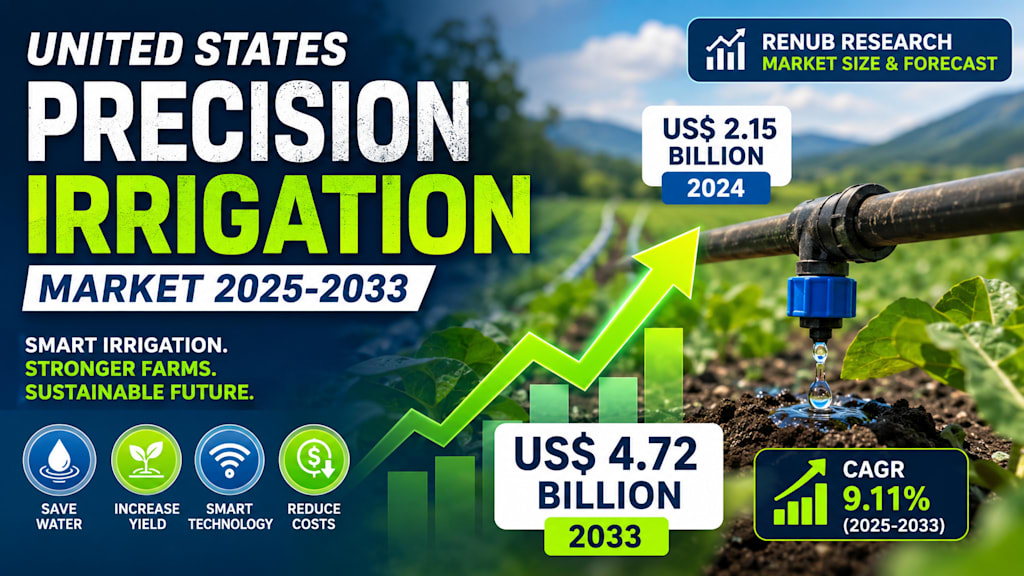
The United States Precision Irrigation Market is undergoing a strong transformation as agriculture increasingly shifts toward data-driven, resource-efficient farming practices. According to Renub Research, the market is expected to grow significantly from US$ 2.15 billion in 2024 to US$ 4.72 billion by 2033, expanding at a CAGR of 9.11% during 2025–2033.
Precision irrigation refers to advanced farming techniques that deliver water in precise quantities based on real-time crop and soil requirements. It integrates technologies such as soil moisture sensors, GPS mapping, IoT-based controllers, satellite imaging, and data analytics to ensure optimal irrigation scheduling.
In the United States—where agriculture spans water-stressed regions like California and highly mechanized farming belts in the Midwest—precision irrigation is no longer optional. It is becoming a necessity for water conservation, productivity improvement, and climate resilience.
Market Transformation: From Traditional Irrigation to Smart Water Management
Traditional irrigation systems often lead to water overuse, nutrient loss, and uneven crop yield. Precision irrigation, however, ensures:
Reduced water consumption
Higher crop yield efficiency
Lower fertilizer waste through fertigation
Reduced environmental runoff
Better resilience against drought conditions
States like California, Texas, Nebraska, and Washington are rapidly adopting smart irrigation systems, especially for high-value crops such as almonds, grapes, corn, apples, and vegetables.
The agricultural sector in the U.S. is now moving toward automated irrigation ecosystems, where machines independently adjust water flow based on soil conditions and weather forecasts.
Growth Drivers of the United States Precision Irrigation Market
1. Increasing Water Scarcity and Climate Pressure
Water scarcity is one of the strongest forces pushing precision irrigation adoption. Western states face frequent drought cycles, making efficient water usage essential.
Agriculture consumes the largest share of freshwater in the U.S., and precision systems like drip and sprinkler irrigation help significantly reduce wastage by delivering water directly to plant roots or evenly across fields.
The increasing frequency of droughts and unpredictable rainfall patterns has accelerated adoption across both small and large farms.
2. Government Support and Financial Incentives
Government policies play a critical role in market expansion. Programs such as the USDA Environmental Quality Incentives Program (EQIP) encourage farmers to adopt water-saving irrigation systems.
Additionally, federal and state-level subsidies reduce the high upfront cost of installation. The U.S. government has invested heavily in sustainable agriculture initiatives, with approximately USD 2 billion allocated in 2023 for precision agriculture programs.
These financial incentives are making smart irrigation systems more accessible to mid-sized farms.
3. Expansion of High-Value Crop Cultivation
The rise in cultivation of fruits, vegetables, nuts, vineyards, and greenhouse crops is another key driver. These crops require controlled irrigation to maintain quality and yield consistency.
High-value crops demand:
Precise nutrient delivery
Controlled soil moisture
Reduced water stress conditions
This makes precision irrigation systems indispensable for modern farming practices.
4. Integration of Digital Agriculture Technologies
The integration of IoT, AI-based analytics, satellite imaging, and automated controllers is revolutionizing irrigation practices. Farmers can now monitor real-time soil conditions through mobile dashboards and cloud-based systems.
This digital transformation is improving farm productivity while reducing operational complexity.
Market Challenges
1. High Initial Installation Costs
Despite long-term savings, precision irrigation systems require significant upfront investment in:
Sensors
Automated valves
Software platforms
Installation and maintenance
Small and medium farmers often struggle with affordability, especially when crop prices fluctuate.
2. Technical Complexity and Skill Gaps
Precision irrigation requires technical knowledge of:
Soil-water interaction
Crop water requirements
Data interpretation
System calibration
A shortage of trained agricultural technicians in rural areas limits adoption and slows market penetration.
United States Precision Irrigation Market Segmentation
By Type
Sprinkler Irrigation
Drip Irrigation
Others
By Crop Type
Field Crops
Vegetable Crops
Orchard Crops
Vineyards
Other Crops
By Application
Agricultural Fields
Greenhouse Farming
Landscape & Turf Irrigation
Residential Use
Others
Technology Insights: Sprinkler vs Drip Irrigation
Sprinkler Irrigation Systems
Sprinkler irrigation remains widely used across large-scale farms producing corn, wheat, and soybeans. Center pivot systems are especially dominant in the Midwest due to their efficiency in covering large agricultural areas.
Modern sprinkler systems now include variable rate irrigation (VRI) technology, allowing farmers to adjust water distribution based on soil variability.
Drip Irrigation Systems
Drip irrigation is rapidly gaining momentum due to its superior water efficiency. It is particularly popular in California and other drought-prone regions.
Benefits include:
Direct root-zone water delivery
Reduced evaporation loss
Efficient fertigation (nutrient delivery)
Higher crop quality and yield
Drip irrigation is widely considered the future of sustainable farming in the U.S.
Regional Market Analysis
California
California dominates the U.S. precision irrigation market due to frequent drought conditions and high-value crop production. Almonds, grapes, and vegetables rely heavily on drip irrigation systems. The state is also a hub for smart farming innovation and IoT-based irrigation solutions.
Texas
Texas uses large-scale sprinkler irrigation systems for cotton, corn, and cattle feed crops. Water-efficient irrigation is increasingly important due to arid conditions in many regions.
Washington
Washington focuses on high-value fruit crops such as apples and cherries. Precision irrigation ensures crop quality and export competitiveness.
New York
New York combines traditional farming with greenhouse cultivation. Vineyards and vegetable farms are increasingly adopting precision irrigation systems for sustainability.
Competitive Landscape
The U.S. precision irrigation market is highly competitive, driven by global and domestic agritech companies focusing on automation, water efficiency, and digital integration.
Key players include:
Jain Irrigation Systems Ltd
Lindsay Corporation
The Toro Company
Valmont Industries
Netafim
Rain Bird Corporation
Rivulis Irrigation
Reinke Manufacturing
Nelson Irrigation
Trimble Inc.
Top 10 Recent Developments (Vocal Format – Companies)
1. Jain Irrigation Systems Ltd
Expanded smart drip irrigation offerings with improved fertigation technologies targeting sustainable farming in water-stressed U.S. regions.
2. Lindsay Corporation
Enhanced its Zimmatic irrigation systems with advanced remote monitoring and AI-based water optimization tools.
3. The Toro Company
Launched upgraded precision irrigation controllers designed for better water distribution efficiency in commercial farming.
4. Valmont Industries
Focused on expanding digital irrigation platforms integrated with IoT-enabled center pivot systems.
5. Netafim
Strengthened its presence in California vineyards with next-generation drip irrigation solutions emphasizing water conservation.
6. Rain Bird Corporation
Introduced smart sprinkler systems with weather-based adaptive irrigation scheduling technology.
7. Rivulis Irrigation
Invested in expanding micro-irrigation solutions for greenhouse and high-value crop applications in the U.S. market.
8. Reinke Manufacturing
Upgraded center pivot systems with precision variable rate irrigation capabilities for large-scale farms.
9. Nelson Irrigation
Developed advanced sprinkler nozzles designed to improve uniform water distribution and reduce runoff losses.
10. Trimble Inc.
Integrated GPS and data analytics into irrigation management systems, enabling farmers to make real-time water optimization decisions.
Future Outlook
The future of the U.S. precision irrigation market is strongly aligned with:
Climate-smart agriculture
AI-driven irrigation scheduling
Autonomous farm systems
Water conservation mandates
Expansion of controlled environment agriculture
As farming becomes more data-driven, irrigation will evolve from a manual practice into a fully automated, intelligent system.
Final Thoughts
The United States Precision Irrigation Market is entering a defining growth phase driven by water scarcity, climate pressure, and technological advancement. With a projected rise from US$ 2.15 billion in 2024 to US$ 4.72 billion by 2033, the sector is not just expanding—it is transforming the future of American agriculture.
Precision irrigation is becoming the backbone of sustainable farming, ensuring that every drop of water contributes directly to productivity, efficiency, and food security. As innovation continues, the U.S. is set to remain one of the global leaders in smart irrigation technologies.
About the Creator
Enjoyed the story? Support the Creator.
Subscribe for free to receive all their stories in your feed.
Comments
There are no comments for this story
Be the first to respond and start the conversation.