
United States Power Equipment Market Set to Reach US$ 13.85 Billion by 2033 as Infrastructure Expansion and Clean Energy Investments Accelerate
Rising Demand for Generators, Solar Equipment, Power Cables, and Grid Modernization Fuels Long-Term Industry Growth Across the United States

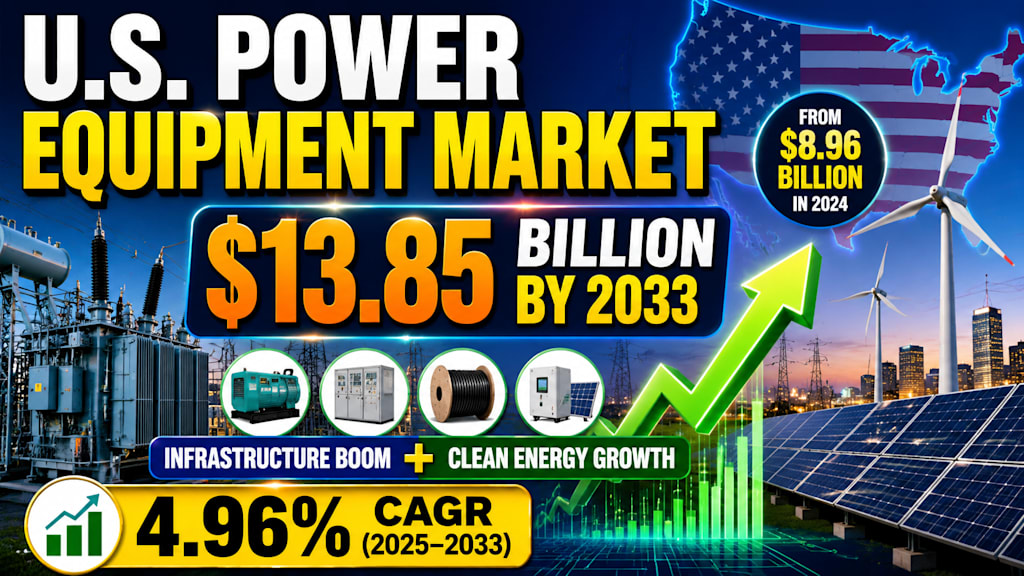
The United States power equipment market is entering a new era of growth driven by infrastructure modernization, renewable energy expansion, and increasing demand for reliable backup power systems. According to Renub Research, the United States Power Equipment Market is projected to grow from US$ 8.96 Billion in 2024 to US$ 13.85 Billion by 2033, expanding at a CAGR of 4.96% between 2025 and 2033.
The market's upward trajectory reflects the nation's commitment to upgrading aging energy infrastructure, strengthening grid resilience, supporting renewable energy integration, and addressing growing electricity consumption from households, businesses, and industrial facilities.
Power equipment serves as the backbone of modern economic activity. Whether powering construction sites, supporting industrial operations, maintaining residential energy security, or enabling renewable energy projects, these systems are essential for keeping America's economy moving.
Why Power Equipment Matters More Than Ever
Power equipment encompasses a wide range of machinery and systems including generators, transformers, switchgears, circuit breakers, power cables, solar equipment, and hydropower systems. These products ensure efficient generation, transmission, distribution, and storage of electricity.
Across the United States, power equipment plays a crucial role in industries such as:
Construction
Manufacturing
Agriculture
Utilities
Residential housing
Commercial real estate
Renewable energy development
As electricity demand continues to rise and infrastructure ages, businesses and governments are investing heavily in modern power equipment solutions capable of delivering greater efficiency, reliability, and sustainability.
Infrastructure Expansion Driving Massive Equipment Demand
One of the strongest growth catalysts for the U.S. power equipment market is the unprecedented level of infrastructure investment occurring nationwide.
Road expansions, bridge replacements, airport upgrades, public transportation improvements, and utility modernization projects require extensive deployment of generators, transformers, cables, switchgear systems, and backup power solutions.
The Infrastructure Investment and Jobs Act (IIJA) has significantly accelerated these investments. By November 2024, more than US$ 568 billion had been allocated to over 66,000 projects across the country, supporting transportation networks, electric vehicle charging stations, airports, roads, bridges, and clean energy infrastructure.
Every infrastructure project relies on dependable power equipment to maintain operations and ensure uninterrupted energy delivery. As a result, manufacturers continue to experience strong demand from both public and private sector customers.
Renewable Energy Transformation Creates New Opportunities
America's transition toward renewable energy represents another major growth engine for the power equipment industry.
Federal incentives, tax credits, state-level clean energy mandates, and corporate sustainability goals are encouraging widespread adoption of solar, wind, and hydropower technologies.
As renewable generation capacity expands, demand is increasing for:
Solar panels
Inverters
Grid interconnection equipment
Smart transformers
Power cables
Battery storage systems
Monitoring and control technologies
In February 2025, SolAmerica Energy and Radiance Solar launched the 2.86 MW Stephenson S1 Solar Project in Illinois, further demonstrating the nation's commitment to expanding renewable energy accessibility.
This renewable energy boom is creating long-term opportunities for equipment manufacturers that can provide efficient, durable, and environmentally friendly solutions.
Residential Consumers Seek Greater Energy Independence
Power reliability has become a growing concern for American households.
Extreme weather events, hurricanes, winter storms, wildfires, and grid disruptions have increased homeowner interest in backup power systems.
Modern residential customers are investing in:
Standby generators
Portable generators
Solar panel systems
Battery energy storage
Smart energy management systems
The growth of remote work has amplified the importance of uninterrupted electricity access. A single outage can impact work productivity, internet connectivity, home security systems, and essential household operations.
Consequently, residential demand has emerged as one of the most resilient segments within the power equipment industry.
Technology Innovation Reshaping the Market
Technological advancements are transforming how power equipment is designed, monitored, and maintained.
Manufacturers are integrating digital technologies such as:
Artificial Intelligence (AI)
Internet of Things (IoT)
Predictive maintenance software
Remote monitoring platforms
Smart sensors
Advanced analytics
These innovations help reduce operational costs while improving reliability and equipment lifespan.
Smart power equipment can now identify faults before failures occur, optimize energy consumption, and provide real-time performance insights to operators.
As digital transformation spreads throughout the energy sector, technologically advanced equipment is becoming increasingly valuable.
Generator Segment Remains a Market Leader
Generators continue to represent one of the most important categories within the U.S. power equipment market.
From hospitals and data centers to manufacturing plants and residential communities, generators provide essential backup power during emergencies.
Demand remains particularly strong in regions vulnerable to:
Hurricanes
Wildfires
Snowstorms
Flooding
Grid instability
Industrial organizations also rely heavily on generator systems to maintain business continuity and prevent costly downtime.
Recent innovations in hybrid generators and fuel-efficient technologies are helping manufacturers address both reliability and sustainability objectives.
Power Cables Supporting Grid Modernization
Power cables form the foundation of electricity transmission and distribution networks.
As utilities upgrade aging infrastructure and expand renewable energy capacity, demand for high-performance cable systems continues to increase.
Modern power cables offer benefits such as:
Reduced transmission losses
Improved safety
Greater durability
Enhanced capacity
Better environmental performance
Smart grid projects across the United States are creating significant opportunities for cable manufacturers that can deliver advanced solutions designed for future energy systems.
Solar Equipment Becomes a Growth Powerhouse
Solar energy has become one of the fastest-growing segments within the broader power equipment market.
Declining technology costs and favorable government policies have made solar energy increasingly attractive for residential, commercial, and utility-scale applications.
The solar equipment ecosystem includes:
Photovoltaic panels
Inverters
Mounting systems
Storage batteries
Monitoring equipment
Many states continue to strengthen renewable energy targets, supporting long-term investment in solar infrastructure.
As energy consumers seek lower electricity costs and reduced carbon emissions, solar equipment adoption is expected to accelerate further throughout the forecast period.
About the Creator
Enjoyed the story? Support the Creator.
Subscribe for free to receive all their stories in your feed.
Comments
There are no comments for this story
Be the first to respond and start the conversation.