
United States Popcorn Market Size Growth Share Industry Demand & Forecast 2034
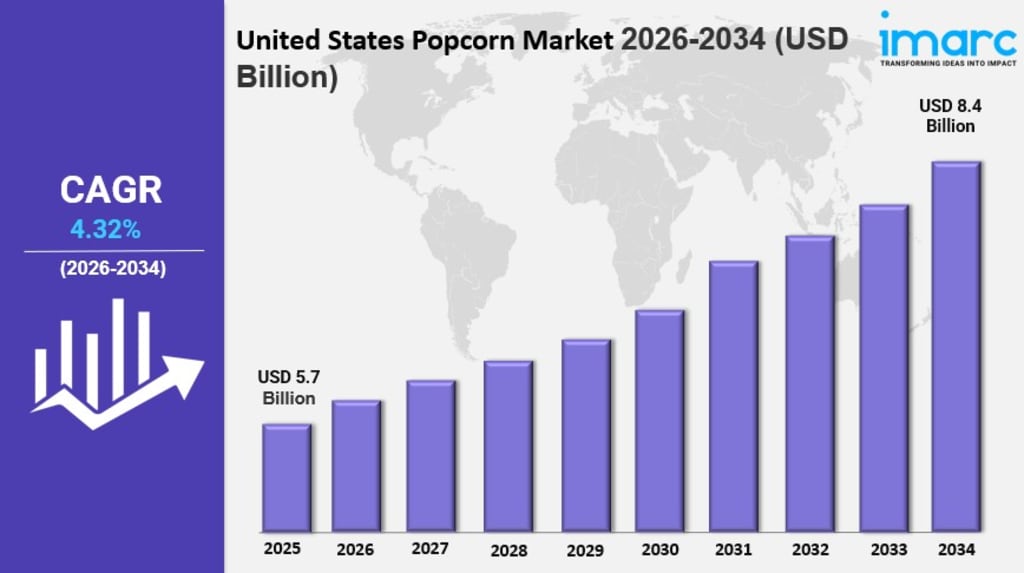
The United States popcorn market reached a value of USD 5.7 Billion in 2025 and projected to reach USD 8.4 Billion by 2034.

United States Popcorn Market Size, Share, and Growth Outlook
The United States popcorn market reached a value of USD 5.7 Billion in 2025 and projected to reach USD 8.4 Billion by 2034, growing at a CAGR of 4.32% during 2026–2034.
Growth in the market is primarily driven by the increasing demand for convenience-based and ready-to-eat (RTE) snack options, along with the rising preference for premium and gourmet popcorn varieties. Changing consumer lifestyles, expanding retail penetration, and continuous product innovation are further strengthening market expansion across the country.
Key Trends Driving the U.S. Popcorn Market Growth
One of the most significant trends shaping the market is the strong shift toward health-conscious snacking. Consumers are increasingly replacing traditional fried snacks with popcorn due to its perception as a lighter, whole-grain, and portion-controlled option.
Another key trend is the rapid rise of flavored and gourmet popcorn products. Brands are introducing diverse flavor profiles such as caramel, cheese blends, spicy variants, and dessert-inspired options to attract younger consumers and premium snack buyers.
The expansion of clean-label and organic popcorn offerings is also gaining traction. Shoppers are showing preference for products with minimal additives, non-GMO ingredients, and transparent labeling, pushing manufacturers to reformulate their product lines.
In addition, online retail and direct-to-consumer (D2C) channels are playing an increasingly important role in market growth, enabling niche popcorn brands to reach wider audiences.
Why Popcorn Consumption Is Rising Across the United States
Popcorn consumption in the United States is increasing due to its strong positioning as a versatile and affordable snack. It is widely consumed across different settings, including home entertainment, office snacking, and social gatherings.
The growth of streaming platforms and at-home entertainment culture has significantly boosted popcorn demand, as consumers increasingly prefer cinema-style snacking at home.
Additionally, the perception of popcorn as a better-for-you snack alternative compared to chips and other processed snacks has contributed to its rising popularity among health-conscious consumers.
Convenience also plays a key role, as popcorn is widely available in ready-to-eat formats across supermarkets, convenience stores, and online platforms.
United States Popcorn Market Forecast and Future Opportunities (2026–2034)
Between 2026 and 2034, the U.S. popcorn market is expected to witness steady and sustained growth, driven by continuous innovation and evolving consumer preferences.
One of the major opportunities lies in the expansion of premium and artisanal popcorn brands, particularly those focusing on unique flavor combinations and organic ingredients.
The growing demand for functional snacks presents another opportunity, with manufacturers exploring popcorn variants enriched with protein, fiber, and reduced sodium formulations.
Sustainability will also play a key role in shaping future growth. Brands adopting eco-friendly packaging and sustainable sourcing practices are expected to gain stronger consumer trust and competitive advantage.
Furthermore, increasing penetration of popcorn in emerging retail formats and subscription snack boxes will open new revenue streams for manufacturers.
Factors Fueling the Growth of the U.S. Popcorn Industry
Several factors are supporting the steady expansion of the popcorn industry in the United States. A primary driver is the rising demand for ready-to-eat snack products, especially among urban consumers with busy lifestyles.
The growth of the retail and e-commerce ecosystem has improved product accessibility, allowing both established and emerging brands to reach a broader customer base.
Innovation in flavors, packaging, and product positioning is also enhancing consumer engagement and repeat purchases.
In addition, strong marketing campaigns and the association of popcorn with entertainment experiences continue to reinforce its consumption across different age groups.
Challenges and Restraints in the United States Popcorn Market
Despite strong growth prospects, the market faces several challenges. One key restraint is the intense competition from alternative snack categories, including protein bars, baked chips, and nut-based snacks.
Price volatility of raw materials such as corn can also impact production costs and profit margins for manufacturers.
Another challenge is the growing concern over high-calorie flavored popcorn variants, which may limit demand among highly health-conscious consumers.
Additionally, maintaining product freshness and shelf stability while expanding distribution channels remains a logistical challenge for many players in the market.
Competitive Landscape of the U.S. Popcorn Market
The United States popcorn market is highly competitive, with the presence of both large multinational companies and specialized snack brands.
Leading players focus on strategies such as product innovation, flavor diversification, and strategic partnerships with retail chains to strengthen their market position.
Private label brands offered by supermarkets are also gaining traction due to their competitive pricing and increasing quality standards.
Companies are increasingly investing in marketing campaigns, celebrity endorsements, and digital promotions to enhance brand visibility and consumer engagement.
Overall, competition in the market continues to intensify as brands aim to capture both mainstream and premium snack segments through differentiated offerings.
About the Creator
Kim Soo hyun
My name is Kim Soo hyun, and I am a research analyst at IMARC Group, specializing in market trends and data analysis to provide insights and support strategic decision-making.
Enjoyed the story? Support the Creator.
Subscribe for free to receive all their stories in your feed.
Comments
There are no comments for this story
Be the first to respond and start the conversation.