
United States Polyols Market Size Growth Share Trends Demand & Forecast 2034
The United States Polyols market size reached USD 1.24 billion in 2025 and is expected to grow to USD 1.47 billion by 2034.

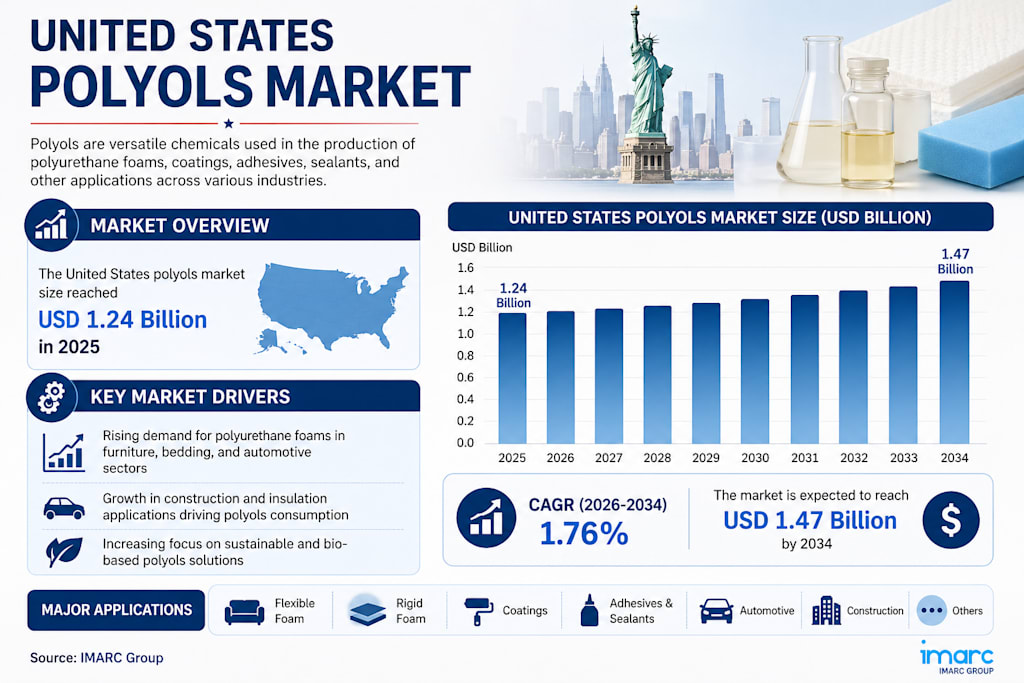
United States Polyols Market Size, Share, and Growth Forecast (2026–2034)
The United States polyols market is developing at a measured pace, shaped more by application demand than rapid expansion. The market reached USD 1.24 billion in 2025 and is expected to grow to USD 1.47 billion by 2034, reflecting a CAGR of 1.76%. While this growth rate appears moderate, the underlying demand remains stable due to polyols’ role in multiple end-use industries.
For manufacturers and suppliers, the market is less about volume spikes and more about consistent demand across sectors such as construction, automotive, food, and pharmaceuticals. Polyols are essential in producing polyurethane foams used for insulation, which continues to see steady demand due to energy efficiency requirements. At the same time, their use as low-calorie sweeteners is expanding in response to changing consumer preferences.
Request a Sample Report with Latest 2026 Data & Forecasts:
Demand Drivers in the U.S. Polyols Market: Construction, Automotive, and Furniture Applications
Demand for polyols in the United States is closely linked to industrial activity, particularly in construction, automotive, and furniture manufacturing. In construction, polyols are widely used in polyurethane insulation materials, which help improve energy efficiency in residential and commercial buildings.
The automotive sector also contributes to demand through applications in seating, interior components, and lightweight materials. As manufacturers focus on reducing vehicle weight and improving fuel efficiency, the use of polyurethane-based materials continues to grow.
In the furniture industry, polyols are used in flexible foams for mattresses and upholstery. Demand in this segment is relatively stable, supported by replacement cycles and ongoing consumer spending.
For B2B stakeholders, understanding these sector-specific demand patterns is key to maintaining consistent sales and planning production.
Polyurethane Production Trends and Their Impact on Polyols Demand in the U.S.
Polyurethane production remains one of the primary drivers of polyols consumption. Any shift in polyurethane output directly affects the demand for polyols, making this relationship critical for suppliers.
In recent years, polyurethane applications have expanded beyond traditional uses. Insulation materials, packaging solutions, and industrial components are all contributing to steady production levels. This diversification helps stabilize demand even when one sector experiences slower growth.
However, production trends are also influenced by external factors such as raw material availability and regulatory requirements. For businesses operating in the polyols market, monitoring polyurethane industry trends provides a clearer view of future demand.
Raw Material Pricing and Supply Chain Dynamics in the U.S. Polyols Industry
Raw material costs play a significant role in the profitability of polyols manufacturers. Inputs such as propylene oxide and ethylene oxide are subject to price fluctuations, which can directly impact production costs.
Supply chain efficiency is equally important. Delays in sourcing or transportation can disrupt production schedules and affect delivery timelines. In a market where margins are already tight, these disruptions can have a noticeable impact.
To manage these challenges, companies are focusing on long-term supplier agreements and improving supply chain visibility. Some are also exploring regional sourcing strategies to reduce dependency on global supply chains.
For B2B buyers, supplier reliability and pricing stability are becoming key factors in vendor selection.
Sustainability Trends: Bio-Based and Green Polyols in the United States
Sustainability is becoming a central consideration in the polyols market. Environmental regulations and corporate sustainability goals are pushing companies to explore bio-based alternatives.
Bio-based polyols, derived from renewable sources such as plant oils, are gaining attention as a way to reduce environmental impact. While they currently represent a smaller share of the market, their adoption is increasing, particularly among companies aiming to meet sustainability targets.
This shift is also influencing product development. Manufacturers are investing in research to improve the performance and cost-effectiveness of green polyols. For businesses, adopting sustainable materials is not only about compliance but also about meeting customer expectations and maintaining competitiveness.
Investment Opportunities in the U.S. Polyols Market for Manufacturers and Suppliers
The U.S. polyols market offers targeted investment opportunities rather than broad expansion potential. One key area is specialty polyols designed for specific applications, such as high-performance insulation or advanced industrial uses.
Another area of opportunity lies in sustainable product development. Companies that can produce cost-effective bio-based polyols are likely to benefit from increasing demand and regulatory support.
Process optimization is also attracting investment. Improving production efficiency, reducing waste, and lowering energy consumption can help manufacturers maintain margins in a competitive market.
For suppliers and investors, focusing on innovation and efficiency rather than scale alone is a more effective strategy in this market.
Competitive Landscape and Key Players in the United States Polyols Market
The competitive landscape of the U.S. polyols market includes a mix of large chemical companies and specialized producers. Key players such as Dow Inc., BASF SE, Huntsman Corporation, and Covestro AG play a significant role in shaping the market through product innovation and global supply networks.
These companies focus on expanding their product portfolios, improving sustainability, and strengthening supply chain capabilities. At the same time, smaller players compete by offering specialized products and flexible services tailored to specific customer needs.
For B2B stakeholders, selecting the right partner depends on factors such as product quality, consistency, pricing, and technical support. As the market continues to evolve, competition will increasingly be defined by innovation and the ability to adapt to changing industry requirements.
About the Creator
Kim Soo hyun
My name is Kim Soo hyun, and I am a research analyst at IMARC Group, specializing in market trends and data analysis to provide insights and support strategic decision-making.
Enjoyed the story? Support the Creator.
Subscribe for free to receive all their stories in your feed.
Comments
There are no comments for this story
Be the first to respond and start the conversation.