
United States Pectin Market Size Growth Share Industry Demand & Forecast 2034
The United States pectin market reached USD 301.7 million in 2025 and is projected to grow to USD 442.8 million by 2034

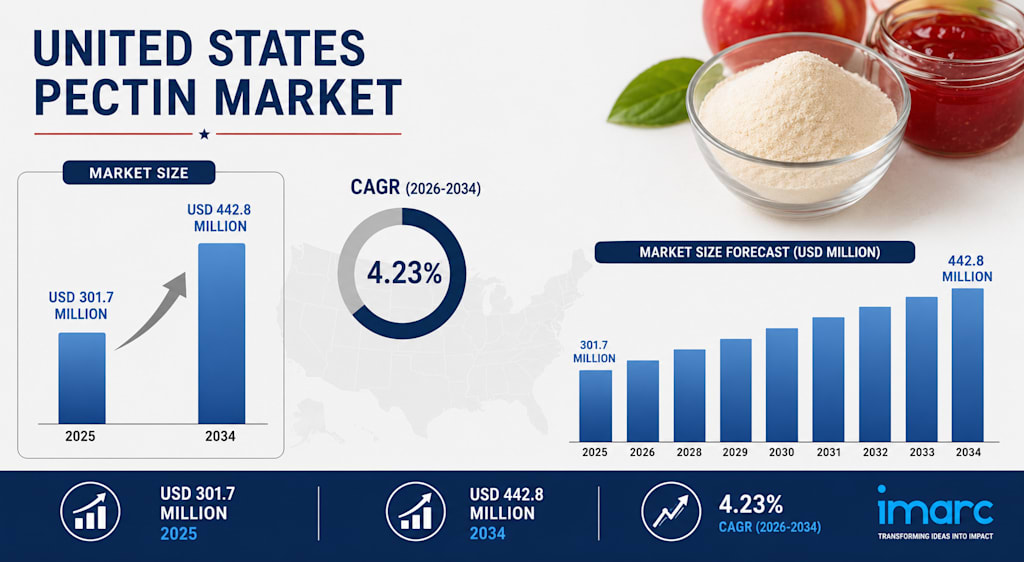
United States Pectin Market Size, Share, and Forecast (2026–2034)
The United States pectin market is witnessing steady growth as food and beverage manufacturers increasingly focus on natural and clean-label ingredients. The market reached USD 301.7 million in 2025 and is projected to grow to USD 442.8 million by 2034, registering a CAGR of 4.23% during 2026–2034.
Pectin is widely used as a gelling, thickening, and stabilizing agent across food applications such as jams, dairy products, confectionery, beverages, and bakery items. Rising consumer preference for healthier and minimally processed foods is encouraging manufacturers to replace synthetic additives with plant-based ingredients, which is supporting market demand.
For businesses, the market offers opportunities in product innovation, clean-label reformulation, and premium food categories. Companies that can ensure ingredient quality, stable supply, and application versatility are expected to strengthen their position in the evolving pectin industry.
Request the Latest Market Report with 2026–2034 Forecast Insights
Key Trends Shaping the United States Pectin Market 2026
• Growing clean-label demand: Consumers are increasingly preferring natural and recognizable ingredients in food products.
• Rising use of pectin in formulations: Food manufacturers are expanding the use of pectin across multiple product categories.
• Expansion of plant-based foods: Pectin is gaining popularity as a plant-derived alternative to gelatin and animal-based stabilizers.
• Increasing demand in vegan applications: Strong adoption across confectionery, dairy alternatives, and functional beverages.
• Growth in convenience foods: Rising consumption of ready-to-eat and packaged foods is supporting demand for stabilizing ingredients like pectin.
• Importance in processed food manufacturing: Pectin is widely used to improve texture, consistency, and shelf stability.
• Product customization trends: Manufacturers are developing tailored pectin solutions for low-sugar, organic, and specialty food products.
• Innovation in specialty beverages: Increasing use of pectin in premium and health-focused beverage formulations.
Major Growth Factors Driving Demand in the U.S. Pectin Market
The increasing demand for natural ingredients remains one of the primary growth drivers in the pectin market. Food and beverage companies are reformulating products to align with changing consumer expectations around health, transparency, and sustainability.
Growth in the processed and packaged food industry is also supporting pectin consumption. The ingredient plays a critical role in improving texture, consistency, and shelf stability across multiple food categories.
Another key factor is the rising popularity of functional and fortified foods. Pectin is increasingly being used in products positioned around digestive health, dietary fiber, and wellness-focused nutrition.
The expansion of the beverage industry is further contributing to market growth. Pectin is commonly used in fruit-based beverages and dairy drinks to maintain consistency and improve product appearance. As beverage innovation continues, demand for multifunctional ingredients like pectin is expected to remain strong.
Challenges in the United States Pectin Industry: Pricing Volatility, Sourcing, and Regulatory Standards
Despite positive growth prospects, the U.S. pectin market faces several operational challenges. Pricing volatility is one of the major concerns, as pectin production depends heavily on raw materials such as citrus peels and apple pomace. Fluctuations in agricultural supply can impact production costs and pricing stability.
Sourcing quality raw materials is another challenge for manufacturers. Consistent supply is essential to maintain product quality and production efficiency. Weather conditions, crop availability, and global trade factors can influence raw material sourcing.
Regulatory compliance also plays an important role in the market. Food ingredient manufacturers must meet strict quality and labeling standards, particularly in clean-label and organic product categories. Adapting to evolving regulatory requirements often requires additional investment in quality assurance and product testing.
Competition within the ingredient industry is increasing as companies continue to develop alternative stabilizers and texturizing agents. Businesses must focus on innovation and application-specific solutions to maintain competitiveness.
Investment Opportunities in the United States Pectin Market
The United States pectin market presents several investment opportunities across food processing, ingredient manufacturing, and product development. One of the strongest opportunities lies in clean-label and natural food formulations, where demand continues to rise across retail and foodservice sectors.
Low-sugar and functional food categories are also creating opportunities for ingredient suppliers. Pectin’s ability to improve texture and stability while supporting healthier product formulations makes it valuable in reduced-sugar applications.
Investment in research and development is becoming increasingly important. Companies are focusing on improving pectin functionality for specific food applications, including dairy alternatives, plant-based products, and premium beverages.
There is also growing potential in sustainable sourcing and circular economy initiatives. Utilizing fruit processing byproducts for pectin extraction supports sustainability goals while improving resource efficiency.
As demand for natural food ingredients continues to expand, businesses that can combine technical expertise, supply chain reliability, and application innovation are likely to capture long-term growth opportunities.
Competitive Landscape and Leading Companies in the U.S. Pectin Industry
• CP Kelco – Focuses on specialty hydrocolloids and provides pectin solutions for food, beverage, and dairy applications.
• Cargill Incorporated – Expands its food ingredient portfolio with pectin products designed for clean-label and texture-enhancing applications.
• Ingredion Incorporated – Develops plant-based ingredient solutions, including pectin for processed foods and beverage formulations.
• DuPont Nutrition & Biosciences – Provides advanced food ingredient technologies with a strong focus on stabilizers and natural texturizing solutions.
• Herbstreith & Fox GmbH & Co. KG – Specializes in high-quality pectin products for confectionery, dairy, bakery, and functional food applications.
About the Creator
Kim Soo hyun
My name is Kim Soo hyun, and I am a research analyst at IMARC Group, specializing in market trends and data analysis to provide insights and support strategic decision-making.
Enjoyed the story? Support the Creator.
Subscribe for free to receive all their stories in your feed.
Comments
There are no comments for this story
Be the first to respond and start the conversation.