
United States Pain Management Therapeutics Market to Reach US$38.66 Billion by 2034 as Non-Opioid Innovation Reshapes Chronic Pain Treatment
Rising cases of chronic pain, an aging population, expanding healthcare infrastructure, and growing demand for safer non-opioid therapies are driving steady growth in the U.S. pain management therapeutics market.

Pain Management Is Becoming a Major Healthcare Priority in the United States
Pain affects millions of Americans every day and remains one of the leading reasons for physician visits, emergency department admissions, and reduced quality of life. From arthritis and cancer to nerve disorders and post-surgical recovery, chronic and acute pain place enormous physical, emotional, and financial burdens on patients and the healthcare system.
Over the past decade, pain management has undergone a significant transformation. While opioids were once the primary treatment option, increasing concerns regarding addiction, misuse, and overdose have accelerated the development of safer alternatives. Today, physicians increasingly rely on non-opioid medications, minimally invasive procedures, advanced medical devices, and personalized treatment plans to provide effective pain relief while minimizing risks.
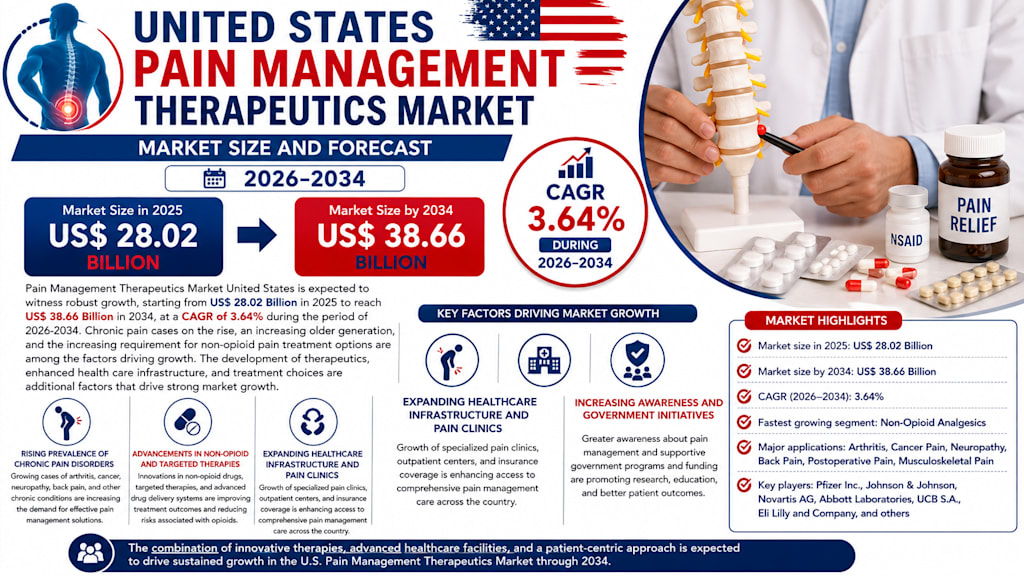
According to the latest market outlook, the United States Pain Management Therapeutics Market is projected to grow from US$28.02 billion in 2025 to US$38.66 billion by 2034, registering a compound annual growth rate (CAGR) of 3.64% during 2026–2034. Rising chronic pain cases, pharmaceutical innovation, and expanding access to specialized pain management services continue supporting long-term market growth.
Understanding Pain Management Therapeutics
Pain management therapeutics encompass a wide range of medications, medical devices, and clinical procedures designed to reduce or eliminate pain associated with acute injuries and chronic medical conditions.
Treatment options include non-steroidal anti-inflammatory drugs (NSAIDs), opioids, anticonvulsants, antidepressants, anesthetics, topical medications, biologics, nerve blocks, neurostimulation devices, and radiofrequency ablation procedures.
Modern pain management increasingly follows a multidisciplinary approach that combines medication with physical therapy, rehabilitation, psychological counseling, and minimally invasive interventions to improve long-term patient outcomes.
Rising Chronic Pain Cases Continue Driving Market Growth
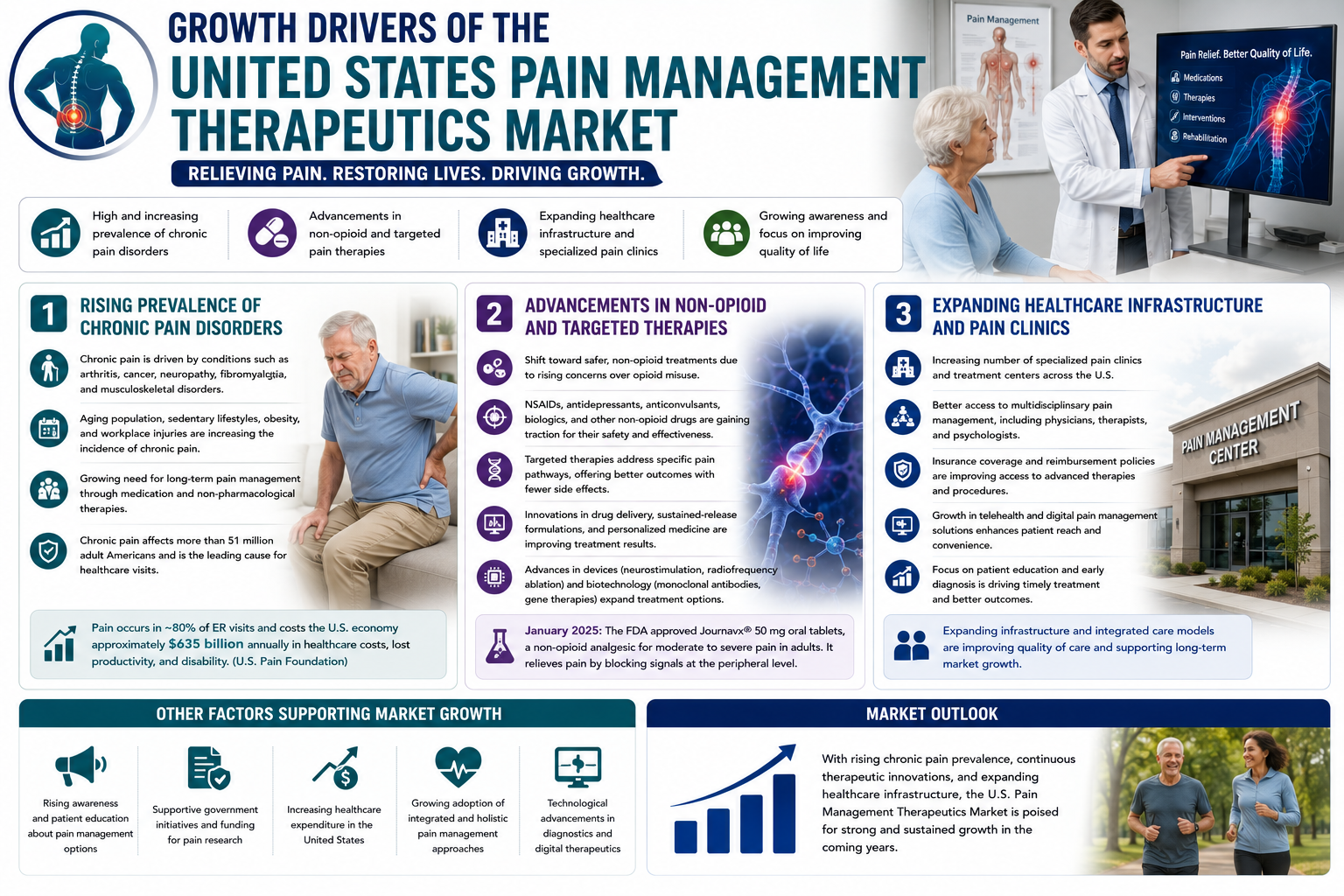
One of the strongest factors fueling market expansion is the growing prevalence of chronic pain throughout the United States.
Millions of Americans experience long-term pain caused by arthritis, neuropathy, fibromyalgia, spinal disorders, cancer, sports injuries, musculoskeletal diseases, and age-related conditions.
The increasing elderly population further contributes to rising demand because older adults are more likely to develop chronic pain associated with degenerative joint disease, osteoporosis, and other age-related disorders.
Lifestyle factors including obesity, sedentary behavior, diabetes, and workplace injuries also continue increasing the number of patients requiring long-term pain management.
As healthcare providers emphasize improving quality of life, demand for comprehensive pain therapies is expected to remain strong.
Non-Opioid Therapies Are Transforming Treatment
Growing concern regarding opioid addiction has accelerated the development of safer pain management solutions.
Healthcare providers increasingly prescribe NSAIDs, anticonvulsants, antidepressants, biologic medicines, and targeted therapies capable of reducing pain without the risks associated with opioid dependence.
Pharmaceutical companies continue investing heavily in novel pain medications with unique mechanisms of action that improve effectiveness while minimizing adverse effects.
Innovative non-opioid drugs, extended-release formulations, and personalized treatment approaches are reshaping pain management practices across the country.
The continued shift toward opioid-sparing therapies is expected to remain one of the industry's most significant long-term trends.
Healthcare Infrastructure Supports Better Patient Care
The United States possesses one of the world's most advanced healthcare systems, creating favorable conditions for continued market expansion.
Hospitals, specialized pain clinics, rehabilitation centers, ambulatory surgical centers, and outpatient facilities continue expanding access to comprehensive pain management services.
Patients increasingly benefit from multidisciplinary treatment programs that combine medication, physical therapy, behavioral health, and minimally invasive procedures under one coordinated care model.
Growing insurance coverage and increased investment in healthcare infrastructure further improve access to advanced pain management therapies.
Medical Devices Expand Treatment Options
Medical devices have become increasingly important within the pain management therapeutics market.
Technologies including neurostimulation systems, electrical stimulators, radiofrequency ablation equipment, and analgesic infusion pumps provide effective alternatives for patients suffering from chronic pain conditions that do not respond adequately to medication alone.
These minimally invasive technologies help reduce pain while improving mobility and quality of life.
Continuous innovation in medical device technology is expected to expand treatment possibilities over the coming years.
Radiofrequency Ablation Gains Popularity
Radiofrequency ablation (RFA) has emerged as one of the fastest-growing interventional pain management techniques.
The procedure uses controlled radiofrequency energy to disable pain-transmitting nerves responsible for chronic back pain, arthritis, neck pain, and other musculoskeletal conditions.
Compared with long-term medication use, RFA offers longer-lasting pain relief while reducing dependence on pharmaceutical treatments.
Improved imaging guidance and procedural accuracy have further strengthened physician confidence in this minimally invasive technology.
Chronic Pain Remains the Largest Clinical Segment
Chronic pain continues representing the largest indication within the U.S. pain management therapeutics market.
Conditions including arthritis, diabetic neuropathy, fibromyalgia, chronic back pain, cancer-related pain, and post-surgical pain require ongoing medical management over extended periods.
Healthcare providers increasingly adopt multimodal treatment strategies combining medication, rehabilitation, psychological support, and interventional procedures to address both the physical and emotional aspects of chronic pain.
Growing awareness regarding chronic pain management continues encouraging earlier diagnosis and more comprehensive treatment.
Retail Pharmacies Improve Patient Access
Retail pharmacies remain one of the most important distribution channels for pain management therapeutics.
Community pharmacies provide prescription medications, over-the-counter pain relievers, topical products, and patient counseling that improve medication adherence and treatment safety.
The continued expansion of national pharmacy chains and online pharmacy services has significantly improved accessibility for patients across both urban and rural communities.
Pharmacists also play an increasingly important role in educating patients regarding responsible medication use and opioid safety.
Opioid Regulations Present Ongoing Challenges
Despite their effectiveness in treating severe pain, opioids continue creating significant challenges for healthcare providers.
The opioid epidemic has resulted in stricter prescribing regulations, enhanced monitoring programs, and greater emphasis on alternative therapies.
While these measures improve patient safety, they may also limit treatment options for individuals experiencing severe chronic pain who require carefully supervised opioid therapy.
Balancing effective pain relief with addiction prevention remains one of the industry's greatest clinical challenges.
High Treatment Costs Limit Accessibility
Advanced pain management therapies often involve substantial costs.
Biologic medicines, implantable neurostimulation devices, radiofrequency ablation procedures, and personalized treatment programs may be financially challenging for patients without comprehensive insurance coverage.
Long-term treatment requirements further increase healthcare expenses for individuals managing chronic pain.
Reducing treatment costs while expanding patient access remains an important objective for healthcare providers, pharmaceutical companies, and policymakers.
Regional Markets Continue Driving Growth
California remains one of the nation's largest pain management markets due to its advanced healthcare infrastructure, large elderly population, strong biotechnology sector, and widespread adoption of innovative therapies.
Texas continues experiencing robust market growth through expanding healthcare investment, increasing chronic disease prevalence, and growing demand for non-opioid treatment options.
New York benefits from world-class medical institutions, specialized pain management centers, and strong adoption of minimally invasive therapies.
Florida remains an important market because of its large senior population, high prevalence of chronic pain conditions, and well-developed healthcare and rehabilitation infrastructure.
Together, these states continue shaping innovation and treatment trends across the United States.
The Future of Pain Management Therapeutics
The future of pain management will increasingly focus on personalized medicine, biologic therapies, regenerative medicine, artificial intelligence, and minimally invasive interventions.
Researchers continue developing highly targeted treatments capable of interrupting pain pathways without producing significant systemic side effects.
Advances in digital health, wearable monitoring devices, remote patient management, and predictive analytics will further improve treatment planning and long-term patient outcomes.
As innovation continues accelerating, pain management is expected to become safer, more personalized, and increasingly effective.
Final Thoughts
The United States pain management therapeutics market continues evolving as healthcare providers seek more effective and safer approaches for treating chronic and acute pain.
The projected growth from US$28.02 billion in 2025 to US$38.66 billion by 2034, supported by a 3.64% CAGR, reflects increasing demand for non-opioid medications, advanced medical devices, minimally invasive procedures, and multidisciplinary treatment strategies.
Although opioid regulations, high treatment costs, and healthcare accessibility remain important challenges, continuous pharmaceutical innovation, expanding healthcare infrastructure, and growing awareness of comprehensive pain management are expected to sustain long-term market growth. As patient-centered care becomes increasingly important, pain management therapeutics will continue playing a vital role in improving health outcomes and quality of life across the United States.
About the Creator
Enjoyed the story? Support the Creator.
Subscribe for free to receive all their stories in your feed.
Comments
There are no comments for this story
Be the first to respond and start the conversation.