
United States Online Grocery Market Set to Cross US$ 713 Billion by 2034 as Digital Shopping Becomes a Daily Habit
Convenience, rapid delivery services, and rising digital adoption are transforming how Americans buy groceries online

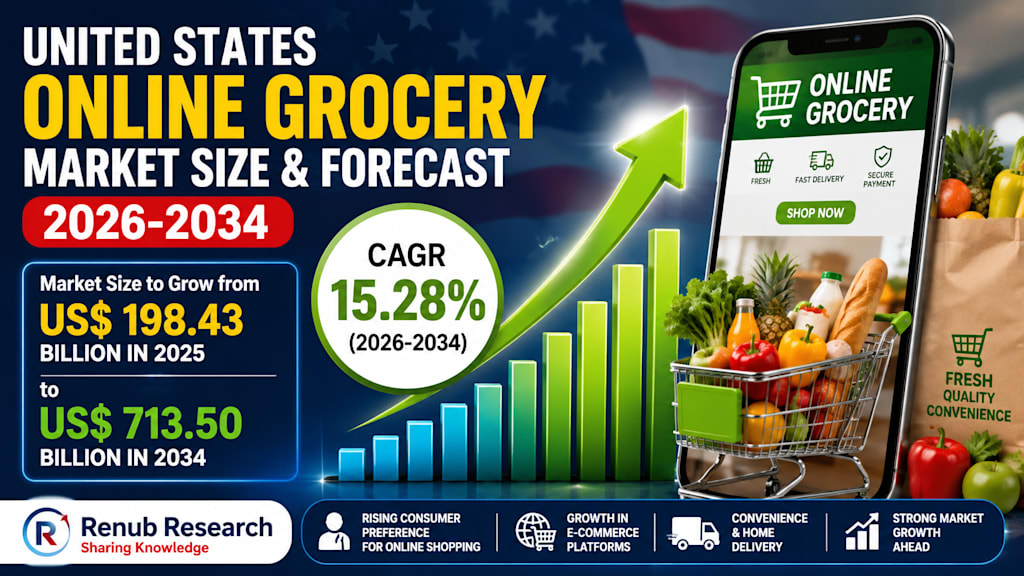
The United States online grocery market is entering a new era of explosive expansion as consumers increasingly rely on digital platforms for everyday grocery needs. From fresh vegetables and dairy products to meat, seafood, and ready-to-eat snacks, online grocery shopping has shifted from a pandemic-driven necessity to a permanent lifestyle choice across the country. According to Renub Research, the market is expected to rise dramatically from US$ 198.43 billion in 2025 to US$ 713.50 billion by 2034, growing at an impressive CAGR of 15.28% during 2026–2034.
The remarkable growth of the market reflects changing consumer behavior, improved logistics infrastructure, mobile commerce penetration, and the growing popularity of same-day delivery services. Consumers today want speed, flexibility, and convenience — and online grocery platforms are delivering exactly that.
As digital transformation reshapes retail across the United States, grocery retailers, delivery startups, and e-commerce giants are racing to strengthen their positions in one of the fastest-growing retail sectors in the country.
Online Grocery Shopping Becomes Mainstream in the United States
Online grocery shopping refers to the purchase of food products, beverages, household essentials, and other daily-use items through websites or mobile applications with delivery or curbside pickup options. Over the last few years, this model has evolved rapidly, supported by smartphone usage, internet penetration, and consumer familiarity with digital payments.
The market has especially benefited from urban consumers seeking to avoid long store visits and traffic congestion. Working professionals, dual-income households, and tech-savvy younger consumers are increasingly turning toward online platforms that allow them to shop anytime and from anywhere.
The COVID-19 pandemic accelerated this transition significantly. Millions of Americans who initially adopted online grocery services during lockdowns have continued using them due to the convenience and reliability offered by digital grocery platforms. Today, online grocery shopping has become a routine part of American lifestyles rather than an occasional alternative.
Rising Demand for Convenience Driving Market Expansion
One of the biggest drivers of the United States online grocery market is the growing demand for convenience. Consumers are prioritizing services that save time and simplify everyday tasks.
According to the Meets Click and Mercatus Grocery Shopping Survey released in November 2024, approximately 77.8 million households purchased groceries online in the United States.
Consumers no longer want to spend hours visiting physical stores, waiting in checkout lines, or carrying heavy grocery bags home. Online grocery apps and websites provide a frictionless shopping experience that aligns perfectly with modern lifestyles.
Features such as scheduled deliveries, one-click reordering, subscription plans, personalized recommendations, and digital loyalty programs are also improving customer retention and satisfaction.
The rise of mobile commerce has further strengthened this trend, allowing consumers to place grocery orders directly from smartphones within minutes.
E-Commerce Infrastructure and Fast Delivery Networks Accelerate Growth
The rapid development of e-commerce infrastructure across the United States is playing a critical role in market growth. Grocery retailers and technology companies are heavily investing in warehouses, fulfillment centers, cold storage systems, and last-mile delivery networks.
Advanced logistics capabilities now enable same-day and even hourly grocery deliveries in several major cities. Real-time order tracking, contactless delivery, and AI-powered inventory management systems are helping companies improve operational efficiency and customer experience.
A major example of market expansion occurred in January 2026, when Uber Technologies and Kroger announced the launch of nearly 2,700 Kroger-owned grocery stores across Uber Eats, Uber, and Postmates applications.
Strategic collaborations like these are increasing accessibility while strengthening competitive positioning among market participants.
Consumer Behavior Is Rapidly Evolving
Digital adoption among consumers continues to reshape the grocery landscape in the United States. Younger generations are leading the transition toward app-based shopping, while older consumers are gradually embracing digital platforms due to ease of use and improved trust.
Consumers are also seeking wider product availability online, including organic foods, specialty diets, plant-based products, and premium imported groceries.
Loyalty programs have emerged as another major factor supporting growth. According to the Bond Loyalty Report, the average number of loyalty program memberships per person in the United States reached 19 in 2024, the highest level in the last decade.
Personalized discounts, subscription savings, and reward points are helping online grocery platforms build stronger customer relationships.
Fresh Produce Segment Witnessing Strong Momentum
The online vegetables and fruits grocery segment is witnessing particularly strong growth as health-conscious consumers increasingly prefer fresh produce delivered directly to their homes.
Consumers are becoming more selective about food quality, freshness, and nutritional value. Online platforms are responding by partnering with local farmers, improving cold-chain logistics, and offering organic produce options.
Innovations in packaging and transportation are helping maintain freshness during delivery, which is boosting consumer confidence in purchasing perishable items online.
As wellness trends continue influencing consumer decisions, demand for fresh fruits and vegetables through online platforms is expected to rise steadily over the coming years.
Online Dairy Segment Continues Expanding
The online dairy market in the United States is also experiencing stable growth. Consumers are increasingly purchasing milk, cheese, yogurt, butter, and specialty dairy products online due to the convenience of recurring deliveries and subscription services.
Additionally, rising demand for lactose-free, organic, and plant-based dairy alternatives is expanding product diversity across digital grocery platforms.
Improved refrigeration technology and packaging innovations are helping retailers maintain freshness and product quality during transportation, which remains crucial for dairy products.
The continued popularity of healthy eating habits and premium dairy products is expected to support future segment growth.
Meat and Seafood Market Gains Consumer Trust
The online meat and seafood segment is growing rapidly as consumers increasingly seek premium-quality protein products delivered safely to their homes.
Consumers are now more willing to purchase fresh, frozen, organic, and sustainably sourced meat and seafood online due to improvements in cold-chain logistics and packaging solutions.
Delivery platforms are focusing heavily on freshness assurance, transparent sourcing, and product quality control to strengthen customer trust.
The rising popularity of high-protein diets, home cooking trends, and premium seafood consumption is likely to continue driving segment expansion across the United States.
Home Delivery Segment Dominates Market Growth
Among delivery types, home delivery remains the fastest-growing segment in the United States online grocery market.
Consumers value the ability to receive groceries directly at their doorsteps without visiting crowded retail stores. Companies are therefore investing aggressively in last-mile delivery systems and faster fulfillment capabilities.
Subscription-based delivery services are also gaining popularity because they offer convenience, exclusive discounts, and predictable delivery schedules.
The increasing use of mobile apps, digital wallets, and AI-powered shopping assistants is making home delivery services more attractive and efficient for consumers nationwide.
California Leads the Online Grocery Revolution
California remains one of the most advanced online grocery markets in the United States due to its large urban population, strong technology ecosystem, and digitally connected consumers.
Cities such as Los Angeles and San Francisco are major hubs for same-day grocery delivery services, AI-powered logistics innovation, and health-conscious shopping trends.
Consumers in California are highly inclined toward organic foods, fresh produce, and premium grocery products, making the state a key growth region for online retailers.
The presence of leading technology companies and sophisticated delivery infrastructure continues to support market expansion across the state.
New York and New Jersey Emerging as High-Growth Regions
New York’s dense urban population and fast-paced lifestyle make it one of the strongest markets for online grocery services.
Consumers increasingly rely on rapid delivery options due to limited time and busy city lifestyles. Grocery platforms are responding with faster fulfillment systems, AI-driven recommendations, and improved customer experience strategies.
Similarly, New Jersey’s proximity to metropolitan areas such as New York City and Philadelphia supports strong online grocery demand. The state’s well-developed transportation and logistics infrastructure further strengthens delivery efficiency.
Washington Market Benefits from Strong Digital Ecosystem
Washington state, particularly the Seattle region, continues witnessing steady growth in online grocery demand due to its highly digital consumer base and advanced technology adoption.
Consumers increasingly prefer online platforms for convenience and access to locally sourced and organic products.
Retailers in the region are utilizing advanced delivery technologies and smart logistics systems to provide efficient same-day and next-day delivery services.
Major Challenges Continue to Impact the Market
Despite strong growth prospects, the online grocery market faces several operational challenges.
High delivery costs, warehouse expenses, inventory management complexities, and last-mile logistics remain major concerns for retailers. Handling perishable products such as fruits, dairy, and meat requires sophisticated storage and transportation systems that increase operational costs.
Maintaining customer trust also remains essential. Unlike physical shopping, consumers cannot inspect products personally before purchasing. Any issues related to freshness, damaged goods, wrong orders, or delivery delays can negatively impact brand reputation.
To address these concerns, companies are investing heavily in quality control systems, employee training, smart packaging technologies, and AI-powered demand forecasting tools.
Competition Intensifies Among Major Industry Players
Competition within the United States online grocery market is becoming increasingly intense as retailers and technology companies expand aggressively.
Major players are focusing on acquisitions, partnerships, automation, subscription models, and AI integration to strengthen customer loyalty and improve profitability.
Key companies operating in the market include:
- Walmart Inc.
- Instacart
- The Kroger Co.
- Costco Wholesale Corporation
- Target Corporation
- FreshDirect
- Tesco Plc.
- Peapod Online Grocer, LLC
Recent Developments Shaping the Industry
Uber Technologies Inc. partnered with The Kroger Co. to add nearly 2,700 stores across Uber Eats and Postmates platforms.
Walmart Inc. expanded same-day grocery delivery services across multiple U.S. cities.
Instacart introduced AI-powered smart carts and personalized recommendation systems.
Target Corporation enhanced curbside pickup and drive-up grocery fulfillment programs.
Costco Wholesale Corporation increased digital grocery offerings through strategic e-commerce partnerships.
FreshDirect strengthened cold-chain logistics capabilities for fresh food delivery.
Amazon expanded grocery delivery operations through Amazon Fresh services.
Albertsons Companies accelerated digital loyalty program integration for online shoppers.
DoorDash expanded grocery delivery partnerships with regional supermarkets.
Whole Foods Market improved rapid delivery capabilities through micro-fulfillment centers.
Final Thoughts
The United States online grocery market is undergoing a historic transformation fueled by digital adoption, evolving consumer preferences, rapid delivery innovation, and expanding e-commerce infrastructure. What was once considered a convenience service has now become a mainstream retail model embraced by millions of households across the country.
As companies continue investing in AI, automation, logistics, and personalized shopping experiences, competition within the industry will intensify further. Businesses capable of balancing delivery speed, affordability, freshness, and customer trust are expected to emerge as long-term winners.
With the market projected to surpass US$ 713.50 billion by 2034, the online grocery sector is set to remain one of the most dynamic and influential segments within the broader U.S. retail industry.
About the Creator
Enjoyed the story? Support the Creator.
Subscribe for free to receive all their stories in your feed.
Comments
There are no comments for this story
Be the first to respond and start the conversation.