
United States Nucleic Acid Methylation Market Set to Reach US$ 2.58 Billion by 2033 as Precision Medicine Accelerates
Growing Demand for Epigenetic Diagnostics, Cancer Biomarkers, and Advanced Sequencing Technologies Drives Market Expansion Across the United States

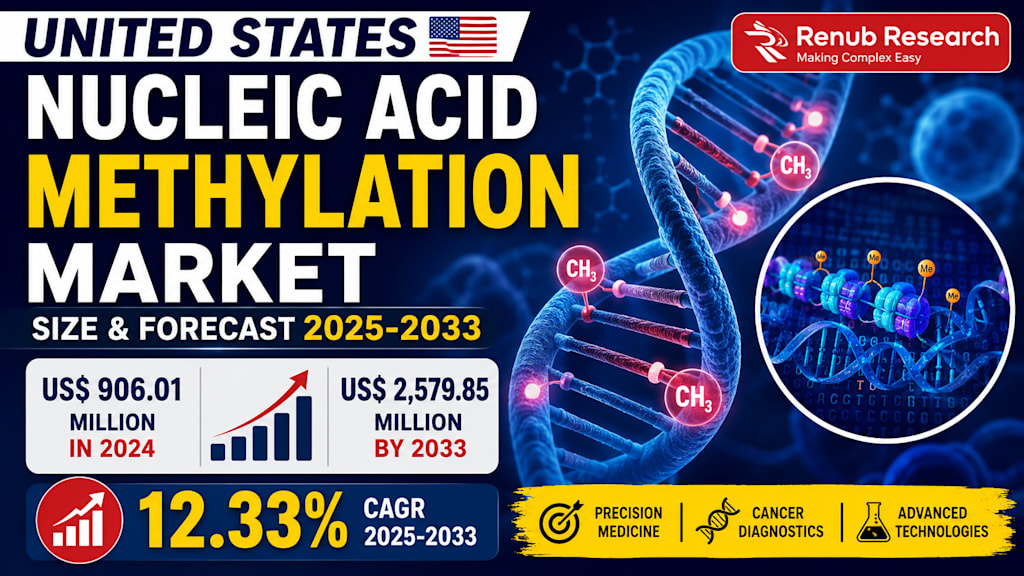
United States Nucleic Acid Methylation Market Size & Forecast 2025–2033
The United States nucleic acid methylation market is entering a period of remarkable growth as healthcare providers, biotechnology companies, pharmaceutical firms, and research institutions increasingly embrace epigenetic technologies. According to Renub Research, the U.S. Nucleic Acid Methylation Market is projected to grow from US$ 906.01 million in 2024 to US$ 2,579.85 million by 2033, expanding at a CAGR of 12.33% during the forecast period from 2025 to 2033.
This impressive growth reflects the expanding importance of nucleic acid methylation in disease diagnosis, precision medicine, drug discovery, and clinical research. As scientists continue to unlock the complexities of gene regulation, methylation-based technologies are emerging as powerful tools for understanding human health and disease progression.
Understanding Nucleic Acid Methylation
Nucleic acid methylation refers to the biochemical process in which methyl groups are added to DNA or RNA molecules. This modification does not alter the underlying genetic sequence but significantly influences gene expression. Because of its role in regulating cellular behavior, methylation is considered one of the most important epigenetic mechanisms in modern biology.
DNA methylation generally suppresses gene activity, while RNA methylation contributes to processes such as mRNA stability, translation efficiency, and cellular signaling. These molecular modifications have become increasingly relevant in understanding cancer, neurological disorders, cardiovascular diseases, metabolic conditions, and aging-related illnesses.
In the United States, the growing focus on personalized healthcare has elevated the importance of methylation research. Healthcare providers are increasingly using methylation biomarkers to improve diagnostic accuracy, monitor treatment responses, and develop targeted therapies tailored to individual patients.
Precision Medicine Revolution Drives Market Growth
One of the strongest catalysts behind market expansion is the rapid adoption of precision medicine. Traditional healthcare approaches often rely on generalized treatment strategies, whereas precision medicine focuses on tailoring therapies according to a patient's genetic and molecular profile.
DNA methylation patterns have emerged as valuable biomarkers for identifying disease risk, detecting cancer at earlier stages, and predicting therapeutic outcomes. These capabilities make methylation technologies highly attractive to hospitals, research institutions, and pharmaceutical developers.
Cancer remains one of the most significant healthcare challenges in the United States. As the incidence of cancer continues to rise, demand for highly sensitive diagnostic technologies is growing rapidly. Methylation-based biomarkers offer clinicians a powerful tool for identifying malignancies before symptoms become apparent, improving treatment success rates and patient survival outcomes.
The increasing popularity of liquid biopsy technologies is further accelerating adoption. These minimally invasive tests analyze circulating DNA fragments in blood samples and frequently rely on methylation signatures to detect cancer and monitor disease progression. Their convenience, accuracy, and patient-friendly nature make them a promising alternative to traditional tissue biopsies.
Additionally, government-supported healthcare initiatives and collaborations between academic institutions and biotechnology companies continue to strengthen research efforts in this field. New educational programs dedicated to precision oncology are helping train the next generation of healthcare professionals and researchers who will drive future innovation.
Technological Advancements Transform Methylation Analysis
Technology continues to play a pivotal role in expanding the nucleic acid methylation market. Innovations in sequencing technologies, bioinformatics platforms, automation systems, and analytical instruments have dramatically improved the efficiency and accessibility of methylation analysis.
Next-generation sequencing (NGS) has become one of the most influential technologies in the field. NGS platforms allow researchers to examine methylation patterns across entire genomes with exceptional accuracy and speed. As sequencing costs continue to decline, more laboratories are integrating NGS-based methylation profiling into routine workflows.
Recent advances in sequencing chemistry are enabling faster and more scalable genomic analysis. New sequencing technologies are helping researchers identify disease-related methylation signatures with unprecedented resolution, supporting breakthroughs in oncology, neurology, and immunology research.
Bioinformatics innovations are equally important. Modern artificial intelligence and machine learning algorithms can analyze massive methylation datasets, uncovering subtle patterns that may otherwise remain hidden. These computational tools help researchers translate complex biological information into actionable clinical insights.
Automation has also simplified laboratory workflows, reducing human error and increasing throughput. Together, these advancements are making methylation research more practical, affordable, and clinically relevant.
Expanding Applications Beyond Oncology
Although oncology remains the dominant application area, nucleic acid methylation technologies are increasingly being applied to a wide range of medical disciplines.
In cardiovascular medicine, researchers are exploring methylation biomarkers that may predict heart disease risk and treatment responses. Similarly, neurological research is leveraging methylation analysis to better understand conditions such as Alzheimer's disease, Parkinson's disease, autism spectrum disorders, and depression.
Metabolic diseases including diabetes and obesity are also becoming important areas of investigation. Scientists are discovering how environmental factors influence methylation patterns, creating new opportunities for disease prevention and intervention.
Forensic science represents another emerging application. Investigators are using methylation analysis to estimate biological age and identify tissue origins from forensic samples, improving the accuracy of criminal investigations and legal proceedings.
The expansion into multiple therapeutic and scientific fields broadens revenue opportunities while reducing dependence on any single application segment.
Market Challenges Continue to Influence Adoption
Despite substantial growth potential, the U.S. nucleic acid methylation market faces several challenges that may affect adoption rates.
High Technology Costs
One of the most significant barriers is the high cost associated with methylation testing and analysis. Advanced sequencing instruments, specialized reagents, software platforms, and data processing infrastructure require considerable investment.
Smaller hospitals, community clinics, and independent laboratories often face budget limitations that restrict access to sophisticated methylation technologies. Reimbursement policies for epigenetic testing are still evolving, creating additional uncertainty for healthcare providers.
As technology matures and economies of scale improve, costs are expected to decline. However, affordability remains a critical issue for broader market penetration.
Data Complexity and Lack of Standardization
Methylation datasets are inherently complex and require advanced bioinformatics expertise for interpretation. Variations in sample preparation methods, analytical procedures, and reporting standards can create inconsistencies across laboratories.
The absence of universally accepted protocols presents challenges for regulatory compliance and clinical implementation. Industry stakeholders are actively working to establish standardized frameworks, but achieving consistency across the healthcare ecosystem remains an ongoing process.
Product and Service Segmentation Analysis
The market consists of multiple product categories, each contributing significantly to overall growth.
Kits and Reagents
Kits and reagents represent a substantial share of market revenue due to their recurring demand in research and clinical laboratories. These products provide the essential materials required for methylation analysis and are increasingly designed for ease of use and reproducibility.
Enzymes
Enzymes such as DNA methyltransferases and methylation-sensitive restriction enzymes play a critical role in epigenetic studies. Their growing use in assay development, therapeutic research, and epigenetic editing applications supports steady market expansion.
Instruments and Software
Sophisticated sequencing systems, mass spectrometers, and bioinformatics platforms form the technological foundation of methylation research. Continuous innovation in hardware and software solutions is expected to strengthen this segment over the coming years.
Consumables
Consumables remain indispensable for routine laboratory operations. Rising testing volumes and increasing adoption of methylation assays ensure sustained demand for these products.
DNA Methylation Maintains Market Leadership
Among methylation types, DNA methylation continues to dominate the market due to its extensive applications in disease diagnosis and biomarker discovery.
Researchers increasingly rely on DNA methylation signatures to identify cancer subtypes, predict treatment outcomes, and detect diseases at early stages. Government-funded research programs and private-sector investments continue to accelerate discoveries in this segment.
Meanwhile, RNA methylation is gaining attention as scientists uncover its role in regulating gene expression and cellular communication. Although still an emerging field, RNA methylation research presents significant future opportunities.
NGS and Mass Spectrometry Shape Future Innovation
Next-generation sequencing remains the preferred technology for comprehensive methylation profiling. Its ability to generate genome-wide methylation maps has transformed epigenetic research and clinical diagnostics.
Mass spectrometry also plays a vital role by providing highly sensitive quantification of methylation modifications. Pharmaceutical companies frequently use mass spectrometry in biomarker validation, drug development, and translational research programs.
Together, these technologies form the backbone of modern methylation analysis and are expected to drive future innovation across healthcare and life sciences.
Clinical Diagnostics Emerges as a Key Growth Area
Clinical diagnostics is becoming one of the most promising applications within the nucleic acid methylation market.
Healthcare providers are increasingly integrating methylation-based tests into cancer screening, prenatal diagnostics, and disease monitoring programs. The growing popularity of liquid biopsy solutions further strengthens this segment.
As regulatory approvals increase and clinical evidence accumulates, methylation-based diagnostics are expected to become a routine component of personalized healthcare strategies.
Hospitals and Diagnostic Laboratories Lead Adoption
Hospitals and diagnostic laboratories represent major end users of nucleic acid methylation technologies.
Large healthcare systems are investing heavily in genomic medicine infrastructure, including in-house sequencing facilities and advanced molecular diagnostics capabilities. These investments enable healthcare providers to offer personalized treatment recommendations based on patient-specific molecular data.
Diagnostic laboratories are also expanding their service portfolios to include methylation profiling and epigenetic testing. Growing physician awareness regarding the clinical value of methylation biomarkers is supporting broader adoption across the healthcare landscape.
Regional Insights: California and New York Lead Innovation
California remains the leading state in nucleic acid methylation research and commercialization. The state's concentration of biotechnology companies, academic institutions, and healthcare innovators creates an ideal environment for technological advancement.
Strong integration between artificial intelligence, genomics, and bioinformatics further strengthens California's leadership position.
New York follows closely behind, supported by world-class medical centers, extensive research funding, and a robust pharmaceutical ecosystem. Hospitals and biotechnology firms throughout the state are actively developing next-generation methylation-based diagnostics and therapeutic solutions.
Both states continue to attract substantial investment and talent, reinforcing their roles as national innovation hubs.
Competitive Landscape
Competition within the U.S. nucleic acid methylation market remains intense as established life science companies and emerging biotechnology firms compete to introduce innovative solutions.
Major market participants include New England Biolabs, Thermo Fisher Scientific, Illumina, Abcam, Agilent Technologies, Roche, Bio-Rad Laboratories, and Exact Sciences Corporation. These companies are investing heavily in product development, strategic partnerships, acquisitions, and research collaborations to strengthen their market positions.
As demand for precision medicine and molecular diagnostics continues to rise, competitive activity is expected to intensify further throughout the forecast period.
10 Recent Developments from Leading Companies
Thermo Fisher Scientific expanded its epigenetics research portfolio through enhanced methylation analysis workflows and sequencing support solutions.
Illumina continued strengthening methylation profiling capabilities across its sequencing platforms to support large-scale genomic research.
Roche introduced advanced sequencing technologies designed to accelerate complex disease research, including oncology applications.
Exact Sciences expanded efforts in liquid biopsy and molecular diagnostics, focusing on earlier cancer detection.
Bio-Rad Laboratories enhanced its digital PCR and molecular analysis platforms to improve epigenetic research accuracy.
Agilent Technologies introduced new sample preparation and analytical solutions supporting methylation studies.
New England Biolabs expanded its enzyme portfolio to support advanced epigenetics workflows and methylation research.
Abcam strengthened its epigenetics reagent offerings through expanded antibody and assay product lines.
Several industry players increased AI integration into bioinformatics platforms to improve methylation data interpretation.
Strategic collaborations between academic institutions and biotechnology firms accelerated the development of clinically relevant methylation biomarkers.
Future Outlook
The future of the United States nucleic acid methylation market appears exceptionally promising. Rising cancer incidence, increasing adoption of precision medicine, rapid technological innovation, and expanding clinical applications are creating powerful growth opportunities.
As sequencing technologies become more affordable and regulatory frameworks mature, methylation-based diagnostics and therapeutics are expected to move further into mainstream healthcare. By 2033, nucleic acid methylation technologies will likely play a central role in disease prevention, diagnosis, and personalized treatment strategies across the United States healthcare system.
About the Creator
Enjoyed the story? Support the Creator.
Subscribe for free to receive all their stories in your feed.
Comments
There are no comments for this story
Be the first to respond and start the conversation.