
United States Molecular Diagnostics Market Expands as Precision Medicine, Cancer Genomics, and Advanced PCR Technologies Transform Healthcare
Rising chronic disease burden, rapid innovation in molecular testing, and growing adoption of personalized medicine are driving strong growth across the United States molecular diagnostics industry.

Market Overview
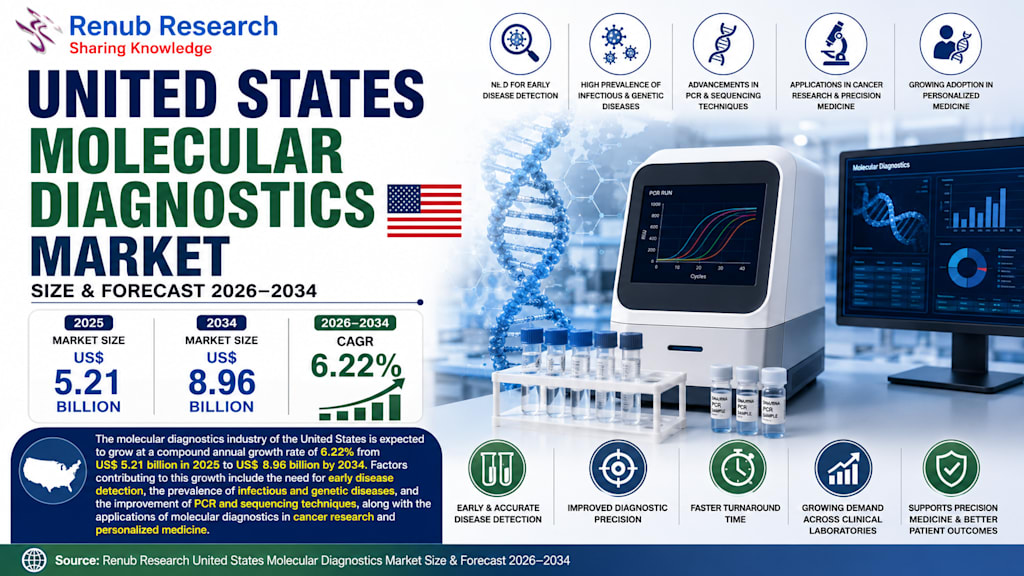
The United States molecular diagnostics market is experiencing significant expansion as healthcare providers increasingly adopt advanced testing technologies for early disease detection, precision medicine, and personalized treatment planning. Molecular diagnostics has become one of the most critical areas within modern healthcare because it enables highly accurate analysis of biological markers, including DNA, RNA, and proteins, to identify diseases at an early stage. According to Renub Research, the United States molecular diagnostics market is projected to grow from US$ 5.21 billion in 2025 to US$ 8.96 billion by 2034, expanding at a CAGR of 6.22% during 2026–2034.
The increasing prevalence of chronic diseases, infectious conditions, and genetic disorders continues to fuel demand for rapid and precise molecular testing solutions across the United States. Technologies such as polymerase chain reaction (PCR), next-generation sequencing (NGS), nucleic acid amplification, and microarray analysis are now widely used for diagnosing infectious diseases, identifying cancer mutations, screening genetic abnormalities, and supporting targeted therapies. These technologies provide healthcare professionals with faster and more accurate clinical information than many traditional diagnostic approaches.
Molecular diagnostics has gained even stronger importance following the COVID-19 pandemic, which accelerated public and institutional acceptance of rapid molecular testing technologies. Hospitals, laboratories, research institutions, and home-care providers increasingly rely on molecular diagnostics for disease management and outbreak control. The ability to deliver highly sensitive and accurate results within shorter timeframes has made molecular testing a core component of modern healthcare delivery in the United States.
The country also benefits from advanced healthcare infrastructure, strong biotechnology research activity, and the presence of leading life sciences companies. Significant investments in research and development continue to accelerate innovation in diagnostic technologies, improving automation, testing speed, and clinical accuracy. These factors position the United States as one of the world’s most technologically advanced and commercially important molecular diagnostics markets.
Growth Drivers
One of the strongest growth drivers in the United States molecular diagnostics market is the increasing prevalence of chronic and infectious diseases. Cancer, diabetes, cardiovascular diseases, influenza, and viral infections require early and accurate diagnosis to improve treatment outcomes and reduce long-term healthcare costs. Molecular diagnostics enables physicians to detect diseases even before severe symptoms appear, allowing earlier intervention and more effective disease management.
According to the report, nearly 23 million Americans visit doctors or medical clinics annually for infection-related treatment. The growing geriatric population in the United States further contributes to rising disease incidence, increasing demand for diagnostic testing. Healthcare providers are therefore incorporating molecular diagnostic tests into routine clinical practice to support preventive healthcare and personalized treatment strategies.
Technological advancement is another major force driving market expansion. Significant innovation in PCR, next-generation sequencing, and microarray analysis has improved the speed, sensitivity, and efficiency of molecular testing. Modern systems are now capable of detecting multiple pathogens or genetic markers simultaneously, reducing testing time and improving clinical accuracy. Automation and digital integration have also streamlined laboratory workflows and enhanced scalability for large-volume testing environments.
Point-of-care molecular diagnostic devices are also becoming increasingly important because they allow testing outside traditional laboratory environments. Home-based molecular diagnostics gained significant attention during infectious disease outbreaks and continue to expand as healthcare providers prioritize convenience and accessibility. Strong investments from both government agencies and private companies are accelerating development in this field. In January 2026, Insight Molecular Diagnostics Inc. announced a major business update related to commercialization efforts and FDA submission plans for its GraftAssureDx™ test kit, highlighting continued innovation in the sector.
Another key growth driver is the rising adoption of personalized medicine. Precision medicine focuses on tailoring treatments according to an individual’s genetic profile, lifestyle, and disease characteristics. Molecular diagnostics plays a central role in this approach because genetic analysis helps determine the most effective treatment options while minimizing unwanted side effects. This has become particularly important in oncology, where targeted therapies depend heavily on molecular profiling and biomarker analysis.
Companion diagnostics, developed alongside pharmaceutical therapies, are further strengthening demand for molecular testing. In February 2026, the U.S. Food and Drug Administration issued draft guidance supporting targeted individualized therapies in cases where randomized controlled studies are difficult because of small patient populations. This reflects the growing regulatory and clinical support for precision medicine approaches in the United States healthcare system.
Market Challenges
Despite strong growth potential, the United States molecular diagnostics market continues to face several important challenges. One of the biggest barriers is the high cost associated with advanced molecular diagnostic testing. Technologies such as next-generation sequencing and specialized PCR systems require expensive equipment, highly trained personnel, and ongoing maintenance investments.
Although insurance reimbursement has improved over time, coverage policies still vary significantly depending on the type of test and healthcare provider. This creates financial challenges for both laboratories and patients. Smaller healthcare facilities and diagnostic centers may struggle to upgrade equipment regularly, limiting broader adoption of newly developed testing technologies.
Regulatory complexity is another major challenge affecting the market. The United States molecular diagnostics industry is heavily regulated by agencies such as the FDA, which requires extensive validation to ensure diagnostic tests meet strict standards for safety, accuracy, and reliability. While these regulations are essential for maintaining healthcare quality, they can slow product approvals and delay commercialization timelines for innovative technologies.
Smaller biotechnology companies often face additional pressure because regulatory compliance requires substantial investment in clinical trials, documentation, and quality assurance. Changing regulations related to laboratory-developed tests (LDTs) also create uncertainty for companies operating within the molecular diagnostics industry.
United States In Situ Hybridization Market
The United States in situ hybridization (ISH) market is expanding steadily because of its growing importance in cancer diagnostics and genetic testing. ISH techniques allow detection and localization of specific nucleic acid sequences within tissue samples, helping clinicians identify gene amplifications and chromosomal abnormalities with high precision.
Technologies such as fluorescence in situ hybridization (FISH) and chromogenic in situ hybridization (CISH) have improved diagnostic sensitivity and reliability. Integration with digital pathology systems is also enhancing efficiency and clinical workflow management. Despite relatively high costs and technical complexity, ISH remains a critical component of oncology-focused molecular diagnostics.
United States Mass Spectrometry Market
The United States mass spectrometry market is growing due to expanding applications in clinical diagnostics, biomarker discovery, toxicology, proteomics, and drug development. Mass spectrometry technologies provide highly accurate biomolecule detection and quantification, making them essential for advanced personalized medicine research.
Technological advancements in high-resolution instruments continue to improve testing speed and accuracy, while strong funding support for life sciences research further accelerates adoption. Clinical laboratories increasingly use mass spectrometry for diagnosing metabolic disorders and infectious diseases. However, high equipment costs and the need for specialized professionals remain limiting factors for wider market penetration.
United States Molecular Diagnostics Pharmacogenomics Market
The pharmacogenomics segment is becoming one of the fastest-growing areas within the United States molecular diagnostics industry. Pharmacogenomics focuses on understanding how a patient’s genetic makeup influences drug response, helping healthcare providers personalize therapies more effectively.
This approach is particularly valuable in cancer treatment, cardiovascular care, and mental health management where personalized drug selection can significantly improve outcomes. Growing awareness regarding individualized medicine and increasing use of companion diagnostics are accelerating adoption of pharmacogenomic testing across the healthcare system.
United States Oncology Molecular Diagnostics Market
The oncology molecular diagnostics segment represents one of the most dynamic growth areas within the broader market. Rising cancer incidence and increasing demand for targeted therapies are driving adoption of molecular profiling technologies. PCR, NGS, and liquid biopsy techniques are now widely used for identifying cancer mutations, monitoring disease progression, and guiding personalized treatment strategies.
Liquid biopsy, in particular, is transforming cancer diagnostics by providing non-invasive methods for detecting and monitoring tumors. Strong collaboration between biotechnology companies, healthcare institutions, and research organizations continues to accelerate innovation within this segment.
United States Molecular Diagnostics Hospitals Market
Hospitals remain one of the largest end users within the United States molecular diagnostics market because of the high volume of diagnostic testing performed daily. Molecular diagnostics supports rapid identification of infectious diseases, cancer, and genetic disorders, helping physicians make timely clinical decisions.
Automated laboratory systems and precision medicine initiatives are increasing demand for advanced molecular platforms across hospital networks. Government healthcare initiatives, positive reimbursement policies, and ongoing infrastructure modernization are additionally supporting adoption within hospital environments.
Regional Outlook Across Key U.S. States
Several states are playing major roles in driving growth within the United States molecular diagnostics industry.
California Molecular Diagnostics Market
California remains one of the largest and most innovative molecular diagnostics markets in the country due to its biotechnology leadership, strong research ecosystem, and concentration of healthcare technology companies. Silicon Valley’s technological environment and strong R&D investment support rapid development of advanced diagnostic solutions.
Washington Molecular Diagnostics Market
Washington benefits from strong research institutions, biotechnology companies, and healthcare innovation centers, particularly around Seattle. Growing adoption of next-generation sequencing and digital diagnostics technologies continues to strengthen the state’s molecular diagnostics market.
New Jersey Molecular Diagnostics Market
New Jersey’s strong pharmaceutical and biotechnology presence makes it an important center for molecular diagnostics growth. Global healthcare companies, advanced laboratory facilities, and skilled professionals support innovation in diagnostics, drug development, and clinical research.
Georgia Molecular Diagnostics Market
Georgia is emerging as a growing healthcare and life sciences hub, particularly around Atlanta. Increased adoption of molecular diagnostics technologies in hospitals and laboratories is supporting market expansion across infectious disease testing and cancer diagnostics.
Recent Developments Companies in Vocal Format
- Insight Molecular Diagnostics Inc. announced commercialization updates and FDA submission plans for the GraftAssureDx™ test kit.
- The U.S. FDA issued draft guidance supporting targeted individualized therapies and precision medicine initiatives.
- Illumina Ltd continues advancing next-generation sequencing technologies for precision diagnostics.
- Abbott Laboratories remains focused on expanding molecular testing and companion diagnostic capabilities.
- Qiagen NV continues strengthening automated molecular workflow and sample preparation technologies.
- Danaher Corporation is expanding advanced diagnostic and life sciences technologies across healthcare systems.
- Becton, Dickinson and Company continues investing in infectious disease diagnostics and laboratory automation.
- Hologic Corporation remains active in oncology-focused molecular testing innovation.
- Agilent Technologies Inc. continues supporting biomarker analysis and genomic research technologies.
- Myriad Genetics remains a major player in genetic testing and personalized medicine solutions.
Segment Outlook
The United States molecular diagnostics market is segmented by technology into PCR, sequencing, mass spectrometry, chips and microarrays, in situ hybridization, and other advanced technologies. PCR remains one of the most widely used technologies due to its speed, reliability, and broad application range.
By application, the market covers pharmacogenomics, infectious disease testing, oncology, genetic disease screening, blood screening, microbiology, and human leukocyte antigen typing. Oncology and infectious disease diagnostics remain among the fastest-growing segments due to rising disease prevalence and increasing demand for precision medicine.
Products include instruments, reagents, and supporting technologies, while hospitals, laboratories, and specialized healthcare facilities remain the primary end users. Strong investment in automation and digital healthcare infrastructure is expected to continue supporting market expansion over the coming decade.
Final Thoughts
The United States molecular diagnostics market is entering a new phase of growth driven by technological innovation, precision medicine, and increasing demand for rapid disease detection. Advances in PCR, next-generation sequencing, pharmacogenomics, and oncology diagnostics are transforming healthcare delivery and enabling more personalized treatment approaches. Renub Research’s projection of US$ 8.96 billion by 2034 highlights the strong long-term opportunity within this sector. Companies that focus on automation, affordability, advanced genomic technologies, and decentralized testing solutions are expected to shape the future of molecular diagnostics in the United States.
About the Creator
Enjoyed the story? Support the Creator.
Subscribe for free to receive all their stories in your feed.
Comments
There are no comments for this story
Be the first to respond and start the conversation.