
United States Mobile App Development Market Size Trends, Share & Forecast 2034
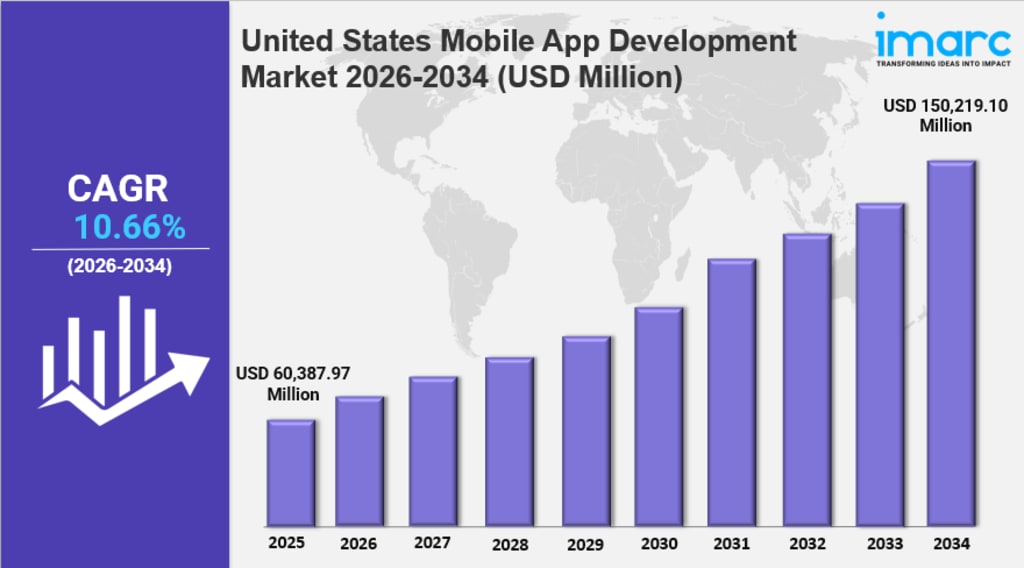
The The US mobile app development market reached USD 60,387.97 million in 2025

United States Mobile App Development Market Size, Share, and Growth Forecast (2026–2034)
The United States mobile app development market continues to expand as businesses across industries prioritize digital engagement and customer-centric platforms. The market reached USD 60,387.97 million in 2025 and is expected to grow to USD 150,219.10 million by 2034, at a CAGR of 10.66%.
This growth reflects the increasing role of mobile applications in business operations, customer acquisition, and service delivery. Organizations are no longer treating apps as optional tools; instead, they are becoming central to digital strategy. From enterprise systems to consumer-facing platforms, mobile applications are helping companies improve efficiency, streamline communication, and create new revenue channels.
Request a Sample Report with Latest 2026 Data & Forecasts:
Enterprise Demand Driving the U.S. Mobile App Development Market
Enterprise demand is a key factor shaping the mobile app development landscape in the United States. Companies are investing in custom applications to support internal operations, enhance productivity, and improve collaboration across teams.
Enterprise mobility solutions, such as workflow automation apps and employee management platforms, are becoming standard across industries. These applications help organizations reduce manual processes, improve data access, and enable real-time decision-making.
In addition, businesses are focusing on customer-facing applications to strengthen engagement and retention. Mobile apps provide direct communication channels, personalized experiences, and data-driven insights, all of which contribute to improved customer relationships.
Key Application Areas: E-commerce, Fintech, Healthcare, and Enterprise Mobility
Mobile app development is being driven by demand across several key sectors. In e-commerce, apps are essential for delivering seamless shopping experiences, enabling features such as personalized recommendations, secure payments, and real-time order tracking.
In fintech, mobile applications support digital banking, payments, and financial management services. These apps require high levels of security and compliance, making them a critical area for specialized development services.
Healthcare is another important segment, where mobile apps are used for telemedicine, patient monitoring, and health data management. These applications improve access to care and support better patient outcomes.
Enterprise mobility continues to be a strong use case, with organizations developing apps for internal communication, project management, and operational efficiency.
Technology Trends in U.S. App Development: AI, Cloud, and Cross-Platform Frameworks
Technology is reshaping how mobile applications are developed and deployed. Artificial intelligence is being integrated into apps to enable features such as personalization, predictive analytics, and automation. This enhances user experience and provides businesses with actionable insights.
Cloud-based development is also gaining importance, allowing applications to scale efficiently and integrate with existing systems. Cloud infrastructure supports faster deployment, reduced costs, and improved performance.
Cross-platform frameworks are becoming widely adopted, enabling developers to build applications that run on multiple operating systems using a single codebase. This approach reduces development time and cost while maintaining consistent functionality across platforms.
Development Cost, Outsourcing, and Pricing Models in the U.S. Market
Cost management is a critical consideration for businesses investing in mobile app development. Development costs vary depending on application complexity, features, and technology requirements.
To optimize costs, many companies are adopting outsourcing strategies. By partnering with external development firms, businesses can access specialized expertise while managing budgets more effectively. Offshore and nearshore development models are commonly used to balance cost and quality.
Pricing models in the market include fixed-price contracts, time-and-material agreements, and dedicated development teams. Each model offers different levels of flexibility and control, allowing businesses to choose based on project requirements and long-term goals.
Challenges in Mobile App Development: Security, Integration, and User Retention
Despite strong growth, mobile app development presents several challenges. Security is one of the most critical concerns, particularly for applications handling sensitive data. Companies must invest in robust security measures to protect user information and comply with regulations.
Integration with existing systems is another challenge. Many organizations operate with complex IT infrastructures, making it difficult to seamlessly connect new applications with legacy systems.
User retention is also a key issue. With a large number of apps available, maintaining user engagement requires continuous updates, performance optimization, and personalized experiences. Businesses must focus on delivering consistent value to keep users active.
Investment Opportunities in the U.S. Mobile App Development Market for Businesses and Investors
The U.S. mobile app development market offers significant opportunities for businesses and investors. Demand for custom applications, enterprise solutions, and industry-specific platforms continues to grow.
Opportunities exist in developing specialized apps for sectors such as healthcare, finance, and logistics, where digital transformation is accelerating. Companies that can provide scalable, secure, and user-friendly solutions are well positioned to capture market share.
In addition, investments in emerging technologies such as AI-driven applications and cloud-based platforms are expected to generate long-term value. Partnerships between technology providers, enterprises, and development firms are also creating new avenues for growth.
As the market evolves, businesses that focus on innovation, efficiency, and user experience will be better equipped to succeed in this competitive environment.
About the Creator
Kim Soo hyun
My name is Kim Soo hyun, and I am a research analyst at IMARC Group, specializing in market trends and data analysis to provide insights and support strategic decision-making.
Enjoyed the story? Support the Creator.
Subscribe for free to receive all their stories in your feed.
Comments
There are no comments for this story
Be the first to respond and start the conversation.