
United States Milk Powder Market Outlook 2026–2034: How Shelf-Stable Dairy Ingredients Are Powering Growth Across Food and Nutrition Industries
Rising demand for protein-rich foods, expanding applications in infant nutrition and sports supplements, and strong export opportunities are driving steady growth in the U.S. milk powder market.

The United States dairy industry continues to evolve as consumer preferences, food manufacturing trends, and global trade dynamics reshape demand for dairy-based ingredients. Among the products benefiting from these changes, milk powder has emerged as one of the most versatile and valuable components within the modern food supply chain.
Milk powder offers a unique combination of nutritional value, convenience, long shelf life, and ease of transportation. Unlike liquid milk, powdered milk products can be stored for extended periods without refrigeration while retaining much of the nutritional content associated with fresh dairy. These advantages have made milk powder an essential ingredient in a wide range of applications, including infant nutrition, bakery products, confectionery items, sports supplements, ready-to-eat foods, and nutritional beverages.
As consumers increasingly seek protein-rich and shelf-stable food products, manufacturers are relying more heavily on milk powder to enhance nutritional value, improve product consistency, and extend shelf life. At the same time, technological advancements in dairy processing are improving quality, functionality, and global competitiveness.
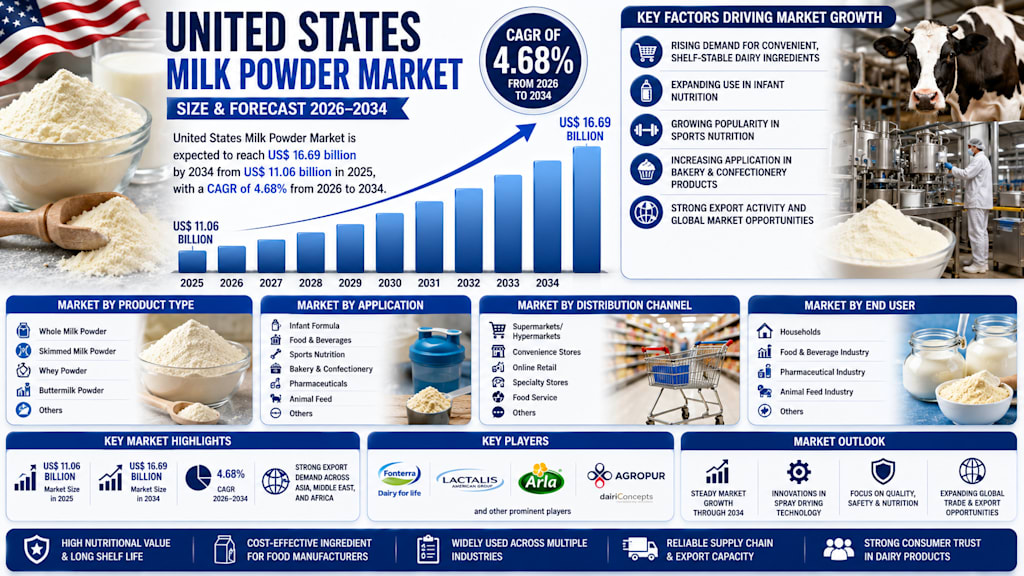
According to Renub Research, the United States Milk Powder Market is expected to grow from US$ 11.06 billion in 2025 to US$ 16.69 billion by 2034, registering a compound annual growth rate (CAGR) of 4.68% from 2026 to 2034. Rising demand for convenient dairy ingredients, expanding use in infant formula and sports nutrition products, advancements in dairy processing technologies, and strong export activity are among the key factors supporting market growth.
As food manufacturers and consumers continue prioritizing convenience, nutrition, and product stability, milk powder is expected to remain a cornerstone ingredient across multiple industries.
Download Free Sample Report

Understanding the Importance of Milk Powder
Milk powder is produced by removing water from liquid milk through evaporation and spray-drying processes.
The resulting product retains most of the proteins, carbohydrates, calcium, vitamins, and essential minerals found in fresh milk while offering significantly improved shelf stability.
Because refrigeration is not required, milk powder provides substantial advantages in storage, transportation, and inventory management.
The product is widely used across industrial food manufacturing, foodservice operations, nutritional supplement production, and household cooking applications.
Common varieties include whole milk powder, skimmed milk powder, buttermilk powder, dairy whitener powder, and fat-filled milk powder.
Each category serves specific purposes depending on nutritional requirements, fat content, texture characteristics, and product formulations.
Its versatility has made milk powder one of the most important ingredients within the global food and beverage industry.
Growing Demand for Shelf-Stable Dairy Ingredients
One of the most significant drivers of the U.S. milk powder market is the increasing demand for shelf-stable food ingredients.
Consumers today increasingly prefer products that offer convenience, long storage life, and easy preparation.
Food manufacturers also value ingredients that can be transported efficiently and incorporated into large-scale production processes without the logistical challenges associated with fresh dairy products.
Milk powder addresses these needs by providing a stable, lightweight, and highly functional ingredient suitable for a wide range of applications.
The growing popularity of packaged foods, ready-to-eat meals, meal kits, and convenience products continues supporting demand.
As supply chains become increasingly globalized and food manufacturers seek greater flexibility, milk powder's importance within the food industry continues expanding.
Infant Nutrition Remains a Major Growth Driver
The infant nutrition segment represents one of the most important markets for milk powder products.
Infant formula manufacturers rely heavily on high-quality dairy ingredients to provide essential nutrients required for healthy growth and development.
Milk powder offers consistent composition, nutritional reliability, and extended shelf life, making it ideal for infant nutrition applications.
Manufacturers utilize skim milk powder, whole milk powder, casein, and whey-based ingredients to formulate specialized products tailored to infant dietary needs.
Growing demand for premium infant formulas featuring organic, lactose-reduced, hypoallergenic, and A2-based formulations is further increasing demand for advanced milk powder varieties.
The premiumization of baby nutrition products continues encouraging investment in high-quality dairy ingredients and innovative production techniques.
As parents increasingly prioritize nutrition and product quality, infant formula applications are expected to remain a key growth driver for the market.
Bakery and Confectionery Industries Continue Expanding Usage
Milk powder has become an essential ingredient across bakery and confectionery manufacturing.
Food producers use milk powder to improve flavor, texture, moisture retention, browning characteristics, and overall product consistency.
Unlike liquid milk, milk powder provides greater flexibility within industrial production environments because it is easier to store, transport, and measure.
The continued popularity of packaged snacks, cakes, cookies, chocolates, desserts, and pastries is supporting strong demand for dairy-based ingredients.
Manufacturers increasingly depend on milk powder to ensure product uniformity while extending shelf life and improving production efficiency.
The rapid growth of convenience foods and ready-to-eat products is creating additional opportunities within this segment.
As consumer demand for baked goods and confectionery products remains strong, milk powder consumption within these industries is expected to continue rising.
Sports Nutrition Is Creating New Opportunities
The growing popularity of fitness and wellness lifestyles is creating substantial opportunities for milk powder producers.
Consumers increasingly seek protein-rich products that support muscle development, athletic performance, recovery, and overall health.
Milk-derived proteins, particularly casein and whey, are highly valued because they provide complete amino acid profiles and excellent nutritional quality.
Milk powder serves as a foundational ingredient in protein shakes, meal replacements, nutritional beverages, energy products, and sports supplements.
Athletes, fitness enthusiasts, and health-conscious consumers continue driving demand for dairy-based protein products.
As awareness regarding protein intake and active lifestyles grows, milk powder's role within sports nutrition is expected to expand significantly.
The increasing integration of dairy proteins into functional foods and beverages further strengthens market prospects.
Export Opportunities Continue Supporting Industry Growth
The United States remains one of the world's leading exporters of dairy products, including milk powder.
Strong international demand from Asia, the Middle East, Africa, and other emerging markets continues supporting domestic production growth.
Many countries rely on imported milk powder to meet nutritional requirements, support food manufacturing, and address limitations in local dairy production.
U.S. dairy producers benefit from advanced processing capabilities, high-quality standards, and efficient supply chains that enhance competitiveness within global markets.
Export demand is particularly strong for skim milk powder and whole milk powder used in infant nutrition, food manufacturing, and nutritional products.
As emerging economies continue expanding food production and dairy consumption, export opportunities are expected to remain a critical growth driver for the industry.
Processing Technology Is Improving Product Quality
Technological innovation continues playing an important role in market development.
Modern dairy processing techniques such as low-heat drying, instantization, membrane filtration, microencapsulation, and advanced spray-drying technologies are improving product functionality and quality.
These innovations enhance solubility, digestibility, nutritional retention, and product performance across various applications.
Manufacturers are increasingly able to develop customized milk powder products tailored to specific customer requirements and industrial applications.
Improved processing methods also support greater efficiency, sustainability, and consistency within production operations.
As technology continues advancing, milk powder producers are expected to benefit from enhanced competitiveness and broader market opportunities.
Whole Milk Powder Maintains Strong Market Position
Whole milk powder remains one of the most important product segments within the market.
Containing natural milk fat alongside proteins, vitamins, and minerals, whole milk powder offers rich flavor and nutritional value.
It is widely used in bakery products, confectionery applications, dairy products, beverages, and foodservice operations.
Many manufacturers prefer whole milk powder because it contributes desirable texture, creaminess, and flavor characteristics to finished products.
Strong demand from both domestic and international markets continues supporting production growth.
As consumers increasingly seek premium dairy experiences, whole milk powder is expected to maintain a strong market presence throughout the forecast period.
Skimmed Milk Powder Benefits from Health Trends
Skimmed milk powder is experiencing growing demand among health-conscious consumers and food manufacturers.
Because most milk fat is removed during processing, skim milk powder provides a lower-fat alternative while retaining high levels of protein, calcium, and essential nutrients.
Manufacturers frequently use skim milk powder in nutritional beverages, protein supplements, dairy products, and low-fat food formulations.
The growing emphasis on healthy eating, weight management, and high-protein diets is supporting demand for this category.
As consumers continue seeking healthier food options, skim milk powder is expected to remain an important growth segment within the broader market.
Price Volatility Remains a Major Challenge
Despite favorable growth prospects, the industry faces several challenges.
One of the most significant concerns involves fluctuations in raw milk prices.
Factors such as feed costs, weather conditions, transportation expenses, labor shortages, and farm economics can significantly influence milk production costs.
Global trade dynamics, currency fluctuations, and geopolitical developments can further impact demand and pricing within export markets.
This volatility creates uncertainty for manufacturers and complicates long-term planning efforts.
Managing supply chain risks and maintaining profitability during periods of market instability remain important priorities for industry participants.
Plant-Based Alternatives Are Increasing Competition
Another challenge facing the milk powder market is the growing popularity of plant-based alternatives.
Products derived from soy, almond, oat, coconut, and other plant sources are gaining traction among consumers seeking vegan, lactose-free, or environmentally conscious options.
Food manufacturers and foodservice operators are increasingly incorporating non-dairy ingredients into product portfolios to address evolving consumer preferences.
Environmental concerns related to greenhouse gas emissions, water usage, and animal welfare have further contributed to interest in alternative products.
Although dairy ingredients continue offering superior nutritional profiles for many applications, competition from plant-based products is expected to remain an ongoing challenge.
To remain competitive, milk powder producers are increasingly focusing on sustainability, product innovation, and premium positioning strategies.
Regional Market Insights
California remains the largest milk powder-producing state in the United States due to its extensive dairy industry and strong food manufacturing infrastructure. The state's export capabilities also provide access to major international markets throughout Asia-Pacific.
Texas continues experiencing rapid growth driven by expanding dairy production, modern processing facilities, and increasing food manufacturing activity. Strong transportation networks further support distribution and export opportunities.
New York benefits from a well-established dairy farming sector and a significant presence within food manufacturing industries. Demand from bakery, confectionery, and nutritional product manufacturers remains particularly strong.
Florida serves as a major consumption market due to strong tourism activity, population growth, and substantial demand for packaged foods, bakery products, and nutritional supplements. The state's warm climate further increases reliance on shelf-stable dairy ingredients.
Competitive Landscape
The U.S. milk powder market remains highly competitive, with major dairy companies focusing on innovation, processing efficiency, and export expansion.
Key industry participants include Dairy Farmers of America Inc., Darigold, Cargill Corporation, The Kraft Heinz Company, Conagra Brands Inc., Land O'Lakes Inc., Schreiber Foods Inc., and California Dairies Inc.
These companies continue investing in processing technologies, product diversification, sustainability initiatives, and global distribution networks to strengthen their market positions.
Strategic partnerships, acquisitions, and investments in value-added dairy products are expected to remain important competitive strategies throughout the forecast period.
Final Thoughts
The United States milk powder market continues benefiting from strong demand across food manufacturing, infant nutrition, sports supplements, and international export markets. Its combination of nutritional value, convenience, shelf stability, and versatility makes milk powder one of the most important ingredients within the modern food industry.
Advancements in dairy processing technologies, expanding consumer interest in protein-rich products, and increasing demand for convenient food solutions are creating new opportunities throughout the value chain.
With the market projected to grow from US$ 11.06 billion in 2025 to US$ 16.69 billion by 2034, milk powder is expected to remain a critical component of both domestic and global food systems. As innovation, nutrition, and convenience continue driving purchasing decisions, the industry's long-term outlook remains highly positive.
About the Creator
Enjoyed the story? Support the Creator.
Subscribe for free to receive all their stories in your feed.
Comments
There are no comments for this story
Be the first to respond and start the conversation.