
United States Milk Powder Market Gains Fresh Momentum as Shelf-Stable Dairy Demand Expands
From infant nutrition to bakery and sports supplements, the U.S. milk powder industry is quietly becoming one of the most versatile dairy segments in the country.

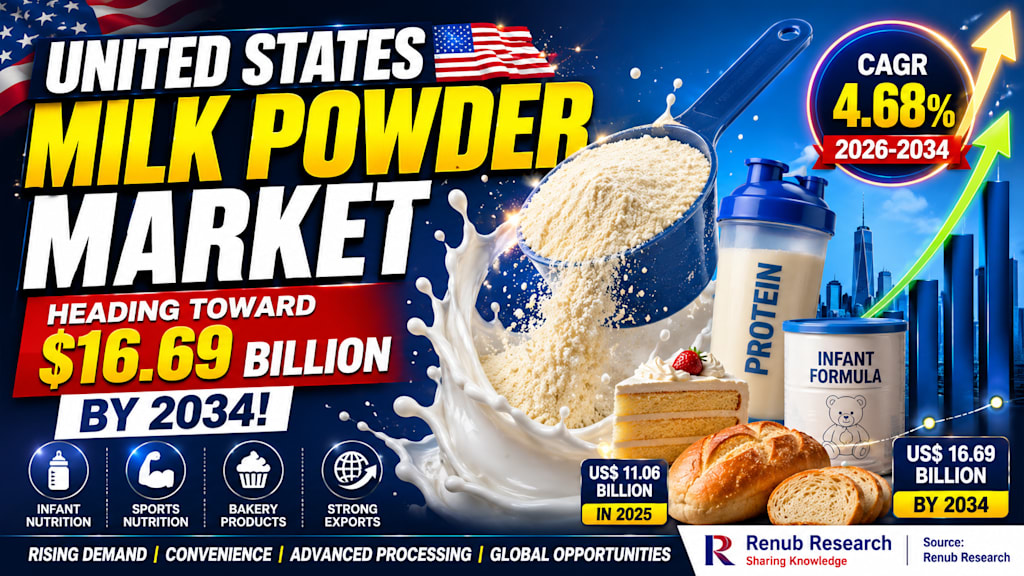
United States Milk Powder Market Overview
The United States milk powder market is entering a period of steady and meaningful expansion, supported by changing consumer habits, stronger demand for convenient food ingredients, and the growing importance of long-shelf-life dairy products in both domestic and international trade. According to Renub Research, the market is expected to rise from US$ 11.06 billion in 2025 to US$ 16.69 billion by 2034, expanding at a CAGR of 4.68% from 2026 to 2034. Rising demand for shelf-stable dairy ingredients, wider use in infant nutrition and sports nutrition, and increasing adoption in bakery and ready-to-eat food manufacturing are all helping shape that growth.
Milk powder may not always dominate headlines, but it plays a major role in modern food systems. It is used in infant formulas, confectionery, baked goods, beverages, nutritional supplements, and packaged meals. Because it retains much of milk’s nutritional value while offering a far longer shelf life, it has become a practical ingredient for manufacturers and households alike. Its lightweight nature, transport efficiency, and versatility make it especially valuable in a market where convenience and consistency matter more than ever.
Why Milk Powder Remains an Important Dairy Ingredient
Milk powder is produced by removing water from liquid milk through evaporation and spray-drying. That process significantly extends shelf life without requiring refrigeration, which makes the product useful in regions and applications where cold-chain logistics are limited or costly. It retains proteins, carbohydrates, calcium, vitamins, and essential minerals, allowing it to function as both a nutritional and industrial ingredient.
Its value is especially clear in large-scale food production. Manufacturers need ingredients that are stable, easy to handle, and reliable over long storage periods. Milk powder offers all of those advantages, which is why it continues to be used across foodservice, retail, and industrial applications. As demand for packaged and convenience foods keeps rising, milk powder remains a practical solution for modern food developers.
Infant Nutrition and Specialty Formulations Are Driving Growth
One of the strongest growth engines for the U.S. milk powder market is infant nutrition. Parents and manufacturers increasingly look for products that are safe, stable, and nutrient-dense. Milk powder supports infant formula production through ingredients such as skim milk powder, whole milk powder, casein, and whey-based derivatives.
Demand is also growing for specialty formulations, including lactose-reduced, organic, A2-based, and hypoallergenic products. That premiumization trend is helping the market move beyond basic dairy consumption and into more specialized, high-value applications. With improving dairy safety regulations and expanding processing technology, this segment is expected to remain a core driver of the U.S. market over the next decade.
Bakery, Confectionery, and Ready-to-Eat Foods Continue to Lift Demand
A major growth catalyst for the U.S. milk powder market is its widespread use in bakery, confectionery, and ready-to-eat food production. Manufacturers rely on milk powder for flavor, texture, browning, and moisture control, qualities that fresh liquid milk cannot always provide because of its perishability.
As consumers continue buying more packaged snacks, cakes, chocolates, biscuits, desserts, and instant foods, producers need ingredients that support both shelf stability and consistent quality. Milk powder fits that need well. It also aligns with clean-label and high-protein product trends, giving food brands more room to reformulate recipes while keeping taste and functionality intact. This is one reason milk powder remains deeply embedded in industrial food manufacturing.
Sports Nutrition and Export Demand Are Creating New Opportunities
Milk powder demand is also rising in sports nutrition, protein-fortified foods, and dietary supplements. Athletes and health-conscious consumers prefer milk-derived proteins such as casein and whey because of their strong nutritional profiles and functional benefits. These ingredients are widely used in protein shakes, bars, meal replacements, and nutritional beverages.
At the same time, the United States remains a major exporter of milk powder. Strong international demand from China, Southeast Asia, the Middle East, and Africa is helping support domestic production. This export activity is reinforced by advancements such as membrane filtration, microencapsulation, and instantization, which improve solubility and performance. As global demand for dairy ingredients expands, U.S. milk powder producers continue to benefit from both domestic and overseas market pull.
Price Volatility and Supply Chain Pressure Remain Key Challenges
Despite its growth prospects, the market faces real pressure. Price volatility is one of the biggest challenges, largely because raw milk supply can shift due to feed prices, drought conditions, transportation costs, and broader farm economics. These factors directly influence the cost of production and can create unpredictable margins for processors.
The market is also affected by trade-related uncertainty, currency shifts, and inflation in labor, packaging, and energy costs. Together, these issues make long-term planning more difficult for manufacturers and distributors. For a market that depends on efficient supply chains and stable input costs, volatility remains a serious issue.
Plant-Based Competition Is Reshaping Consumer Choices
Another challenge comes from the growing popularity of plant-based alternatives such as soy, almond, oat, and coconut powders. Consumers seeking vegan, lactose-free, or allergen-friendly options are increasingly choosing these products in beverages, bakery items, and other applications. Foodservice chains and packaged food brands are also adding more non-dairy options.
Environmental concerns related to greenhouse gas emissions, water usage, and animal welfare are also influencing purchasing behavior. While dairy still offers nutritional and functional advantages in many applications, milk powder producers now face stronger competition than before. This is pushing the industry toward innovation, better sustainability practices, and more premium positioning.
California Milk Powder Market
California is one of the most influential states in the U.S. milk powder market because it is the nation’s largest dairy producer. It supplies large volumes of liquid milk for powder processing and also has a strong food and beverage manufacturing base. Bakery, confectionery, and nutritional supplement companies in the state help drive industrial demand. California also serves as a major export hub, supporting shipments of skim and whole milk powder to Asia-Pacific markets.
Even so, the state faces challenges such as water scarcity, strict environmental regulations, and rising production costs. Despite those constraints, California remains a cornerstone of the national supply chain and one of the most important contributors to U.S. milk powder production.
Texas Milk Powder Market
Texas is expanding quickly thanks to rising dairy production, strong transportation infrastructure, and growing food manufacturing activity. The state is one of the fastest-growing dairy regions in the country and provides a reliable raw-milk base for processing facilities. Demand is supported by packaged foods, sports nutrition products, and ready-to-eat items across Dallas, Houston, and Austin.
Its proximity to Mexico also strengthens cross-border trade potential. Investments in processing plants and agricultural modernization are improving efficiency across the state. Although heat stress on livestock and feed price volatility remain concerns, Texas continues to gain importance in milk powder production and distribution.
New York Milk Powder Market
New York benefits from a long-established dairy farming base and a strong food manufacturing presence. Skim milk powder is widely used in bakery, confectionery, and specialty food production, while nutrition companies and protein beverage brands continue to expand their use of dairy ingredients. The state’s access to ports also supports export shipments to Europe and the Middle East.
At the same time, New York faces high operating costs, strict regulation, and pressure on smaller dairy farms. Even so, it remains an important contributor to value-added dairy production, especially in powder-based formulations.
Florida Milk Powder Market
Florida is more of a consumption market than a production hub. It depends heavily on milk powder from other states, but its large foodservice and tourism sectors generate strong demand for dairy-based ingredients. The bakery and confectionery industries in Miami, Orlando, and Tampa use powdered milk extensively because of its stability in warm climates.
Florida’s strong fitness culture also supports demand for protein powders and dairy-based supplements. While the state has limited dairy farming and higher logistics costs, steady population growth and year-round tourism continue to make it a high-consumption market for milk powder products.
Recent Developments in the United States Milk Powder Market
Industry activity suggests that companies are continuing to invest in innovation and capacity expansion. In March 2023, Dairy Farmers of America partnered with Good Culture to expand its probiotic milk offerings. In January 2023, DFA also acquired two extended shelf-life manufacturing facilities from SmithFoods to strengthen processing capacity. Around the same time, Royal FrieslandCampina introduced fortified milk powder products aimed at older adults and athletes. These moves reflect a market that is becoming more functional, specialized, and nutrition-focused.
Market Segmentation and Competitive Landscape
The market includes a wide range of product types, such as whole milk powder, skimmed milk powder, dairy whitener powder, buttermilk powder, fat-filled milk powder, and other milk powder products. These are used across nutritional food, infant formulas, confectionery, baked sweets, savories, and other applications. That diversity helps the market stay resilient because it is supported by multiple demand channels at once.
The competitive landscape includes major players such as Dairy Farmers of America Inc., Darigold, Cargill Corporation, The Kraft Heinz Company, Conagra Brands Inc., Land O’Lakes, Inc., Schreiber Foods Inc., and California Dairies Inc. Their presence reflects a market built on large-scale processing, established distribution, and broad food industry reach.
Final Thoughts
The United States milk powder market is becoming more important as consumer demand shifts toward shelf-stable, nutrient-rich, and multifunctional ingredients. Its use across infant formula, bakery products, sports nutrition, and ready-to-eat foods gives it a strong and diversified base. At the same time, export demand is adding another layer of growth. With the market projected to reach US$ 16.69 billion by 2034 from US$ 11.06 billion in 2025, the long-term outlook remains positive. Companies that focus on innovation, quality, and supply-chain resilience are likely to benefit most as the market continues to evolve.
About the Creator
Enjoyed the story? Support the Creator.
Subscribe for free to receive all their stories in your feed.
Comments
There are no comments for this story
Be the first to respond and start the conversation.