
United States Microwave Oven Market Expands as Smart Kitchens, Urban Living, and Convenience Cooking Drive Consumer Demand
Rising adoption of smart kitchen appliances, growing demand for quick meal preparation, and increasing urbanization are reshaping the future of the United States microwave oven industry.

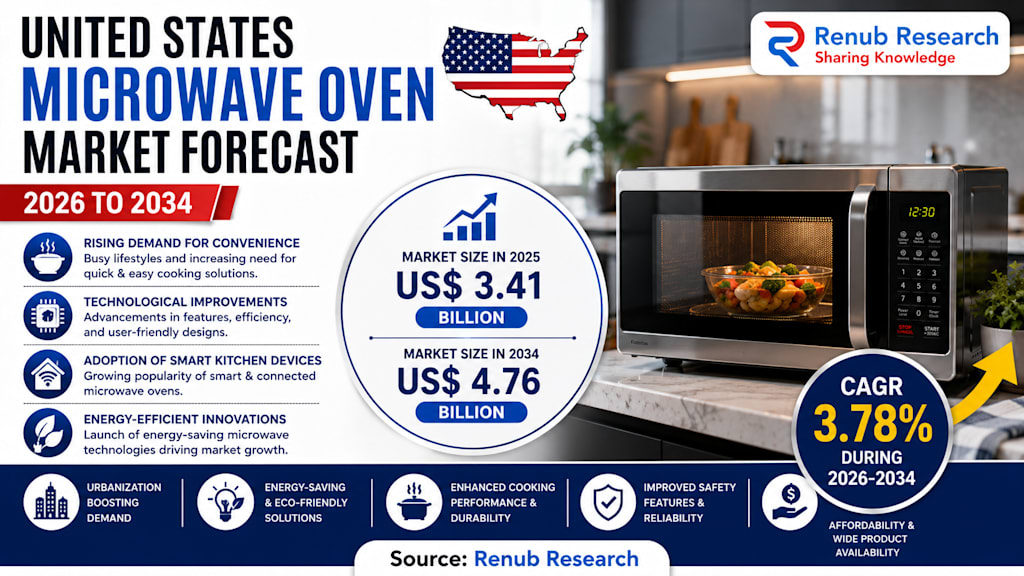
The United States microwave oven market is experiencing steady growth as modern consumers increasingly prioritize convenience, speed, and smart kitchen functionality. According to Renub Research, the United States microwave oven market is expected to rise from US$ 3.41 billion in 2025 to US$ 4.76 billion by 2034, growing at a CAGR of 3.78% during the forecast period from 2026 to 2034. Rising demand for convenient cooking solutions, technological innovation, urbanization, and smart home integration are among the key factors driving market expansion across the country.
Market Overview
Microwave ovens are electric kitchen appliances that use microwave-frequency electromagnetic waves to heat, cook, and defrost food. These appliances work by causing water molecules in food to vibrate rapidly, generating heat and allowing food to cook efficiently. Microwave ovens are commonly used for reheating leftovers, preparing frozen meals, defrosting food, and cooking quick dishes such as rice, vegetables, and ready-to-eat meals.
In the United States, microwave ovens have become essential household appliances because they provide significant time-saving and convenience benefits. Busy work schedules, changing lifestyles, and rising demand for fast meal preparation solutions have strengthened microwave oven adoption across residential and commercial environments alike.
Modern microwave ovens now feature advanced technologies such as sensor cooking, inverter systems, touch controls, eco modes, and Wi-Fi connectivity, making them more efficient and user-friendly than earlier generations of products.
Rising Demand for Convenience Appliances Driving Market Growth
One of the strongest growth drivers in the United States microwave oven market is the increasing need for convenient and time-saving kitchen appliances. Consumers today lead increasingly fast-paced lifestyles, especially working professionals, students, and dual-income households seeking efficient meal preparation solutions.
Microwave ovens significantly reduce cooking and reheating time, making them highly attractive for households where convenience is a top priority. Growing consumption of frozen foods, instant meals, and ready-to-eat products is also contributing to strong demand for microwave ovens across the country.
The report highlights that active smart home device usage in the United States reached approximately 69.91 million households in 2024 and is expected to rise to around 103 million by 2028. This broader smart home trend is directly supporting the adoption of connected kitchen appliances, including microwave ovens.
Demand is also increasing in offices, hostels, dormitories, and compact living spaces where multifunctional appliances are highly valued because of limited kitchen space and convenience needs.
Technological Innovation and Smart Features Transforming the Industry
Technological advancements are playing a major role in reshaping the microwave oven market in the United States. Manufacturers are increasingly integrating features such as sensor cooking, inverter technology, automatic cooking programs, touch controls, and eco modes to improve cooking precision and energy efficiency.
Smart microwave ovens equipped with Wi-Fi connectivity and voice control functionality are becoming increasingly popular among tech-savvy consumers. These appliances can be remotely controlled through smartphones or integrated with virtual assistants and smart home ecosystems.
Consumers are also increasingly demanding multifunctional products that combine microwave cooking, grilling, convection baking, steaming, and air frying capabilities within a single appliance. Manufacturers are therefore focusing on design aesthetics, compactness, and enhanced functionality to remain competitive.
In 2024, Panasonic expanded its partnership with Fresco to develop an advanced cooking assistant for Panasonic kitchen appliances. The first product introduced through this collaboration was the HomeCHEF 4-in-1 multi-oven.
Urbanization and Evolving Food Habits Supporting Expansion
Urbanization and changing food consumption patterns are also contributing significantly to market growth. As more Americans move into urban areas, consumers increasingly prefer compact and multifunctional appliances that suit smaller kitchens and modern apartment lifestyles.
Consumers living in urban environments often lead busy lives and therefore rely heavily on frozen meals, instant foods, and microwave-compatible products. Food manufacturers are also increasingly designing products specifically intended for microwave cooking, further strengthening microwave oven usage in households.
The report notes that urban populations represented approximately 83.3% of the total United States population in 2023. This continued urbanization trend is expected to create ongoing demand for efficient kitchen appliances and space-saving cooking solutions.
Additionally, the rise of single-person households, independent student living, and social media-driven food trends is encouraging consumers to experiment with microwave cooking techniques and quick meal preparation.
Health Concerns and Alternative Appliances Creating Challenges
Despite strong growth opportunities, the United States microwave oven market also faces several challenges. One of the biggest concerns involves changing consumer perceptions regarding health and nutrition. Some consumers continue believing that microwave cooking is less healthy compared to traditional cooking methods, even though scientific evidence does not support these concerns.
The growing popularity of fresh, organic, and home-cooked meals is also encouraging some consumers to choose alternative cooking devices such as air fryers, steam ovens, toaster ovens, and induction cooktops. These products are often perceived as healthier and more versatile alternatives.
Social media trends promoting wellness-focused cooking styles are also influencing purchasing decisions and encouraging diversification away from traditional microwave-only cooking methods.
Market Saturation Intensifying Competition
The United States microwave oven market is also highly saturated, creating intense competition among manufacturers. Microwave ovens already have widespread household penetration, meaning much of the market now depends on replacement purchases rather than first-time buyers.
Manufacturers face intense pricing competition from both established global brands and emerging low-cost competitors. Consumers also have many appliance alternatives available, including air fryers, convection ovens, and multifunctional cooking systems.
As a result, companies must focus heavily on innovation, branding, energy efficiency, and value-added features to differentiate products and maintain market share.
Grill Microwave Ovens Witnessing Rising Demand
Grill microwave ovens are becoming increasingly popular across the United States because they combine microwave heating with grilling functionality in a single appliance. Consumers increasingly prefer appliances capable of delivering crispy textures and more advanced cooking results.
Young consumers and urban households particularly favor grill microwave ovens because they support a wider variety of meal preparation styles while saving kitchen space. The growing demand for multifunctional cooking solutions is expected to support continued growth in this segment.
Household Segment Maintaining Market Dominance
The household microwave oven segment continues dominating the overall United States market due to widespread appliance adoption across residential kitchens. Microwave ovens are considered essential appliances because of their convenience, affordability, and ease of use.
Increasing dual-income households, changing lifestyles, and modern kitchen designs are further supporting household demand. Technological advancements are also encouraging consumers to upgrade older models with newer smart and energy-efficient microwave ovens.
Commercial Microwave Oven Market Growing Rapidly
Commercial microwave ovens are also experiencing strong growth across restaurants, hotels, cafes, foodservice operators, and cloud kitchens. Commercial users require high-powered, durable appliances capable of handling heavy usage and fast cooking requirements.
The rapid expansion of quick-service restaurants, online food delivery services, and cloud kitchens is significantly increasing demand for commercial microwave ovens across the United States.
Built-In Microwave Ovens Gaining Popularity
Built-in microwave ovens are becoming increasingly popular due to growing demand for modern and space-efficient kitchen designs. These appliances integrate directly into cabinetry, creating cleaner aesthetics and maximizing countertop space.
Rising home renovation activities, modular kitchen adoption, and premium home construction projects are supporting strong demand for built-in microwave ovens nationwide.
Online Retail Transforming Appliance Sales
Online retail has emerged as one of the fastest-growing distribution channels for microwave ovens in the United States. Consumers increasingly prefer online shopping because it offers convenience, detailed product comparisons, reviews, competitive pricing, and home delivery services.
The COVID-19 pandemic significantly accelerated online appliance purchases, and digital shopping habits remain strong across the market. Discounts, promotional offers, and flexible return policies are also encouraging consumers to purchase microwave ovens online.
California Microwave Oven Market
California remains one of the most important regional microwave oven markets in the United States due to its large population, high urbanization, and strong technology adoption rates. Consumers in cities such as Los Angeles and San Francisco strongly favor smart and premium kitchen appliances.
The state’s sustainability culture is also encouraging demand for energy-efficient and environmentally friendly microwave ovens. Working professionals and students continue driving strong demand for compact and multifunctional appliances.
Texas Microwave Oven Market
Texas is witnessing particularly strong microwave oven market growth because of rapid urbanization, housing development, and population expansion in cities such as Houston, Dallas, and Austin.
In July 2024, Samsung launched a new range of smart all-in-one microwave ovens featuring air frying, grilling, steaming, and fermentation functions with Wi-Fi connectivity and SmartThings integration.
Recent Company Developments and Industry Updates
Panasonic expanded its partnership with Fresco in 2024 to develop advanced smart cooking assistants and launched the HomeCHEF 4-in-1 multi-oven.
Samsung launched smart all-in-one microwave ovens in July 2024 featuring air frying, grilling, steaming, and SmartThings connectivity.
Smart home device adoption in the United States is projected to exceed 103 million households by 2028, supporting smart microwave demand.
Built-in microwave oven demand continues rising alongside modular kitchen and home renovation trends.
Commercial microwave ovens are gaining traction in cloud kitchens and quick-service restaurants across the United States.
LG Electronics is expected to benefit from increasing smart appliance integration trends within US households. This is an editorial market inference.
Whirlpool Corporation may strengthen its market position through energy-efficient and multifunctional appliances targeting modern households. This is an editorial market inference.
Sharp is likely to benefit from growing demand for compact microwave ovens in urban apartments and small living spaces. This is an editorial market inference.
Midea Group could expand further through online retail and affordable appliance strategies in the United States market. This is an editorial market inference.
GE Appliances is expected to gain from rising consumer demand for premium built-in kitchen systems. This is an editorial market inference.
Final Thoughts
The United States microwave oven market continues evolving as consumer lifestyles become increasingly centered around convenience, smart technology, and efficient kitchen solutions. Urbanization, online retail growth, changing food consumption patterns, and rising smart home adoption are collectively supporting long-term market expansion.
At the same time, manufacturers face growing competition from alternative cooking appliances and increasing pressure to deliver multifunctional, energy-efficient, and aesthetically appealing products. Companies capable of combining innovation, smart connectivity, sustainability, and modern kitchen design are expected to emerge as long-term leaders in the future US microwave oven industry.
About the Creator
Enjoyed the story? Support the Creator.
Subscribe for free to receive all their stories in your feed.
Comments
There are no comments for this story
Be the first to respond and start the conversation.