
United States Logistics Automation Market Size Growth Share Trends & Forecast 2034
United States Logistics Automation Market is anticipated to reach USD 19.0 Billion in 2025 and is projected to grow to USD 40.1 Billion by 2034.

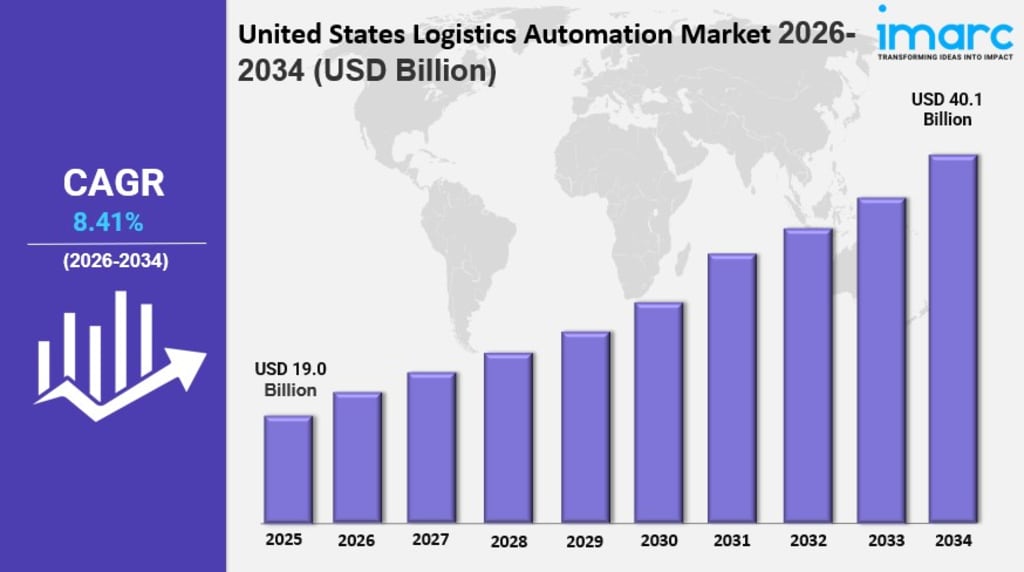
United States Logistics Automation Market Share, and Growth Analysis
The United States logistics automation market is experiencing strong momentum as businesses focus on improving operational efficiency, reducing delivery timelines, and managing growing order volumes. According to IMARC Group, the market is anticipated to reach USD 19.0 Billion in 2025 and is projected to grow to USD 40.1 Billion by 2034, expanding at a CAGR of 8.41% during 2026–2034. The rapid rise of e-commerce activities, along with the integration of AI, robotics, and IoT technologies, is significantly supporting market expansion across the country.
United States Logistics Automation Market Size, Share, and Growth Analysis
The logistics industry in the United States is undergoing major technological transformation. Automation solutions are increasingly being adopted across warehouses, fulfillment centers, transportation networks, and distribution facilities to improve productivity and reduce operational errors. Businesses are investing in automated storage and retrieval systems, robotic picking solutions, and intelligent transportation management systems to streamline supply chain activities.
The growing volume of online retail orders is one of the key factors driving automation adoption. Consumers now expect faster and more accurate deliveries, encouraging logistics companies to modernize their operations. In addition, labor shortages and rising workforce costs are pushing companies toward automated systems that can maintain efficiency while lowering long-term expenses.
Key Trends Transforming the U.S. Logistics Automation Market
• Increasing adoption of artificial intelligence and machine learning for supply chain analysis and route optimization.
• Rising use of warehouse robotics, including autonomous mobile robots and robotic arms, for picking and packaging operations.
• Growing integration of Internet of Things (IoT) devices for real-time shipment monitoring and asset tracking.
• Expansion of connected logistics systems to improve supply chain visibility and operational efficiency.
• Development of autonomous delivery vehicles and drones for faster and cost-effective deliveries.
• Higher focus on automation technologies to reduce manual workload and improve warehouse productivity.
Why Logistics Automation Demand Is Rising in the United States
Demand for logistics automation is increasing rapidly due to the expansion of e-commerce and changing consumer expectations. Online shopping growth has created pressure on warehouses and distribution centers to process orders more efficiently and deliver products within shorter timeframes.
Automation technologies help companies improve order accuracy, reduce operational delays, and manage large product volumes with greater efficiency. Businesses are also using automation to lower dependency on manual labor and minimize operational disruptions caused by workforce shortages.
The increasing focus on supply chain resilience is another factor supporting market growth. Companies are investing in automation systems to improve flexibility, reduce risks, and maintain business continuity during unexpected disruptions. As supply chains become more complex, automation solutions are playing an important role in improving logistics performance across industries.
United States Logistics Automation Market Forecast and Future Outlook (2026–2034)
The future outlook for the U.S. logistics automation market remains highly positive. Growing investments in smart warehouses, robotics, and AI-powered logistics systems are expected to support long-term market expansion. Businesses are increasingly recognizing the benefits of automation in improving efficiency, reducing costs, and enhancing customer satisfaction.
The adoption of cloud-based logistics platforms and predictive analytics solutions is expected to increase in the coming years. These technologies allow companies to make data-driven decisions and improve overall supply chain management. Additionally, advancements in autonomous transportation and drone delivery systems may create new growth opportunities for logistics providers.
As industries continue focusing on digital transformation, logistics automation is expected to become an essential component of modern supply chain operations across the United States.
Challenges and Opportunities in the United States Logistics Automation Market
Despite strong growth potential, the market faces several challenges. High initial investment costs remain a major barrier for small and medium-sized enterprises. Implementing advanced automation systems often requires significant infrastructure upgrades and employee training.
Cybersecurity concerns are also increasing as logistics operations become more digitally connected. Businesses must ensure data protection and system reliability while integrating advanced technologies into their supply chains.
However, the market also presents significant opportunities. The continued growth of e-commerce, rising demand for same-day delivery services, and increasing investments in warehouse modernization are expected to create favorable conditions for automation providers. In addition, advancements in AI, robotics, and sensor technologies are likely to improve the affordability and efficiency of automation systems over time.
Competitive Landscape of the United States Logistics Automation Market
• Honeywell International Inc. – The company provides advanced warehouse automation, robotics, and supply chain management solutions for logistics operations.
• Siemens AG – Siemens offers smart logistics technologies, automated material handling systems, and digital supply chain solutions.
• Dematic – Dematic specializes in intelligent warehouse automation systems, including automated storage and robotic fulfillment technologies.
• Swisslog Holding AG – Swisslog delivers automated warehousing and intralogistics solutions for e-commerce and retail industries.
• KION Group AG – KION Group provides automated material handling equipment and integrated warehouse automation systems.
• Daifuku Co., Ltd. – Daifuku develops automated conveyor, sorting, and warehouse management systems for logistics facilities.
• Zebra Technologies Corporation – Zebra Technologies offers barcode scanning, tracking, and real-time visibility solutions for logistics operations.
Why Companies Are Investing in Logistics Automation Technologies in the United States
Companies across the United States are increasingly investing in logistics automation technologies to improve operational performance and remain competitive in a rapidly evolving market environment. Automation helps businesses reduce processing times, optimize warehouse operations, and improve delivery accuracy.
Organizations are also focusing on automation to address labor shortages and rising operational costs. Automated systems can perform repetitive tasks with greater consistency, helping companies improve productivity while minimizing human errors.
About the Creator
Kim Soo hyun
My name is Kim Soo hyun, and I am a research analyst at IMARC Group, specializing in market trends and data analysis to provide insights and support strategic decision-making.
Enjoyed the story? Support the Creator.
Subscribe for free to receive all their stories in your feed.
Comments
There are no comments for this story
Be the first to respond and start the conversation.