
United States Lime Market Size and Forecast 2025–2033: Infrastructure Growth, Environmental Compliance, and Sustainable Agriculture Drive Industry Expansion
Rising investments in construction, water treatment, industrial manufacturing, and soil management are positioning the U.S. lime industry for steady growth through 2033.

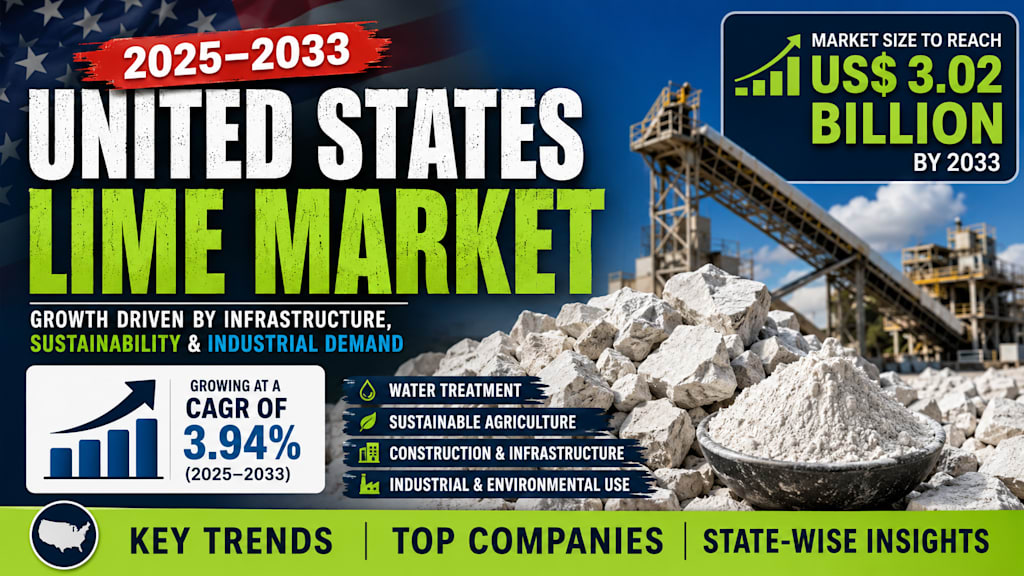
The United States lime market continues to play a vital role in the nation’s industrial ecosystem, supporting sectors ranging from construction and agriculture to water treatment and environmental management. As industries focus on sustainability, infrastructure modernization, and operational efficiency, lime remains an essential material with diverse applications.
According to Renub Research, the United States Lime Market is projected to grow from US$ 2.13 billion in 2024 to US$ 3.02 billion by 2033, expanding at a CAGR of 3.94% during 2025–2033. The market's expansion is being supported by increasing urbanization, industrial development, environmental regulations, and growing demand for sustainable agricultural practices.
Lime products, including quicklime, hydrated lime, and dolomitic lime, are increasingly used in infrastructure projects, chemical processing, wastewater treatment, mining operations, and soil enhancement. Continued technological advancements in lime production and quality control are also helping manufacturers improve competitiveness while meeting evolving industry requirements.
Why Lime Remains Critical to the U.S. Economy
Lime has long been recognized as one of the most versatile industrial minerals in the United States. Produced through the calcination of limestone, lime serves as a key component in numerous industrial processes.
Its importance extends across:
- Construction and infrastructure development
- Agriculture and soil management
- Water and wastewater treatment
- Steel manufacturing
- Mining and metallurgy
- Environmental remediation
- Chemical production
As federal and state governments continue investing in transportation networks, utilities, and environmental compliance initiatives, demand for lime-based solutions is expected to remain strong throughout the forecast period.
Urbanization and Industrial Growth Continue to Fuel Demand
Urban expansion remains one of the strongest growth drivers for the U.S. lime industry. Growing cities require extensive construction activities, including roads, bridges, housing developments, and commercial infrastructure.
Lime plays a critical role in:
- Soil stabilization for highways and roads
- Asphalt production
- Cement manufacturing
- Mortar and plaster applications
- Sewer sludge treatment
- Industrial waste neutralization
As industrial parks and manufacturing hubs expand across the country, demand for lime is increasing in sectors such as metallurgy, chemical processing, and aggregate production.
Modern infrastructure projects often require materials capable of enhancing durability and reducing maintenance costs. Lime-based stabilization techniques continue to offer cost-effective solutions, making the mineral indispensable in large-scale construction projects.
The ongoing modernization of aging infrastructure throughout the United States is expected to provide additional momentum for market growth during the coming decade.
Sustainable Agriculture Strengthens Market Prospects
Agriculture remains another major contributor to lime consumption across the United States.
Farmers increasingly recognize the importance of maintaining optimal soil health to improve crop productivity. Lime is widely used to adjust soil pH levels, enabling better nutrient absorption and enhancing crop yields.
Key agricultural benefits include:
- Improved nutrient availability
- Enhanced soil structure
- Better microbial activity
- Increased fertilizer efficiency
- Long-term soil fertility improvement
The growing adoption of sustainable farming methods is encouraging regular liming practices across agricultural regions. Government programs promoting responsible land management and soil conservation further support market expansion.
Beyond traditional farming, lime demand is growing within:
- Organic agriculture
- Turf management
- Landscaping
- Horticulture
Specialty crop production
As consumers increasingly seek sustainably produced food products, agricultural producers are investing in practices that improve long-term soil productivity, creating favorable conditions for continued lime demand.
Environmental Regulations Create New Opportunities
Environmental sustainability has emerged as a major growth catalyst for the lime market.
Government agencies and environmental organizations continue implementing stricter regulations regarding emissions control, wastewater treatment, and industrial waste management.
Lime plays an essential role in:
Water Treatment
Municipal and industrial treatment facilities use lime to:
- Neutralize acidic water
- Remove contaminants
- Reduce heavy metal concentrations
- Improve water clarity
- Eliminate pathogens
With growing concerns regarding water quality and infrastructure resilience, investment in treatment systems continues to rise nationwide.
Air Pollution Control
Lime is extensively used in flue gas desulfurization systems to reduce sulfur dioxide emissions from power plants and industrial facilities.
As environmental compliance standards become more rigorous, industrial operators increasingly rely on lime-based solutions to meet emission reduction targets.
- Environmental Remediation
- Lime is also used in:
- Hazardous waste treatment
- Soil remediation projects
- Mine reclamation activities
Industrial wastewater management
These applications are becoming increasingly important as companies seek sustainable methods for addressing environmental challenges.
Construction and Infrastructure Development Drive Consumption
The U.S. construction sector remains one of the largest consumers of lime products.
Federal infrastructure initiatives and state-level construction projects continue generating significant demand for lime-based materials.
Applications include:
Soil Stabilization
Lime improves soil strength and durability, making it ideal for:
- Highway construction
- Airport runways
- Rail infrastructure
- Industrial facilities
- Cement and Concrete Production
Lime contributes to the production of durable construction materials used across residential and commercial projects.
Masonry Applications
Builders frequently utilize lime in:
- Mortar production
- Plaster systems
- Limewash coatings
- Restoration projects
As urban populations expand and housing demand increases, construction-related lime consumption is expected to remain robust.
Chemical and Industrial Manufacturing Support Growth
The United States remains one of the world's leading chemical manufacturing centers.
Lime serves as a critical input for numerous industrial processes, including:
- pH adjustment
- Chemical synthesis
- Neutralization reactions
- Mineral processing
- Refining operations
- Industrial users value lime for its:
- Chemical stability
- Cost-effectiveness
- High reactivity
- Versatility
Advancements in kiln technologies, automation systems, and process optimization are helping producers improve efficiency while maintaining product consistency.
These innovations are making lime increasingly attractive across multiple industrial sectors.
Market Challenges Limiting Growth
Despite positive growth prospects, several challenges continue to affect the industry.
Limited Availability of High-Quality Limestone
The production of premium lime depends on access to high-quality limestone reserves.
However, suitable deposits are not evenly distributed across the United States.
This creates challenges such as:
- Higher transportation costs
- Regional supply constraints
- Increased logistics complexity
- Longer delivery timelines
Environmental permitting requirements and land-use regulations can further limit quarry expansion efforts.
Rising Import Competition
Domestic producers also face increasing competition from imported lime products.
Foreign manufacturers often benefit from:
- Lower labor costs
- Reduced energy expenses
- Less stringent environmental regulations
As a result, imported products may enter the market at lower prices, creating pressure on domestic margins.
Market participants must continue investing in efficiency improvements and product innovation to maintain competitiveness.
State-Level Market Analysis
California
California remains one of the most important markets for lime consumption and agricultural applications.
The state's strong construction sector, extensive agricultural activities, and environmental regulations support steady demand.
Southern California's favorable climate also supports lime cultivation, contributing to agricultural output and export opportunities.
However, challenges such as water shortages, labor costs, and pest management continue affecting producers.
Texas
Texas occupies a strategic position within the lime market due to its proximity to Mexico.
The state serves as a major distribution hub for imported lime products while also supporting substantial industrial demand.
Strong consumption is driven by:
- Construction projects
- Oil and gas operations
- Manufacturing facilities
- Agricultural activities
Major metropolitan areas such as Houston, Dallas, and San Antonio remain key demand centers.
New York
New York relies heavily on imported lime products due to climatic limitations on local production.
The state's large population and extensive foodservice sector support consistent demand.
Its logistical advantages, including access to major ports and transportation networks, help ensure reliable supply chains throughout the Northeast region.
Competitive Landscape
The U.S. lime market features a mix of established regional producers and diversified industrial mineral companies.
Manufacturers continue focusing on:
- Capacity expansion
- Sustainability initiatives
- Operational efficiency
- Strategic partnerships
- Product innovation
Growing environmental requirements and infrastructure investments are expected to encourage further industry consolidation and modernization.
Recent Developments from Major Industry Participants
1. Mississippi Lime Company (MLC) Rebranding Initiative – April 2024
Mississippi Lime Company unveiled a new global identity under the name MLC, strengthening its international growth strategy and expanding its portfolio of lime-based solutions.
2. MLC and Singleton Birch Strategic Alignment
The company's collaboration with UK-based affiliate Singleton Birch enhanced its global presence and improved access to international markets.
3. TETRA Technologies Environmental Innovation – December 2024
TETRA Technologies introduced the TETRA Oasis TDS System in the Permian Basin to support water reuse and mineral recovery initiatives linked to industrial lime applications.
4. American Cement Association Rebranding – May 2025
The Portland Cement Association rebranded as the American Cement Association, reflecting increased industry focus on low-carbon construction materials, including lime-based solutions.
5. GAMMA Investing Expands Position in United States Lime & Minerals – June 2025
GAMMA Investing significantly increased its ownership stake in United States Lime & Minerals, demonstrating investor confidence in the sector's long-term prospects.
6. Increased Focus on Decarbonized Lime Production
Leading producers accelerated investments in energy-efficient kiln technologies to reduce emissions and improve sustainability.
7. Expansion of Water Treatment Applications
Manufacturers broadened product offerings targeting municipal and industrial water treatment facilities nationwide.
8. Digitalization of Production Facilities
Several major producers adopted automation and monitoring technologies to improve operational efficiency and product consistency.
9. Growth in Sustainable Agriculture Solutions
Lime suppliers introduced specialized soil enhancement products designed to support regenerative and sustainable farming practices.
10. Capacity Optimization Projects Across U.S. Facilities
Multiple industry participants implemented modernization initiatives aimed at increasing output while lowering production costs.
Market Segmentation
By Type
- Quicklime
- Hydrated Lime
- Dolomitic Lime
By Application
- Agriculture
- Building Material
- Mining & Metallurgy
- Water Treatment
- Others
By State
- California
- Texas
- New York
- Florida
- Illinois
- Pennsylvania
- Ohio
- Georgia
- Washington
- New Jersey
- Rest of United States
Leading Companies Operating in the Market
- Mississippi Lime Company (MLC)
- United States Lime & Minerals Inc.
- Linwood Mining & Minerals Corporation
- Minerals Technologies, Inc.
- Cheney Lime & Cement Company
- Pete Lien & Sons, Inc.
- Valley Mineral LLC
- Brookville Manufacturing
Final Thoughts
The United States lime market is entering a period of stable and sustainable expansion, supported by infrastructure modernization, environmental compliance initiatives, industrial growth, and evolving agricultural practices. With Renub Research forecasting the market to reach US$ 3.02 billion by 2033, industry participants are well-positioned to benefit from long-term demand across multiple sectors.
As sustainability becomes increasingly central to national economic priorities, lime's role in water treatment, emissions control, soil improvement, and infrastructure development will continue to expand. Companies that invest in efficient production technologies, environmental stewardship, and innovative applications are likely to emerge as the strongest beneficiaries of the next phase of market growth.
About the Creator
Enjoyed the story? Support the Creator.
Subscribe for free to receive all their stories in your feed.
Comments
There are no comments for this story
Be the first to respond and start the conversation.