
United States Intraoperative Imaging Market Set to Reach US$ 1.46 Billion by 2033 as Precision Surgery Becomes the New Standard
Growing adoption of image-guided procedures, technological innovation, and rising chronic disease burden are transforming surgical care across the United States.

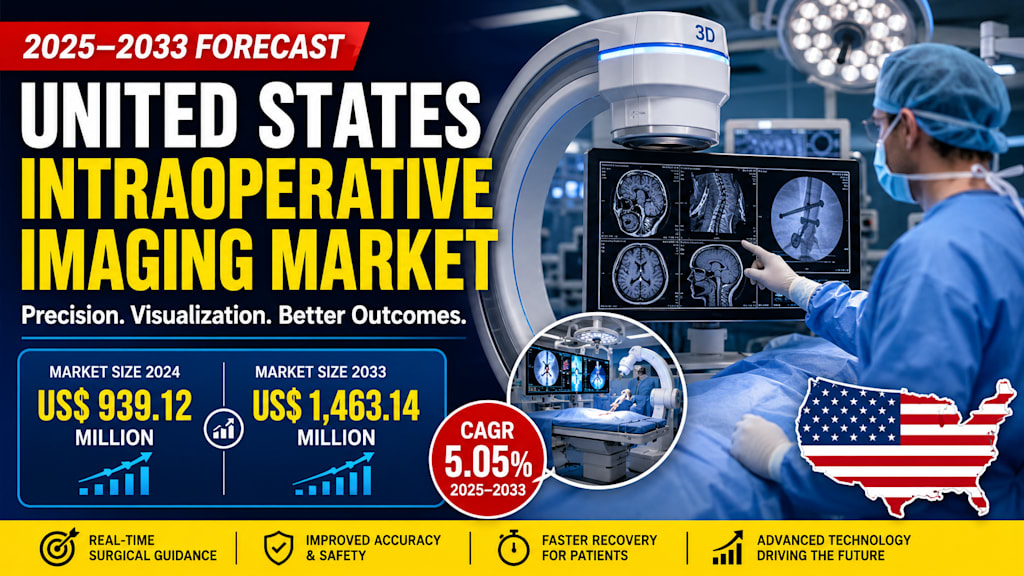
United States Intraoperative Imaging Market Size and Forecast 2025–2033
The United States Intraoperative Imaging Market is expected to grow from US$ 939.12 million in 2024 to US$ 1,463.14 million by 2033, expanding at a CAGR of 5.05% between 2025 and 2033. The market's growth is being driven by increasing demand for precision-based surgeries, continuous advancements in imaging technologies, and the rising use of image-guided surgical procedures across multiple medical specialties.
As healthcare providers focus on improving patient outcomes while reducing surgical complications, intraoperative imaging technologies have become essential tools in modern operating rooms. These systems provide real-time visualization during procedures, allowing surgeons to make immediate and accurate decisions that enhance treatment effectiveness and patient safety.
The Growing Importance of Intraoperative Imaging in Modern Surgery
The healthcare landscape in the United States is undergoing a profound transformation. Surgical procedures are becoming increasingly sophisticated, and the need for enhanced visualization has never been greater. Intraoperative imaging technologies offer surgeons the ability to view anatomical structures and surgical progress in real time, improving precision during complex procedures.
From neurosurgery and orthopedic interventions to cardiovascular and oncological procedures, intraoperative imaging plays a crucial role in helping surgeons navigate delicate structures with greater confidence. By providing immediate feedback during surgery, these systems reduce the likelihood of complications, improve surgical accuracy, and decrease the need for revision procedures.
Hospitals and ambulatory surgical centers across the country are investing heavily in advanced imaging solutions as part of broader efforts to modernize operating rooms and improve quality of care. The integration of imaging systems into surgical workflows is helping healthcare providers deliver better outcomes while optimizing operational efficiency.
Aging Population Creates Strong Market Demand
One of the most influential factors supporting market growth is the rapidly aging population in the United States. Older adults are more susceptible to chronic diseases and conditions that often require surgical intervention.
According to demographic projections, Americans aged 65 years and older are expected to account for approximately 22% of the population by 2050. This demographic shift is contributing to higher incidences of neurological disorders, cardiovascular diseases, musculoskeletal conditions, and various forms of cancer.
The growing prevalence of age-related health conditions is increasing demand for surgical procedures that require precise visualization and navigation. For example, millions of Americans are affected by degenerative joint diseases that lead to knee and hip replacement surgeries. Likewise, the prevalence of neurological disorders such as Alzheimer's disease continues to rise, increasing demand for advanced neurosurgical interventions.
Cardiovascular disease remains the leading cause of death in the United States, accounting for hundreds of thousands of deaths annually. Many cardiovascular procedures rely heavily on intraoperative imaging to ensure accurate device placement and successful treatment outcomes.
As healthcare providers respond to the needs of an aging population, intraoperative imaging systems are becoming indispensable components of advanced surgical care.
Rising Demand for Precision and Minimally Invasive Procedures
Modern patients increasingly seek treatments that offer shorter recovery times, reduced pain, and fewer complications. This preference has accelerated the adoption of minimally invasive surgical techniques across numerous specialties.
Intraoperative imaging serves as a critical enabler of these procedures. Real-time imaging allows surgeons to perform interventions through smaller incisions while maintaining exceptional accuracy and control.
In neurosurgery, imaging systems help surgeons identify critical brain structures and precisely target abnormalities. In orthopedic surgery, real-time imaging ensures proper implant positioning and alignment. In oncology, surgeons can verify tumor margins during procedures, reducing the likelihood of residual cancerous tissue.
The demand for precision medicine is further strengthening the role of intraoperative imaging. Healthcare providers are increasingly focused on delivering personalized treatment approaches that maximize clinical effectiveness while minimizing risk. As a result, image-guided surgery continues to gain momentum throughout the United States healthcare system.
Technological Advancements Reshaping the Market
Technology remains one of the strongest growth catalysts in the intraoperative imaging industry. Manufacturers are introducing advanced imaging solutions that deliver superior image quality, enhanced functionality, and improved workflow efficiency.
Modern intraoperative MRI, CT, and ultrasound systems provide highly detailed images that support accurate decision-making during surgery. These innovations allow clinicians to assess surgical progress instantly and make adjustments when necessary.
Another significant trend is the integration of imaging technologies with robotic-assisted surgical platforms. Combining robotics with advanced imaging enables surgeons to perform highly complex procedures with unprecedented precision.
Artificial intelligence is also beginning to influence the market. AI-powered image analysis tools can assist clinicians in identifying anatomical landmarks, detecting abnormalities, and optimizing procedural workflows. These capabilities help improve efficiency and reduce the likelihood of human error.
Additionally, portable and mobile imaging systems are expanding access to advanced technologies beyond major academic medical centers. Smaller hospitals and community healthcare facilities are increasingly adopting compact solutions that offer flexibility and affordability.
Increasing Burden of Chronic Diseases Fuels Adoption
The prevalence of chronic diseases continues to rise throughout the United States, creating sustained demand for advanced surgical technologies.
Cancer remains one of the most significant health challenges nationwide. Many oncological procedures require precise tumor localization and margin assessment, making intraoperative imaging an invaluable surgical tool.
Similarly, cardiovascular diseases often necessitate complex interventions that depend on real-time visualization for successful outcomes. Neurosurgical procedures involving tumors, aneurysms, and spinal disorders also benefit significantly from advanced imaging capabilities.
Orthopedic conditions, including degenerative joint diseases and spinal disorders, are becoming increasingly common as the population ages. Intraoperative imaging supports accurate implant placement and surgical navigation, helping improve long-term patient outcomes.
The growing burden of chronic diseases is expected to sustain demand for image-guided surgical procedures over the forecast period, supporting continued market expansion.
Challenges Limiting Market Growth
Despite its strong growth prospects, the intraoperative imaging market faces several challenges.
High Installation and Operating Costs
One of the primary obstacles is the substantial financial investment required to implement advanced imaging systems. Hospitals often need to renovate operating rooms or build hybrid surgical suites capable of accommodating sophisticated imaging equipment.
In addition to installation expenses, facilities must manage ongoing costs related to maintenance, software updates, technical support, and staff training.
While large academic hospitals and healthcare networks can often absorb these expenses, smaller hospitals and rural healthcare facilities may face financial constraints that limit adoption.
Training and Workflow Integration Issues
Successful implementation of intraoperative imaging requires significant changes to surgical workflows. Surgeons, radiologists, nurses, and technical staff must undergo specialized training to operate imaging systems effectively and interpret images during procedures.
The learning curve associated with these technologies can initially affect operating room efficiency. Healthcare organizations must invest in comprehensive training programs and workflow optimization strategies to maximize the value of their imaging investments.
State-Level Market Analysis
California
California remains one of the most advanced markets for intraoperative imaging in the United States. Leading healthcare institutions in Los Angeles, San Francisco, and San Diego continue to invest heavily in hybrid operating rooms and cutting-edge imaging technologies.
The state's strong focus on healthcare innovation, research, and precision medicine has accelerated the adoption of advanced surgical imaging systems. Collaborations between hospitals, universities, and technology companies further strengthen California's leadership position.
Texas
Texas is experiencing robust growth in intraoperative imaging adoption. Major medical centers in Houston, Dallas, and Austin are expanding investments in image-guided surgical technologies to address increasing healthcare demands.
The state's large population, growing healthcare infrastructure, and rising prevalence of chronic diseases are supporting widespread implementation of advanced imaging solutions across multiple specialties.
New York
New York remains a key market driven by world-renowned academic medical centers and research institutions. Hospitals throughout the state are adopting intraoperative MRI, CT, and ultrasound systems to improve outcomes in neurosurgery, oncology, and orthopedic procedures.
Strong partnerships between healthcare providers and technology developers continue to drive innovation and market growth.
Florida
Florida's rapidly aging population creates significant demand for advanced surgical care. Hospitals across Miami, Orlando, Tampa, and other major cities are investing in intraoperative imaging technologies to improve outcomes in cardiovascular, neurological, and cancer-related procedures.
The state's commitment to healthcare modernization and patient-centered care positions it as an important growth market through 2033.
Competitive Landscape
The U.S. intraoperative imaging market is highly competitive, with leading medical technology companies focusing on innovation, strategic partnerships, and product development.
Major market participants include:
GE HealthCare
Siemens Healthineers
Medtronic plc
Koninklijke Philips N.V.
Canon Medical Systems Corporation
Brainlab AG
Ziehm Imaging GmbH
NeuroLogica Corp.
These companies continue to invest in research and development to improve imaging quality, workflow efficiency, portability, and integration with surgical navigation and robotic systems.
10 Recent Developments in the U.S. Intraoperative Imaging Market
1. Philips Launches Zenition 90 Mobile C-Arm (2024)
Royal Philips introduced the Zenition 90 Motorized Mobile C-Arm system, offering enhanced image quality, workflow automation, and surgeon-controlled functionality for complex image-guided procedures.
2. Philips Highlights Imaging Innovations at RSNA (2023)
Philips showcased advanced diagnostic imaging and workflow technologies focused on improving clinical productivity and operational efficiency.
3. GE HealthCare Expands AI-Enabled Imaging Solutions
GE HealthCare continues integrating AI-powered capabilities into surgical imaging platforms to enhance visualization and support clinical decision-making.
4. Siemens Healthineers Advances Hybrid OR Technologies
The company expanded solutions designed to improve integration between imaging equipment and surgical navigation systems.
5. Medtronic Strengthens Image-Guided Surgery Portfolio
Medtronic has continued enhancing surgical navigation platforms that leverage real-time imaging for improved procedural accuracy.
6. Brainlab Introduces Advanced Digital Surgery Innovations
Brainlab expanded software-driven solutions that combine imaging, navigation, and data analytics for precision surgery.
7. Canon Medical Enhances Intraoperative CT Capabilities
The company invested in next-generation CT technologies aimed at improving surgical workflow and image clarity.
8. Ziehm Imaging Expands Mobile Imaging Offerings
Ziehm introduced enhanced mobile imaging systems designed to improve accessibility and flexibility in surgical environments.
9. NeuroLogica Advances Portable Imaging Solutions
The company continues developing compact imaging platforms that support neurosurgical and emergency care applications.
10. Growing Adoption of Hybrid Operating Rooms Across U.S. Hospitals
Healthcare systems nationwide are increasingly investing in hybrid operating rooms equipped with integrated imaging technologies to support complex procedures and improve patient outcomes.
Final Thoughts
The United States intraoperative imaging market is entering a period of sustained growth as healthcare providers increasingly prioritize precision, safety, and efficiency in surgical procedures. With the market projected to reach US$ 1.46 billion by 2033, opportunities remain substantial for technology developers, healthcare institutions, and investors alike.
The convergence of advanced imaging modalities, artificial intelligence, robotic-assisted surgery, and hybrid operating room infrastructure is redefining how surgeries are performed across the country. Although high implementation costs and training requirements remain challenges, ongoing technological innovation and rising demand for image-guided interventions are expected to support long-term market expansion.
As chronic disease prevalence increases and the population continues to age, intraoperative imaging will remain a cornerstone of modern surgical care, helping physicians deliver better outcomes while advancing the future of precision medicine in the United States.
About the Creator
Enjoyed the story? Support the Creator.
Subscribe for free to receive all their stories in your feed.
Comments
There are no comments for this story
Be the first to respond and start the conversation.