
United States In-Vitro Diagnostics Market Set for Major Expansion as Preventive Healthcare and AI Transform Diagnostics
Rising chronic disease burden, rapid technological innovation, and growing demand for personalized medicine are pushing the U.S. IVD market toward nearly US$ 66 billion by 2034.

United States IVD Market Enters a High-Growth Phase
The United States in-vitro diagnostics (IVD) market is entering a period of strong expansion as healthcare providers increasingly prioritize early disease detection, precision medicine, and advanced diagnostic technologies. From hospitals and research laboratories to pharmacies and home-testing platforms, diagnostic testing is becoming a central pillar of modern healthcare delivery in the United States.
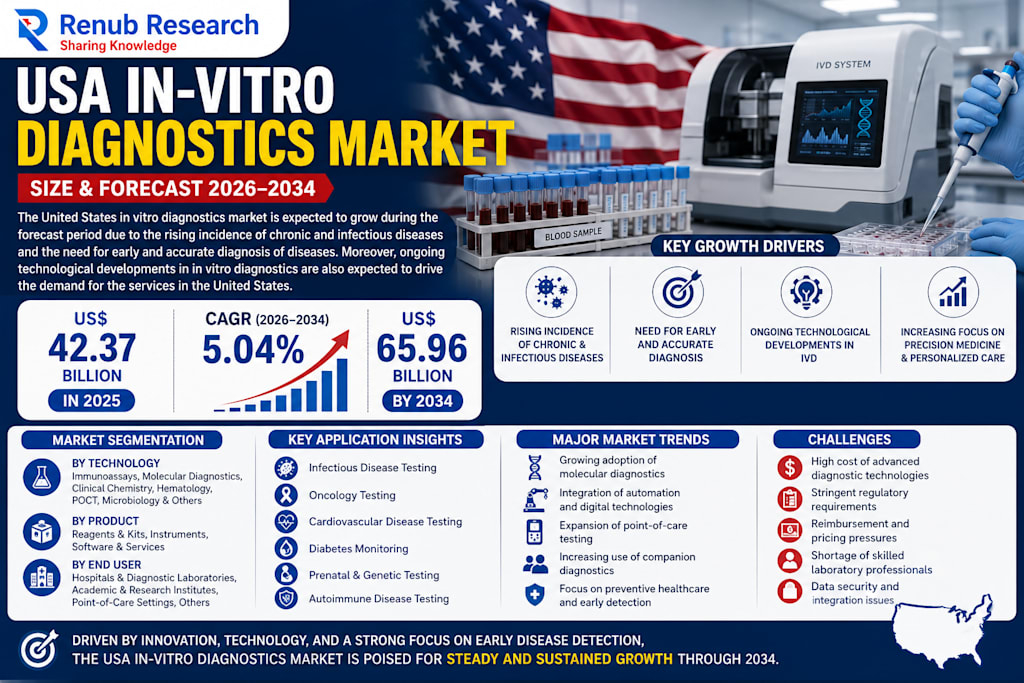
According to Renub Research, the United States in-vitro diagnostics market is expected to grow from US$ 42.37 billion in 2025 to US$ 65.96 billion by 2034, expanding at a compound annual growth rate (CAGR) of 5.04% between 2026 and 2034. The steady rise in chronic diseases, continuous technological advancement, and strong healthcare infrastructure are among the key forces driving this growth.
IVD refers to tests performed outside the human body using biological samples such as blood, urine, saliva, or tissue. These tests are critical for disease diagnosis, treatment monitoring, preventive healthcare, and personalized medicine. Products in this sector include instruments, reagents, test kits, software, and automated systems used across clinical chemistry, hematology, microbiology, immunology, and molecular diagnostics.
As healthcare increasingly shifts toward prevention and personalized treatment, the role of diagnostic testing is becoming more important than ever before.
Chronic Diseases Continue to Fuel Testing Demand
One of the biggest growth drivers for the U.S. IVD market is the massive burden of chronic disease across the country. Chronic and non-communicable diseases account for most healthcare spending and remain among the leading causes of death in the United States.
The report highlights that approximately 129 million Americans live with at least one major chronic disease, including heart disease, diabetes, obesity, cancer, and hypertension. Additionally, around 42% of Americans live with two or more chronic diseases, while 12% suffer from at least five chronic conditions simultaneously. These statistics reveal the enormous long-term demand for diagnostic testing services.
Patients with chronic illnesses require continuous monitoring through blood tests, biomarker analysis, and disease-specific diagnostics. Regular screening and early detection are essential for improving patient outcomes and reducing healthcare costs. This ongoing need for disease management is helping sustain strong demand for diagnostic technologies across hospitals, clinics, and laboratories nationwide.
Infectious disease outbreaks also continue to drive demand for rapid and accurate testing solutions. The healthcare industry’s experience during the COVID-19 pandemic reinforced the importance of scalable diagnostic infrastructure and accelerated innovation in rapid testing technologies.
Advanced Healthcare Infrastructure Gives the U.S. a Major Advantage
The United States maintains one of the most advanced healthcare systems in the world, and this plays a major role in supporting the IVD market. Hospitals, academic medical centers, diagnostic laboratories, and biotechnology firms rapidly adopt innovative technologies, allowing the country to remain a global leader in diagnostics.
The U.S. is particularly strong in areas such as molecular diagnostics, next-generation sequencing, immunoassays, and laboratory automation. Continuous investment in research and development allows companies to improve testing precision, speed, and efficiency. The integration of artificial intelligence and digital healthcare tools is further reshaping the diagnostic landscape by improving workflow automation and decision-making.
The report also highlights developments such as the launch of Polaris AI by Eleos in collaboration with Google Cloud. This AI-driven platform demonstrates how advanced technologies are increasingly being integrated into healthcare and diagnostics to address challenges such as clinician burnout and operational efficiency.
The presence of leading diagnostic companies, world-class research institutions, and a strong biotechnology ecosystem continues to position the United States at the forefront of global diagnostic innovation.
Preventive Healthcare Is Becoming a National Priority
Preventive healthcare is another powerful trend driving the U.S. IVD market forward. Healthcare providers and insurers are increasingly emphasizing early disease detection and risk assessment to reduce long-term healthcare costs and improve patient outcomes.
Diagnostic testing is essential for preventive medicine because it allows physicians to identify diseases before symptoms become severe. Routine screenings for diabetes, cancer, cardiovascular diseases, and infectious conditions are becoming more common across the healthcare system.
At the same time, personalized medicine is transforming how treatments are developed and delivered. Personalized healthcare relies heavily on molecular diagnostics and genetic testing to determine the most effective therapies for individual patients. As precision medicine becomes more mainstream, advanced IVD technologies are expected to experience even stronger demand.
The report references Tempus AI’s FDA-cleared RNA-based Tempus xR IVD product, which highlights how AI and molecular diagnostics are increasingly intersecting to support drug development and targeted therapies.
Regulatory and Reimbursement Challenges Remain Significant
Despite its strong growth outlook, the U.S. IVD market still faces important challenges. One major issue is the highly stringent regulatory environment governing diagnostic products. Companies developing IVD solutions must comply with rigorous clinical validation requirements, quality standards, and post-market surveillance rules.
The approval process for new diagnostic technologies can be time-consuming and expensive, especially for smaller companies and startups with limited resources. Regulatory ambiguity around laboratory-developed tests also creates uncertainty within the industry.
Pricing pressure and reimbursement limitations are additional concerns. As the healthcare system shifts toward value-based care and cost containment, expensive molecular and genetic diagnostics may face reimbursement restrictions. Diagnostic laboratories must carefully balance innovation with financial sustainability, particularly as advanced testing technologies become more complex and costly.
ELISA and CLIA Technologies Continue to Expand
The ELISA and CLIA segment remains one of the most mature and important categories within the U.S. IVD market. These immunoassay technologies are widely used for detecting infectious diseases, autoimmune disorders, hormone imbalances, and cancer biomarkers.
CLIA systems, in particular, are becoming increasingly popular due to their high sensitivity, rapid turnaround times, and compatibility with automated laboratory workflows. Large hospitals and reference laboratories continue to adopt these systems to improve testing efficiency and handle increasing sample volumes.
Technological advancements such as multiplexing and improved assay sensitivity are helping further expand demand for ELISA and CLIA-based diagnostics in the United States.
Rapid Testing and Point-of-Care Diagnostics Gain Momentum
Rapid diagnostic testing has become one of the fastest-growing areas within the U.S. IVD industry. These tests are widely used in emergency departments, clinics, pharmacies, and home healthcare settings for conditions including infectious diseases, pregnancy, cardiac events, and glucose monitoring.
The pandemic significantly accelerated consumer acceptance of rapid tests and decentralized healthcare solutions. Today, both healthcare professionals and consumers increasingly value diagnostic tools that provide faster results and greater convenience.
Advances in lateral flow testing and digital connectivity are improving the accuracy and usability of rapid diagnostic products. As healthcare delivery continues shifting toward convenience and home-based care, rapid testing technologies are expected to remain a major growth driver.
Reagents and Clinical Chemistry Remain Core Revenue Segments
Reagents continue to represent one of the most important revenue streams within the U.S. IVD market because they are essential for nearly every diagnostic procedure. Large testing volumes driven by chronic disease monitoring, preventive screenings, and routine health assessments ensure stable demand for reagents across healthcare facilities.
Clinical chemistry also remains one of the largest diagnostic categories in the country. Tests such as glucose monitoring, cholesterol analysis, liver function testing, and electrolyte analysis are fundamental for managing chronic diseases like diabetes and cardiovascular disorders.
Hospitals are increasingly adopting automated analyzers to improve efficiency, reduce errors, and process higher testing volumes. As preventive healthcare grows in importance, demand for clinical chemistry testing is expected to remain strong.
Microbiology Diagnostics Play a Critical Role
The microbiology IVD market in the United States is expanding due to rising concerns around infectious diseases, hospital-acquired infections, and antimicrobial resistance. Accurate and timely pathogen detection has become essential in hospitals, public health agencies, and research laboratories.
Automated culture systems, molecular microbiology tools, and rapid pathogen identification technologies are improving diagnostic precision and helping healthcare providers respond more effectively to infectious disease threats. Increased public health awareness and disease surveillance efforts are expected to continue supporting this segment’s growth.
California Leads While Other States Show Strong Growth
California remains one of the most important IVD markets in the United States due to its strong biotechnology ecosystem, advanced healthcare infrastructure, and concentration of research institutions. The state is a major center for molecular diagnostics, genetic testing, and precision medicine innovation, supported by technology hubs such as Silicon Valley and San Diego.
Texas is also experiencing rapid market growth because of its large population, expanding healthcare infrastructure, and rising chronic disease burden. The increasing presence of private healthcare facilities and diagnostic laboratories continues to support testing demand across the state.
Florida’s large elderly population is driving strong demand for preventive diagnostics and chronic disease management, while Washington’s focus on technology, public health research, and personalized medicine is helping the state remain an important innovation center within the U.S. IVD industry.
Competitive Landscape
The U.S. IVD market includes some of the world’s leading diagnostic companies, including Roche Diagnostics, Danaher Corporation, Thermo Fisher Scientific, Bio-Rad Laboratories, Biomerieux, Abbott Laboratories, and Sysmex Corporation.
These companies continue investing heavily in automation, molecular diagnostics, AI integration, and precision medicine technologies. Competition is expected to intensify further as healthcare systems increasingly prioritize early detection, decentralized testing, and personalized treatment strategies.
Final Thoughts
The United States in-vitro diagnostics market is becoming more important than ever in modern healthcare. Rising chronic disease rates, growing focus on preventive medicine, and rapid advances in molecular diagnostics and artificial intelligence are reshaping how diseases are detected and managed.
With the market projected to expand from US$ 42.37 billion in 2025 to US$ 65.96 billion by 2034, the industry is poised for sustained long-term growth. Companies that successfully combine innovation, accuracy, automation, and affordability will likely lead the next generation of diagnostic healthcare solutions in the United States.
About the Creator
Enjoyed the story? Support the Creator.
Subscribe for free to receive all their stories in your feed.
Comments
There are no comments for this story
Be the first to respond and start the conversation.