
United States Image-guided Therapy Systems Market Set to Reach US$ 2.35 Billion by 2033 as Precision Medicine Reshapes Healthcare
Advanced imaging technologies, minimally invasive procedures, and AI-powered surgical navigation are driving a new era of precision treatment across the United States.

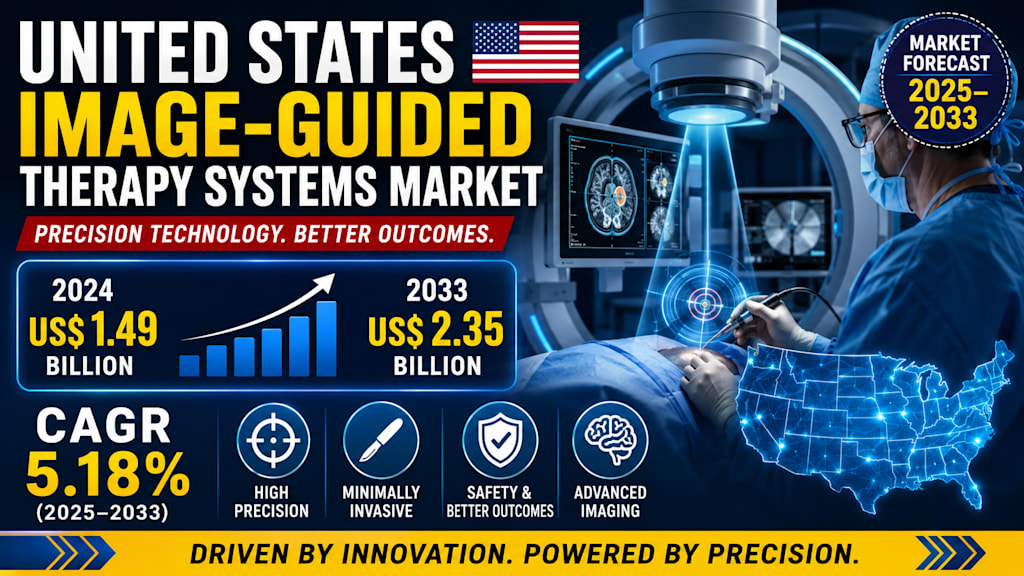
United States Image-guided Therapy Systems Market Outlook 2025–2033
The healthcare industry in the United States is experiencing a profound transformation as medical providers increasingly embrace technologies that improve treatment precision, patient safety, and clinical outcomes. Among the innovations driving this evolution, image-guided therapy systems have emerged as a critical component of modern medicine.
According to Renub Research, the United States Image-guided Therapy Systems Market is projected to grow from US$ 1.49 billion in 2024 to US$ 2.35 billion by 2033, expanding at a CAGR of 5.18% during 2025–2033. The market's growth reflects rising demand for minimally invasive procedures, advancements in imaging technologies, and increasing investments in precision medicine.
Image-guided therapy systems combine sophisticated imaging modalities such as MRI, CT scans, ultrasound, PET, and fluoroscopy with advanced navigation technologies. These systems allow physicians to visualize internal anatomy in real time, enabling highly accurate diagnosis, intervention, and treatment delivery.
As healthcare providers seek better patient outcomes while reducing surgical complications and recovery times, image-guided therapy systems are becoming indispensable across multiple medical specialties.
The Growing Importance of Image-Guided Therapy in Modern Healthcare
Traditional surgical approaches often require large incisions and extended recovery periods. Today, healthcare institutions are moving toward minimally invasive techniques that reduce patient trauma and shorten hospital stays.
Image-guided therapy systems play a central role in this transition. By providing real-time visualization during procedures, surgeons can accurately locate treatment targets while avoiding healthy tissues.
Whether treating brain tumors, repairing heart conditions, performing orthopedic surgeries, or targeting cancerous lesions, image-guided systems significantly improve procedural accuracy and patient safety.
The growing emphasis on value-based healthcare has further strengthened demand. Hospitals are increasingly measured by patient outcomes, readmission rates, and treatment efficiency, making precision-guided interventions highly attractive investments.
Rising Demand for Minimally Invasive Procedures Fuels Market Expansion
One of the strongest growth drivers for the market is the increasing preference for minimally invasive surgical procedures.
Patients increasingly seek treatment options that offer:
Smaller incisions
Less post-operative pain
Reduced risk of infection
Faster recovery
Shorter hospital stays
Improved cosmetic outcomes
Healthcare providers also benefit through reduced resource utilization and improved operating room efficiency.
Image-guided therapy systems enable surgeons to navigate complex anatomical structures with exceptional precision. This capability has become particularly important in neurosurgery, cardiology, oncology, and orthopedic procedures where even minor inaccuracies can significantly impact outcomes.
As the U.S. population continues to age, demand for these procedures is expected to accelerate further.
Technological Advancements Are Transforming Clinical Practice
Technology remains at the heart of market growth.
Over the past decade, image-guided therapy systems have evolved dramatically. Modern systems now integrate multiple imaging modalities with advanced software platforms capable of providing three-dimensional visualization and real-time navigation.
Key innovations include:
Artificial intelligence-assisted imaging
Machine learning algorithms for treatment planning
Robotic-assisted surgery integration
Enhanced 3D anatomical mapping
Real-time image fusion technologies
Cloud-connected imaging platforms
These advancements allow physicians to make more informed decisions during procedures while improving treatment precision.
The integration of AI is particularly significant. Intelligent systems can assist clinicians by identifying anatomical landmarks, predicting procedural risks, and supporting personalized treatment planning.
As technology continues to mature, image-guided therapy systems are becoming increasingly efficient, accurate, and accessible.
Expanding Applications Across Medical Specialties
Initially used primarily in neurosurgery, image-guided therapy systems have expanded into a wide range of medical disciplines.
Oncology
Cancer treatment represents one of the largest application areas.
Image-guided systems support:
Tumor localization
Radiation therapy planning
Biopsy procedures
Tumor ablation
Targeted drug delivery
Precise visualization enables clinicians to maximize treatment effectiveness while minimizing damage to surrounding healthy tissues.
Cardiology
Cardiologists increasingly utilize image-guided systems during catheter-based interventions and structural heart procedures.
These technologies improve procedural accuracy and reduce complications associated with cardiovascular treatments.
Orthopedics
Orthopedic surgeons rely on image-guided systems for:
Joint replacement procedures
Spine surgeries
Trauma repair
Navigation-assisted implant placement
The result is improved implant alignment and better long-term patient outcomes.
Gastroenterology and Urology
Advanced imaging guidance enables more accurate diagnosis and treatment of digestive and urinary tract conditions, supporting minimally invasive interventions.
The expansion into diverse specialties continues to broaden market opportunities across the healthcare landscape.
Chronic Disease Burden Drives Demand
The United States continues to face a growing burden of chronic diseases.
Conditions such as:
Cancer
Cardiovascular disease
Neurological disorders
Musculoskeletal diseases
Kidney disorders
require increasingly sophisticated diagnostic and therapeutic solutions.
According to healthcare experts, many of these conditions benefit significantly from image-guided interventions that improve treatment precision while reducing patient risk.
As disease prevalence rises alongside population aging, healthcare providers are investing in advanced imaging platforms to enhance treatment capabilities and patient outcomes.
This trend is expected to remain a major growth catalyst throughout the forecast period.
Challenges Limiting Wider Adoption
Despite strong growth prospects, several challenges continue to affect market expansion.
High Equipment Costs
Image-guided therapy systems represent a substantial capital investment.
Advanced MRI-guided or robotic-assisted systems can cost millions of dollars, making them difficult to acquire for smaller hospitals and outpatient facilities.
Additional expenses include:
Installation costs
Maintenance contracts
Software updates
Training programs
Infrastructure upgrades
These financial barriers may slow adoption, particularly among resource-constrained healthcare providers.
Workforce Training Requirements
Successful implementation requires highly trained professionals.
Physicians, radiologists, surgeons, and technicians must develop expertise in advanced imaging technologies and navigation systems.
However, many healthcare institutions face shortages of adequately trained personnel.
The learning curve associated with new technologies can delay implementation and reduce utilization rates.
Continued investments in education, certification programs, and user-friendly software interfaces will be essential for overcoming these challenges.
Regional Market Analysis
California Leads Innovation and Adoption
California remains one of the most advanced markets for image-guided therapy systems.
The state benefits from:
Leading academic medical centers
Strong biotechnology sector
Significant healthcare investments
Major research institutions
Hospitals throughout California frequently serve as early adopters of innovative surgical and imaging technologies.
The state's commitment to precision medicine further supports market growth.
Texas Strengthens Healthcare Infrastructure
Texas continues to experience significant adoption driven by expanding healthcare infrastructure and a rapidly growing population.
Major cancer centers and cardiovascular institutes are integrating image-guided technologies to improve treatment outcomes.
Collaborations among universities, hospitals, and medical technology companies continue to drive innovation across the state.
New York Advances Precision Medicine
New York's world-renowned healthcare institutions have positioned the state as a leader in image-guided therapy.
Research collaborations and clinical trials are accelerating the adoption of advanced imaging solutions across multiple specialties.
Strong investment in precision medicine initiatives further contributes to market expansion.
Florida Benefits from Aging Population
Florida's large elderly population creates strong demand for advanced healthcare services.
As chronic disease rates rise, healthcare providers are increasingly investing in image-guided technologies to support minimally invasive treatments and improve patient outcomes.
The state's growing network of specialty centers further strengthens adoption.
Market Segmentation Highlights
By Product
Endoscope
Magnetic Resonance Imaging (MRI)
Computed Tomography (CT) Scanners
Ultrasound Systems
X-Ray Fluoroscopy
Single Photon Emission Computed Tomography (SPECT)
Positron Emission Tomography (PET)
By Application
Cardiac Surgery
Neurosurgery
Orthopedic Surgery
Urology
Gastroenterology
Oncology Surgery
Others
By End User
Hospitals
Ambulatory Surgical Centers
Specialty Clinics
Research and Academic Institutions
Competitive Landscape
The United States image-guided therapy systems market remains highly competitive, with leading global medical technology companies investing heavily in innovation, research, and strategic partnerships.
Major industry participants include:
Siemens Healthineers
Philips
GE HealthCare
Brainlab
Medtronic plc
Olympus Corporation
KARL STORZ SE & Co. KG
Stryker Corporation
These organizations continue to expand their portfolios through acquisitions, partnerships, and technological innovations.
10 Recent Developments by Leading Companies
1. Siemens Healthineers
Expanded AI-enabled imaging solutions to improve procedural guidance and workflow efficiency across surgical environments.
2. Philips
Strengthened its image-guided therapy portfolio through advanced interventional imaging platforms designed for cardiovascular and minimally invasive procedures.
3. GE HealthCare
Introduced next-generation imaging systems focused on enhancing real-time visualization and precision during therapeutic interventions.
4. Brainlab
Enhanced digital surgery and navigation software capabilities, improving accuracy for neurosurgical and orthopedic procedures.
5. Medtronic
Expanded robotic-assisted surgery integration with advanced imaging technologies to support minimally invasive treatments.
6. Olympus Corporation
Advanced its endoscopic imaging portfolio with high-definition visualization technologies aimed at improving diagnostic accuracy.
7. KARL STORZ
Introduced innovative surgical visualization solutions supporting image-guided minimally invasive procedures.
8. Stryker Corporation
Continued investments in navigation-assisted surgical systems to enhance orthopedic and spine surgery outcomes.
9. Philips and Hospital Partnerships
Expanded collaborative agreements with major U.S. healthcare institutions to accelerate adoption of image-guided treatment solutions.
10. Siemens Healthineers and Research Collaborations
Strengthened partnerships with academic medical centers to advance precision imaging applications and clinical innovation.
Final Thoughts
The United States Image-guided Therapy Systems Market is entering a period of sustained growth as healthcare providers increasingly prioritize precision, safety, and efficiency in patient care. With the market expected to rise from US$ 1.49 billion in 2024 to US$ 2.35 billion by 2033, technological innovation will remain the primary catalyst driving adoption.
Advancements in artificial intelligence, robotics, real-time imaging, and navigation software are transforming the way physicians diagnose and treat complex medical conditions. While challenges such as high equipment costs and workforce training requirements persist, ongoing innovation and expanding clinical applications are expected to create substantial opportunities throughout the forecast period.
As hospitals, specialty clinics, and research institutions continue to embrace image-guided therapy systems, these technologies will play an increasingly vital role in shaping the future of precision medicine in the United States.
About the Creator
Enjoyed the story? Support the Creator.
Subscribe for free to receive all their stories in your feed.
Comments
There are no comments for this story
Be the first to respond and start the conversation.