
United States Identity Verification Market Size, Share & Growth Forecast to 2034
The United States identity verification market was valued at USD 3.3 billion in 2025 and is expected to reach USD 9.5 billion by 2034

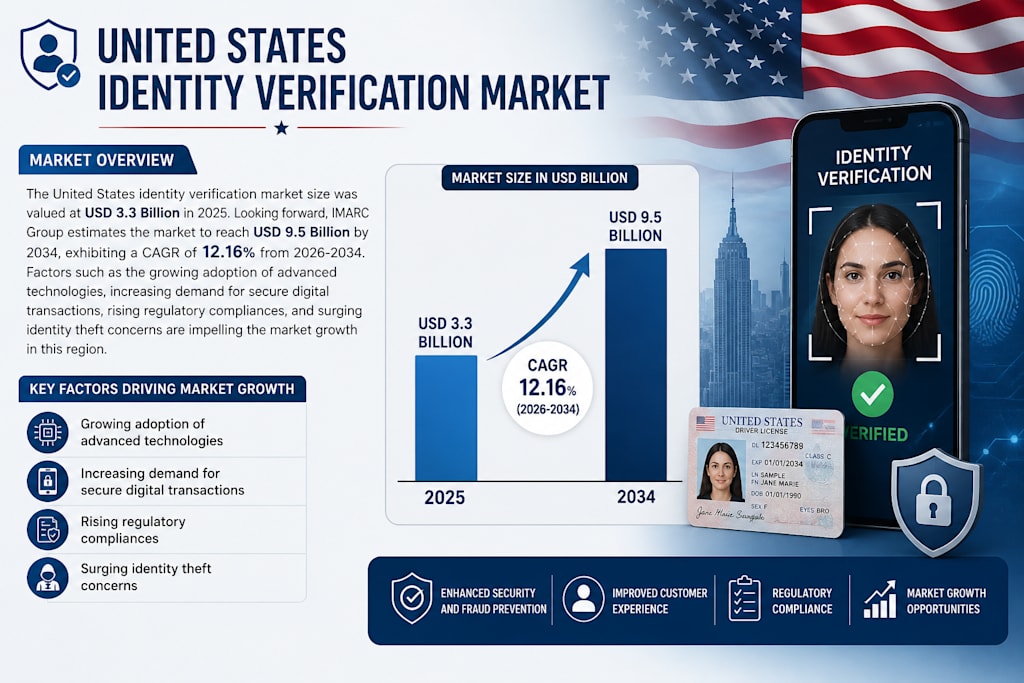
United States Identity Verification Market Size, Share, and Growth Forecast (2026–2034)
The United States identity verification market is expanding at a strong pace as organizations prioritize secure digital interactions and regulatory compliance. The market was valued at USD 3.3 billion in 2025 and is expected to reach USD 9.5 billion by 2034, growing at a CAGR of 12.16% during 2026–2034.
This growth is tied to the rapid shift toward digital services across banking, e-commerce, healthcare, and enterprise platforms. As customer onboarding and transactions increasingly move online, businesses require reliable systems to verify identities in real time. For B2B stakeholders, identity verification is no longer a back-end process—it is becoming a critical component of customer experience, risk management, and operational efficiency.
Request a Sample Report with Latest 2026 Data & Forecasts:
Key Growth Drivers in the U.S. Identity Verification Market: Digital Adoption and Fraud Prevention Needs
Digital adoption continues to be one of the primary drivers of the identity verification market. As organizations expand online services, the need to authenticate users quickly and securely has become essential. Businesses are under pressure to deliver seamless onboarding experiences without compromising on security.
At the same time, the rise in identity fraud and cyber threats is pushing companies to invest in more advanced verification solutions. Fraud prevention is no longer limited to financial institutions; it now impacts e-commerce platforms, healthcare providers, and digital service companies.
Another key driver is the increasing focus on compliance. Regulatory requirements around customer identification and anti-money laundering are compelling organizations to adopt robust verification systems. This is creating consistent demand for scalable and compliant solutions across industries.
Adoption Trends Across Industries: Banking, Fintech, E-commerce, and Healthcare
Adoption of identity verification solutions varies across industries, but the underlying objective remains the same—secure and efficient user authentication.
In banking and fintech, identity verification is essential for customer onboarding, transaction monitoring, and compliance. Financial institutions are increasingly adopting automated solutions to reduce onboarding time while maintaining regulatory standards.
E-commerce platforms are using identity verification to prevent fraudulent transactions and build trust with customers. As online shopping grows, ensuring secure payments and account protection has become a priority.
In healthcare, identity verification is being used to secure patient data and enable safe access to digital health services. The expansion of telehealth and online medical platforms is further increasing demand in this segment.
For B2B providers, understanding these industry-specific requirements is key to developing tailored solutions that address unique operational challenges.
Technology Trends in Identity Verification: AI, Biometrics, and Digital Identity Solutions
Technology is playing a central role in shaping the identity verification market. Artificial intelligence is being widely used to automate verification processes, detect anomalies, and improve accuracy. AI-driven systems can analyze large volumes of data quickly, reducing manual intervention and operational costs.
Biometric verification, including facial recognition and fingerprint scanning, is becoming a standard feature in many solutions. These technologies provide an additional layer of security while enabling faster user authentication.
Digital identity solutions are also gaining traction, allowing users to manage and share verified credentials securely. These systems support seamless interactions across multiple platforms, improving user experience and reducing friction in digital transactions.
For businesses, investing in advanced technologies is essential to stay competitive and meet evolving security requirements.
Regulatory Landscape and Compliance Requirements in the U.S. Identity Verification Market
The regulatory environment in the United States plays a significant role in shaping the identity verification market. Organizations must comply with strict guidelines related to data protection, customer identification, and financial transactions.
Compliance requirements such as Know Your Customer (KYC) and anti-money laundering (AML) regulations are driving the adoption of verification solutions. Companies must ensure that their systems can meet these standards while maintaining efficiency and scalability.
In addition, data privacy regulations are becoming increasingly important. Businesses must implement secure data handling practices to protect user information and maintain trust.
For B2B stakeholders, compliance is not just a requirement—it is a key factor in building credibility and long-term partnerships.
Challenges in Identity Verification: Data Privacy, Integration, and Accuracy Concerns
Despite strong growth, the identity verification market faces several challenges. Data privacy remains a major concern, as organizations handle sensitive personal information. Ensuring secure storage and processing of data is critical to maintaining user trust.
Integration with existing systems can also be complex. Many organizations operate on legacy infrastructure, making it difficult to implement new verification technologies without significant investment.
Accuracy is another important factor. False positives and verification errors can impact user experience and operational efficiency. Businesses must balance security with convenience to ensure smooth customer interactions.
Addressing these challenges requires continuous investment in technology, process optimization, and compliance management.
Investment Opportunities in the U.S. Identity Verification Market for Enterprises and Startups
The U.S. identity verification market presents strong opportunities for both established enterprises and emerging startups. As demand for secure digital interactions grows, businesses are looking for solutions that are scalable, accurate, and easy to integrate.
Opportunities exist in developing AI-driven verification platforms, biometric authentication tools, and cloud-based identity solutions. Companies that can offer flexible and customizable products are likely to attract a wide range of clients across industries.
Partnerships are also becoming an important growth strategy. Collaboration between technology providers, financial institutions, and digital platforms is enabling faster innovation and market expansion.
For investors, the focus is on companies that combine strong technology capabilities with regulatory compliance and user-centric design. As digital ecosystems continue to evolve, identity verification will remain a critical component of secure and efficient business operations.
About the Creator
Kim Soo hyun
My name is Kim Soo hyun, and I am a research analyst at IMARC Group, specializing in market trends and data analysis to provide insights and support strategic decision-making.
Enjoyed the story? Support the Creator.
Subscribe for free to receive all their stories in your feed.
Comments
There are no comments for this story
Be the first to respond and start the conversation.