
United States Hydroponics Market Expected to Reach US$6.34 Billion by 2034 as Sustainable Farming Gains Momentum
Rising demand for water-efficient agriculture, urban food production, and advanced farming technology is transforming the future of American agriculture

The United States hydroponics market is rapidly emerging as one of the most innovative and sustainable segments within modern agriculture. As concerns surrounding climate change, water scarcity, land limitations, and food security continue intensifying, hydroponic farming is gaining widespread attention as a highly efficient alternative to traditional agriculture.
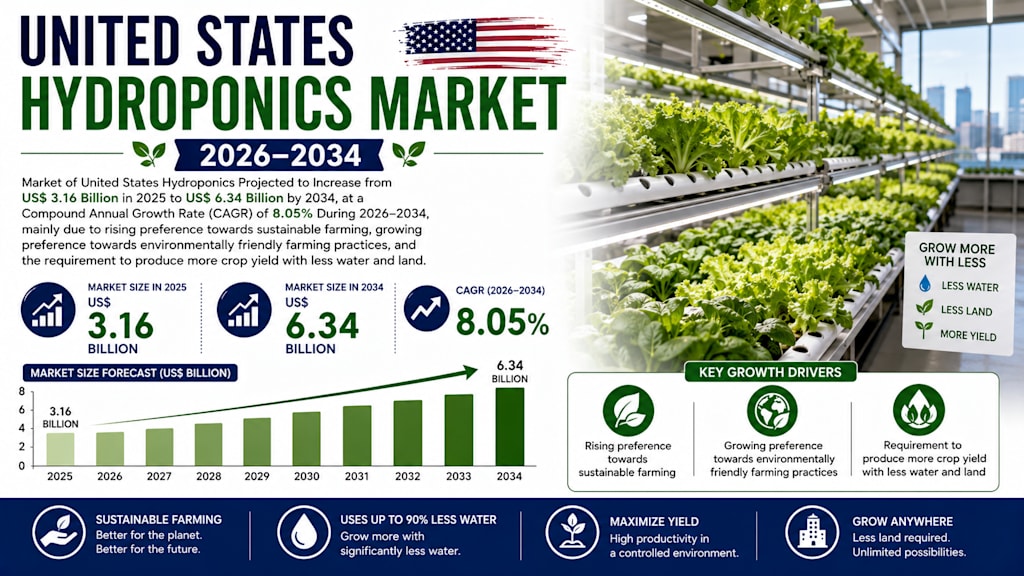
According to Renub Research, the United States hydroponics market is projected to grow from US$3.16 billion in 2025 to approximately US$6.34 billion by 2034, expanding at a compound annual growth rate (CAGR) of 8.05% between 2026 and 2034.
The market’s strong growth is being driven by rising preference for sustainable farming methods, increasing demand for environmentally friendly agricultural practices, and the urgent need to produce higher crop yields while using less water and land.
As technology and agriculture continue merging, hydroponics is increasingly being viewed not just as an alternative farming method, but as a critical solution for the future of food production in the United States.
Hydroponics Is Redefining Modern Agriculture
Hydroponics is a method of growing plants without soil by using nutrient-rich water solutions instead. Crops are cultivated in controlled environments using mediums such as coco coir, perlite, and rock wool while carefully managing nutrients, light, humidity, and temperature.
This advanced agricultural approach offers several major advantages over conventional farming, including:
- Faster plant growth
- Higher crop yields
- Significant water conservation
- Reduced pesticide use
- Year-round cultivation
- Efficient land utilization
Hydroponic systems are especially effective for growing:
- Leafy greens
- Herbs
- Tomatoes
- Strawberries
- Cucumbers
- Peppers
The method is becoming increasingly popular in urban areas where land availability is limited and consumers seek locally sourced fresh produce.
Sustainability Concerns Are Driving Rapid Adoption
One of the strongest factors fueling the hydroponics market is the growing need for sustainable and resource-efficient farming.
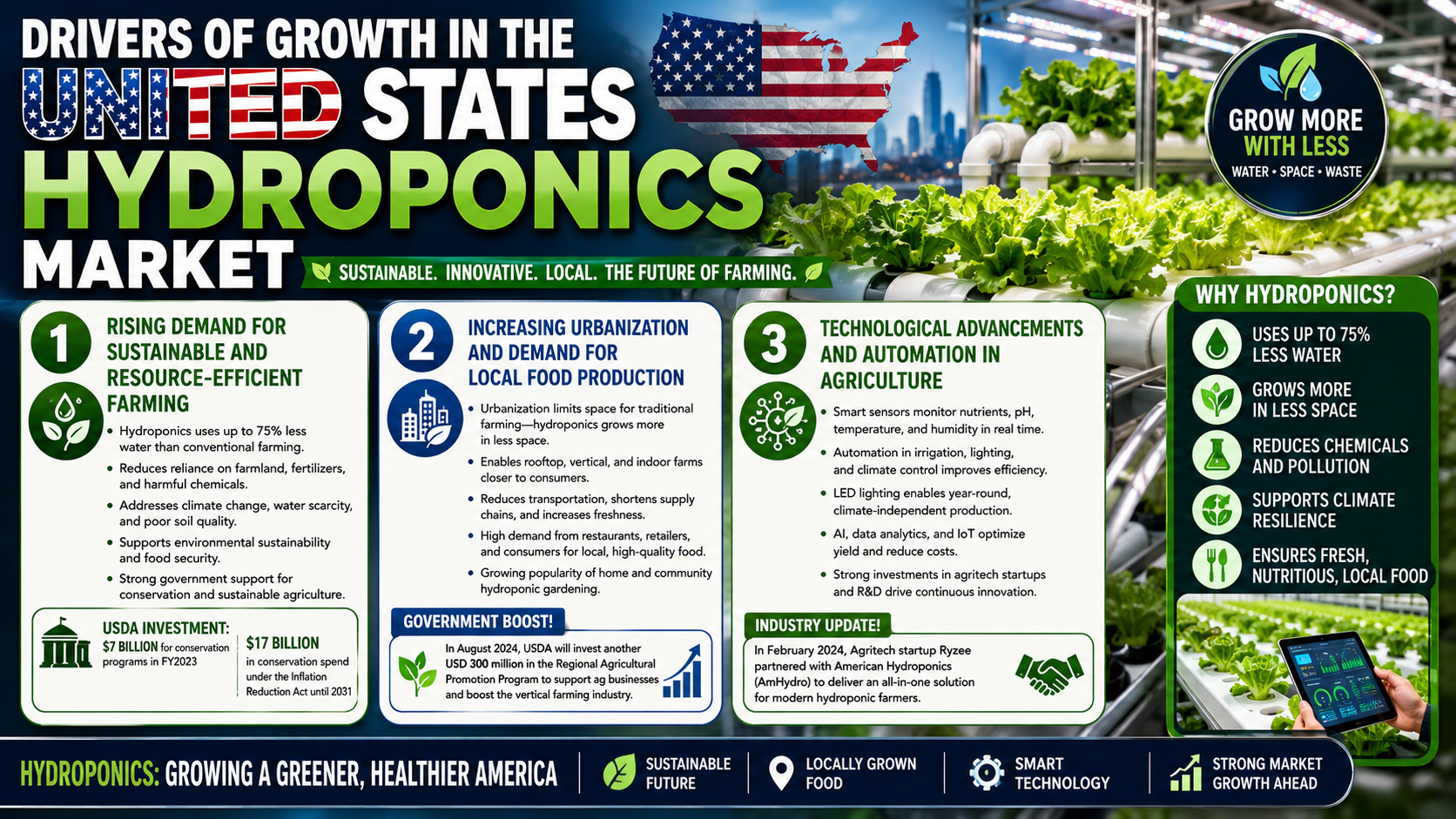
Traditional agriculture consumes vast amounts of water and arable land, while hydroponics can reduce water usage by up to 75% compared to conventional farming methods.
As climate change intensifies drought conditions and soil degradation across many regions of the United States, hydroponics is becoming an increasingly attractive solution for ensuring food security.
Additional sustainability advantages include:
- Reduced fertilizer runoff
- Lower pesticide dependence
- Minimized transportation emissions through local farming
- Efficient indoor cultivation
- Reduced agricultural land pressure
Government investment is also supporting sustainable agriculture initiatives. According to the report, the U.S. Department of Agriculture allocated:
US$7 billion toward conservation programs
US$17 billion in conservation spending through the Inflation Reduction Act until 2031
These investments are expected to further accelerate hydroponic agriculture adoption nationwide.
Urban Farming and Local Food Production Are Expanding
Rapid urbanization across the United States is significantly boosting demand for local food production systems.
As cities expand and farmland becomes less accessible, hydroponic farming offers a practical way to cultivate crops in:
- Rooftop farms
- Warehouses
- Indoor facilities
- Vertical farming systems
- Community gardens
Hydroponics enables food production much closer to consumers, reducing transportation distances and improving freshness.
Consumers increasingly prefer locally grown produce because of its:
- Freshness
- Reduced environmental footprint
- Perceived quality
- Lower transportation impact
Restaurants, grocery chains, and catering companies are also partnering with urban hydroponic farms to ensure stable supplies of fresh vegetables and herbs.
In August 2024, the U.S. Department of Agriculture announced an additional US$300 million investment into the Regional Agricultural Promotion Program aimed at strengthening agricultural business development.
These investments are expected to further encourage urban agriculture and vertical farming projects.
Technology and Automation Are Revolutionizing Hydroponics
Technology is playing a transformative role in the hydroponics industry.
Modern hydroponic farms increasingly integrate:
- Artificial intelligence
- Automation systems
- Smart sensors
- Big data analytics
- Climate control systems
- Automated irrigation technologies
Advanced monitoring systems can precisely regulate nutrient levels, pH balance, humidity, lighting, and temperature to optimize crop growth and productivity.
Automation is also reducing labor costs while improving consistency and operational efficiency.
LED grow lighting technology has become especially important because it allows year-round indoor crop production regardless of outdoor climate conditions.
In February 2024, agritech startup Ryzee partnered with American Hydroponics to develop integrated solutions aimed at simplifying operational challenges for farmers.
Continuous advancements in automation and controlled-environment agriculture are expected to make hydroponics increasingly scalable and commercially viable.
Major Industry Investments Continue Expanding the Market
The hydroponics industry is attracting substantial investment from both established agricultural companies and emerging agritech startups.
Several major developments highlighted in the report include:
- In January 2025, Plantaform launched its Smart Indoor Garden in the United States using innovative fog-based cultivation systems
- In April 2023, AeroFarms announced plans to build a new vertical farm in Virginia
- In June 2023, Plenty Unlimited partnered with Albertsons to distribute hydroponically grown leafy greens in over 2,000 stores nationwide
- In October 2023, Gotham Greens expanded into the Midwest with a new facility in Chicago
- In December 2023, Freight Farms launched hydroponics kits for homegrown food production
- These developments demonstrate how hydroponics is expanding across both commercial agriculture and consumer gardening segments.
High Initial Investment Remains a Key Challenge
Despite strong growth potential, hydroponics continues facing significant financial barriers.
Setting up hydroponic farms requires expensive infrastructure, including:
- Climate control systems
- LED lighting
- Automated irrigation equipment
- Nutrient delivery systems
- Advanced monitoring technology
Operational costs related to electricity, maintenance, and skilled labor can also be substantial.
Although hydroponics offers long-term efficiency benefits, high upfront investment costs may discourage smaller farmers and first-time entrants from adopting the technology.
Technical Complexity Creates Operational Challenges
Hydroponics is a highly technical farming method that requires specialized expertise.
Managing nutrient levels, pH balance, temperature, humidity, and environmental conditions can be difficult, particularly for inexperienced growers.
Small imbalances in these variables can negatively affect crop yields and quality.
As a result, the industry continues facing demand for skilled professionals capable of operating sophisticated hydroponic systems effectively.
Training and education remain essential for expanding adoption and reducing operational risks.
Aggregate Systems Continue Dominating Hydroponic Production
Aggregate hydroponic systems are becoming increasingly popular within the United States.
These systems use solid growing media such as:
- Perlite
- Vermiculite
- Coco coir
- Rock wool
Growers prefer aggregate systems because they provide:
Better root stability
Efficient moisture retention
Improved nutrient management
Lower risk of water-borne diseases
The scalability and flexibility of these systems make them suitable for both greenhouse and indoor vertical farming applications.
Tomatoes and Herbs Are Leading Crop Segments
Tomatoes
Tomatoes remain one of the most widely cultivated hydroponic crops in the United States because of consistent year-round demand. Hydroponics enables growers to optimize flavor, quality, and yield while reducing pesticide usage.
Commercial greenhouse operations and vertical farms are increasingly supplying hydroponic tomatoes to restaurants, retailers, and consumers nationwide.
Herbs
Hydroponic herbs such as basil, mint, parsley, and cilantro are also experiencing strong demand growth. Restaurants, grocery stores, and meal-kit providers rely heavily on hydroponically grown herbs because of their freshness and consistency.
Consumer interest in organic and chemical-free herbs is further accelerating market expansion.
HVAC and Irrigation Systems Are Becoming Critical Technologies
HVAC Systems
HVAC technology plays a crucial role in hydroponics by regulating temperature, humidity, and airflow within indoor growing environments. Advanced climate-control systems are essential for maintaining crop health and maximizing yields.
Energy-efficient HVAC solutions are becoming increasingly important because environmental control systems account for a major share of operational expenses.
Irrigation Systems
Hydroponic irrigation systems are designed to deliver nutrients and water precisely and efficiently. Common systems include:
- Drip irrigation
- Nutrient film technique (NFT)
- Ebb and flow systems
Smart irrigation technologies with remote monitoring capabilities are improving operational efficiency while reducing water waste.
California, Texas, New York, and Florida Lead Regional Growth
California
California remains the largest hydroponics market in the United States because of its strong agricultural infrastructure, drought conditions, and commitment to sustainability.
Texas
Texas is rapidly emerging as a major hydroponics hub due to population growth, water challenges, and increasing investment in greenhouse farming.
New York
New York’s hydroponics sector is expanding through urban farming projects, rooftop agriculture, and indoor vertical farming operations serving densely populated metropolitan areas.
Florida
Florida continues seeing strong hydroponics adoption because of favorable climate conditions and increasing demand for fresh vegetables from tourism and hospitality sectors.
Major Companies Intensify Industry Competition
Competition within the United States hydroponics market is intensifying as companies focus on automation, sustainability, and scalable food production systems.
Major industry participants include:
- AeroFarms
- AmHydro
- Freight Farms
- BrightFarms
- LumiGrow
- The Scotts Company
- Signify
Manufacturers and agritech firms are increasingly investing in smart farming systems, automation technologies, and energy-efficient solutions to remain competitive.
Final Thoughts
The United States hydroponics market is entering a transformative phase as agriculture increasingly embraces sustainability, automation, and controlled-environment farming.
With the market projected to reach approximately US$6.34 billion by 2034, hydroponics is expected to play a major role in addressing future food security, water conservation, and urban agriculture challenges.
However, the industry must continue addressing high operational costs, technical complexity, and workforce training requirements to unlock its full potential.
As consumers demand fresher, locally sourced, and environmentally sustainable food products, hydroponic farming may become one of the defining agricultural technologies of the next decade.
About the Creator
Enjoyed the story? Support the Creator.
Subscribe for free to receive all their stories in your feed.
Comments
There are no comments for this story
Be the first to respond and start the conversation.