
United States HR Technology Market Size, Share, Trends | Forecast 2034
The United States human resource (HR) technology market size was valued at USD 12.28 Billion in 2025 and is projected to reach USD 31.75 Billion by 2034, growing at a compound annual growth rate of 11.14% from 2026-2034.

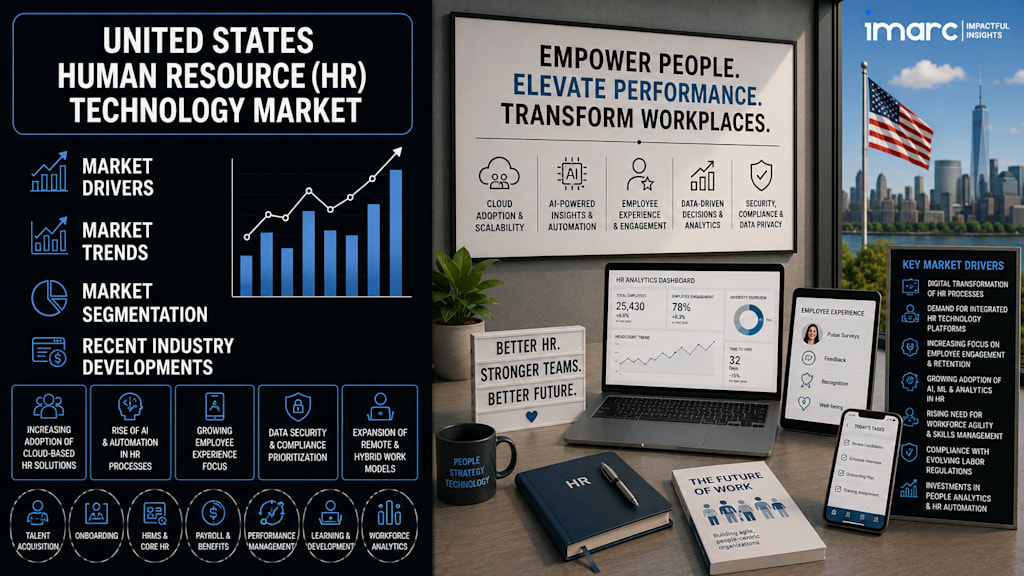
United States Human Resource (HR) Technology Market Size, Growth, and Forecast (2026–2034)
The modern workplace is undergoing a profound transformation. As businesses adapt to changing workforce expectations, remote work models, and increasing competition for talent, human resource departments are embracing technology to improve efficiency and employee experiences. In 2026, HR technology has become a strategic business tool rather than simply an administrative support system.
The United States Human Resource (HR) Technology market was valued at USD 12.28 Billion in 2025 and is projected to reach USD 31.75 Billion by 2034, expanding at a compound annual growth rate (CAGR) of 11.14% during 2026–2034. This strong growth reflects the increasing adoption of digital platforms designed to streamline recruitment, workforce management, employee engagement, and organizational development.
HR technology encompasses a broad range of solutions, including recruitment software, payroll systems, workforce analytics, performance management tools, employee engagement platforms, and AI-powered talent management solutions.
Request a Sample Report with Latest 2026 Data & Forecasts:
Key Trends Shaping the United States Human Resource (HR) Technology Market
Several important trends are influencing market development:
• Growing adoption of artificial intelligence in recruitment and talent management
• Rising use of cloud-based HR platforms
• Increasing demand for employee experience and engagement solutions
• Expansion of workforce analytics and predictive insights tools
• Growing focus on hybrid and remote workforce management technologies
These trends highlight how organizations are increasingly relying on technology to create more agile and productive workplaces.
Major Growth Drivers in the United States Human Resource (HR) Technology Market
Several factors continue supporting market expansion.
One of the primary growth drivers is the increasing need for workforce efficiency and automation. Organizations are looking for ways to reduce manual administrative tasks while improving decision-making processes.
Another important factor is the growing complexity of workforce management. Businesses must manage diverse teams, remote employees, compliance requirements, and evolving workplace expectations.
The competition for skilled talent is also encouraging organizations to invest in advanced recruitment and employee retention tools. HR technology solutions help businesses identify suitable candidates, improve onboarding processes, and enhance employee satisfaction.
The growing popularity of hybrid work models has further accelerated demand for digital HR platforms capable of supporting distributed teams.
Additionally, companies increasingly recognize the value of data-driven workforce planning and performance management.
Role of Artificial Intelligence in HR Technology
Artificial intelligence is becoming one of the most influential technologies within human resources.
AI-powered recruitment tools can help organizations identify qualified candidates more efficiently.
Machine learning systems assist with workforce planning by analyzing employee data and identifying trends.
Chatbots and virtual assistants are improving employee support by providing instant responses to common inquiries.
AI-driven analytics also help organizations understand employee engagement, turnover risks, and productivity patterns.
These innovations are transforming how HR departments operate and make strategic decisions.
Investment Opportunities in the United States HR Technology Market
The rapid expansion of the market creates significant opportunities for investors and technology providers.
Companies are investing in AI-powered HR software, workforce analytics platforms, and employee experience solutions to strengthen market competitiveness.
There is also increasing interest in cloud-based systems that offer scalability and flexibility for businesses of all sizes.
Investments in cybersecurity, compliance management, and workforce automation technologies continue supporting market development.
Partnerships between HR software providers and enterprise technology companies are also creating new opportunities for innovation.
With continued growth expected through 2034, the market presents attractive long-term investment potential.
Challenges Impacting the United States Human Resource (HR) Technology Market
Despite positive growth prospects, several challenges remain.
One challenge is data privacy and cybersecurity concerns, particularly as organizations manage large volumes of employee information.
Another issue is integration complexity, as businesses often use multiple systems that must work together effectively.
Resistance to technology adoption can also slow implementation within some organizations.
Additionally, maintaining compliance with changing labor regulations requires ongoing platform updates and monitoring.
Future Outlook (2026–2034)
Looking ahead, the United States HR Technology market is expected to maintain strong growth momentum.
Between 2026 and 2034, demand for AI-powered, cloud-based, and employee-centric HR solutions is likely to increase significantly. Businesses are expected to prioritize technologies that improve workforce productivity, enhance employee experiences, and support strategic decision-making.
Future developments may focus on advanced predictive analytics, personalized employee development programs, and intelligent automation systems.
The continued evolution of workplace models and growing emphasis on talent management are also expected to support market expansion.
Overall, the market appears positioned for sustained development driven by digital transformation, workforce modernization, and technological innovation.
Conclusion
The United States Human Resource (HR) Technology market is evolving rapidly as businesses increasingly adopt digital tools to improve workforce management and employee experiences. Supported by artificial intelligence, cloud computing, and data analytics, the market is expected to experience substantial growth during 2026–2034.
Although challenges such as cybersecurity risks and integration complexity remain, ongoing innovation and investment are likely to support long-term development. As workplaces continue transforming, HR technology will remain a critical component of organizational success and workforce strategy.
About the Creator
Jackson Watson
I'm a market research analyst at Imarc group company delivering data-driven insights, industry analysis, and customized research solutions. We support businesses with market sizing, competitive analysis, and strategic decision-making.
Enjoyed the story? Support the Creator.
Subscribe for free to receive all their stories in your feed.
Comments
There are no comments for this story
Be the first to respond and start the conversation.