
United States Higher Education Market Size Trends, Growth Demand & Forecast 2026-2034
United States Higher Education Market Size Growth Share Industry Demand & Forecast 2034

United States Higher Education Market Size, Share, and Forecast 2034
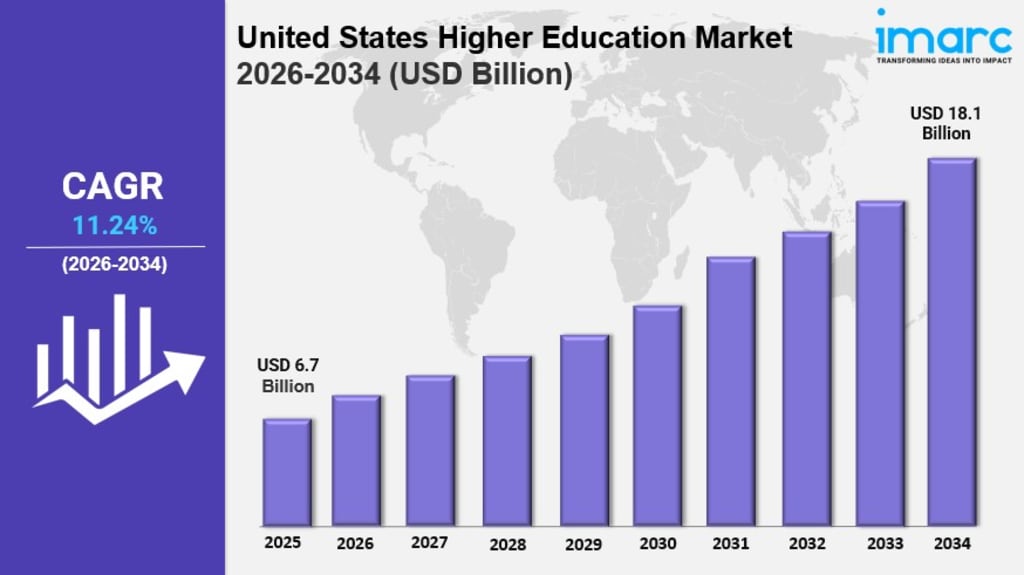
The United States higher education market was valued at USD 6.7 Billion in 2025 and is projected to reach USD 18.1 Billion by 2034, growing at a CAGR of 11.24% during 2026–2034. The market is supported by the increasing adoption of digital learning platforms, the expansion of community colleges, and growing demand for flexible educational pathways. Institutions across the country are adapting to changing student expectations by expanding online programs, improving accessibility, and developing career-focused curricula. As workforce requirements continue to evolve, higher education providers are focusing on skills development, research initiatives, and industry collaboration to remain relevant in a competitive environment.
Online Education and Hybrid Learning Trends in the United States
Online education has become an important component of the U.S. higher education system. Universities and colleges are increasingly offering degree programs, certifications, and professional courses through digital platforms. The availability of remote learning options allows institutions to reach students beyond traditional geographic boundaries while providing greater flexibility for working professionals and adult learners.
Hybrid learning models, which combine classroom instruction with online coursework, are also gaining wider acceptance. These models enable students to access educational resources remotely while maintaining opportunities for direct interaction with instructors and peers. Educational institutions are investing in learning management systems, virtual classrooms, and digital content libraries to support these approaches. As a result, online and hybrid learning continue to influence how higher education is delivered across the country.
The Role of Artificial Intelligence and EdTech in Higher Education
Technology is playing a growing role in improving teaching, learning, and administrative processes. Artificial intelligence is being used to personalize learning experiences, analyze student performance, and identify learners who may require additional academic support. These capabilities help institutions improve student engagement and retention rates.
Educational technology solutions are also supporting course management, assessments, and communication between students and faculty members. Digital tools simplify administrative tasks such as enrollment management, scheduling, and academic advising. In addition, virtual laboratories, simulation platforms, and interactive learning applications are creating new opportunities for students in science, engineering, healthcare, and other technical fields. The continued adoption of AI and educational technologies is expected to support efficiency and improve learning outcomes throughout the higher education sector.
Workforce Development and Career-Oriented Learning Programs
The growing focus on employability is shaping academic program development across U.S. colleges and universities. Students increasingly seek education that provides practical skills and prepares them for evolving labor market requirements. As a result, institutions are expanding career-oriented programs in areas such as information technology, healthcare, business management, engineering, and data analytics.
Many universities are incorporating experiential learning opportunities, including internships, apprenticeships, and project-based coursework. These initiatives help students gain real-world experience before entering the workforce. Short-term certificate programs and professional development courses are also becoming more common, allowing individuals to upgrade their skills without committing to traditional degree programs. This emphasis on workforce readiness is contributing to the growth of higher education offerings that align closely with employer needs.
International Student Demand and Its Impact on U.S. Higher Education
International students continue to play an important role in the U.S. higher education landscape. American universities attract students from various countries due to their academic reputation, research opportunities, and diverse educational programs. The presence of international students contributes to campus diversity and supports institutional revenues through tuition and related expenditures.
Universities are strengthening recruitment strategies by expanding global partnerships, participating in international education fairs, and offering enhanced student support services. Many institutions are also increasing online engagement to connect with prospective students worldwide. While changes in visa policies and economic conditions can influence enrollment patterns, international student demand remains a significant factor supporting the growth of the higher education market.
Public and Private Institution Strategies in a Changing Education Landscape
Public and private institutions are adopting different strategies to address changing market conditions and student expectations. Public universities often focus on expanding access, affordability, and community engagement. Many are strengthening partnerships with local industries and government agencies to support workforce development initiatives.
Private institutions, meanwhile, frequently emphasize specialized academic programs, smaller class sizes, and personalized learning experiences. Both public and private organizations are investing in digital infrastructure, student support services, and curriculum modernization. Institutions are also exploring alternative revenue sources, including executive education, continuing education programs, and research commercialization activities. These strategic adjustments are helping colleges and universities respond to increased competition and evolving educational demands.
Funding, Affordability, and Accessibility Trends in Higher Education
Affordability remains a major consideration for students and families when making higher education decisions. Rising tuition costs have encouraged institutions to expand scholarship programs, financial aid options, and flexible payment plans. Community colleges continue to provide a cost-effective pathway for students seeking higher education credentials while managing educational expenses.
Accessibility initiatives are also becoming increasingly important. Universities are investing in digital learning tools, disability support services, and academic assistance programs to create inclusive learning environments. Additionally, online education has improved access for students living in remote areas and individuals balancing education with work or family responsibilities. These efforts support broader participation in higher education and contribute to long-term market growth.
Research and Innovation Activities Across U.S. Universities
Research remains one of the defining strengths of the U.S. higher education system. Universities play a significant role in advancing scientific knowledge, technological development, and innovation across multiple industries. Research institutions receive funding from government agencies, private organizations, and industry partners to support projects in healthcare, engineering, environmental sciences, and information technology.
Many universities operate specialized research centers and innovation hubs that encourage collaboration among faculty members, students, and industry professionals. Research activities contribute to academic excellence while supporting economic development through the creation of new technologies, intellectual property, and startup ventures. As investment in research continues, universities are expected to maintain their role as important contributors to innovation and knowledge creation.
Partnerships Between Higher Education Institutions and Industry
Collaboration between universities and businesses has become increasingly important in recent years. Industry partnerships help institutions align academic programs with workforce requirements while providing students with practical learning opportunities. Companies often work with universities on curriculum development, internships, research projects, and talent recruitment initiatives.
These partnerships benefit both educational institutions and employers. Students gain exposure to real-world challenges, while businesses gain access to emerging talent and research expertise. Collaborative efforts are particularly common in sectors such as technology, healthcare, manufacturing, and engineering. The growing emphasis on industry engagement is strengthening the connection between education and employment outcomes.
Competitive Landscape and Key Participants in the U.S. Higher Education Market
The U.S. higher education market is characterized by the presence of numerous public universities, private colleges, community colleges, and specialized institutions. Competition is influenced by factors such as academic reputation, program diversity, research capabilities, tuition costs, and student support services.
Institutions are focusing on expanding online learning offerings, strengthening industry partnerships, and investing in technology infrastructure to attract and retain students. Research excellence, international recruitment strategies, and career-focused education programs also play an important role in market positioning. As student expectations continue to evolve, higher education providers are adapting their strategies to remain competitive while delivering quality educational experiences.
About the Creator
Kim Soo hyun
My name is Kim Soo hyun, and I am a research analyst at IMARC Group, specializing in market trends and data analysis to provide insights and support strategic decision-making.
Enjoyed the story? Support the Creator.
Subscribe for free to receive all their stories in your feed.
Comments
There are no comments for this story
Be the first to respond and start the conversation.